

ERM Software to Transform Risks into an Advanced Strategy
ERM Software to Transform Risks into an Advanced Strategy
Planning, execution, and tracking in the same environment
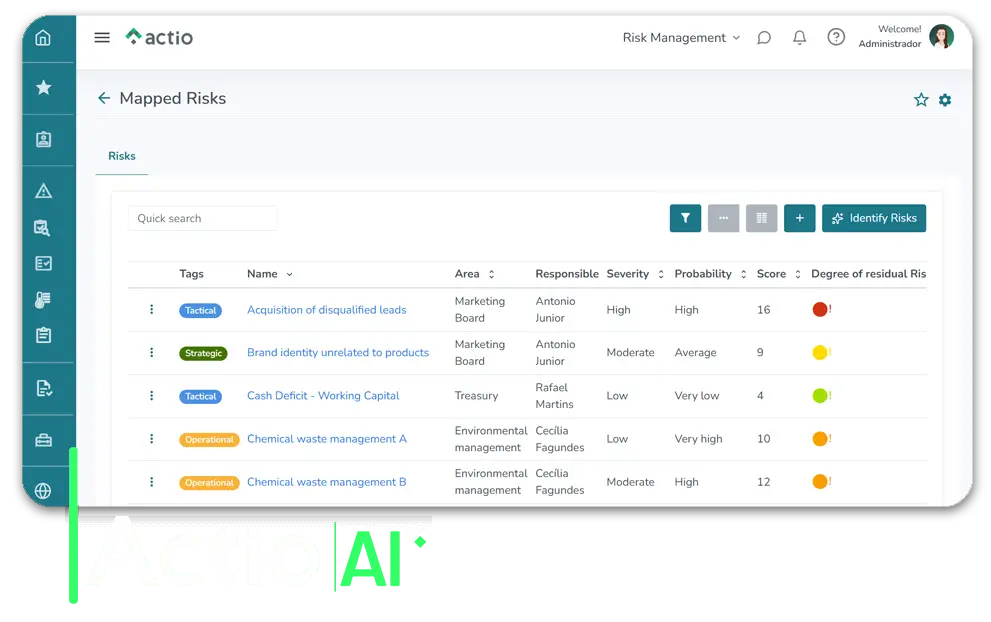
Transform your ERM program with Actio
Without an ERM Software
- The risks are scattered across spreadsheets, emails, and slide presentations, disconnected from business objectives.
- Evidence of the risks are gathered in a disorganized manner at the time of the audit.
- Residual risks manually reassessed, often subjectively and rarely related to management performance.
- Mitigation plans in separate tracking systems, not linked to the risk being addressed.
With Actio’s ERM Software
- Risk registries are connected to objectives, initiatives, processes, and controls in real time.
- Continuous risk analysis with efficient assessments, clear evidence, and automatically flagged lagging controls.
- Residual risks are automatically recalculated when effectiveness changes, so that the risk analysis reflects the current reality.
- Action plans coexist with the risks being addressed. Owners, deadlines, budget, and status in one place.
Features to structure and strengthen risk management
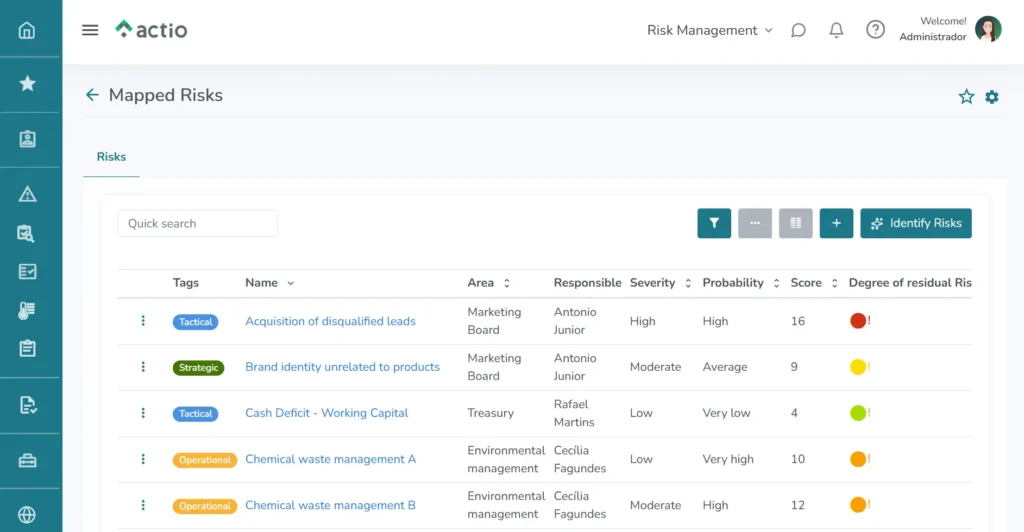

A single source of truth for corporate risks
Centralize all organizational risks in a single structured environment, reducing data dispersion in spreadsheets and ensuring a consolidated corporate view.

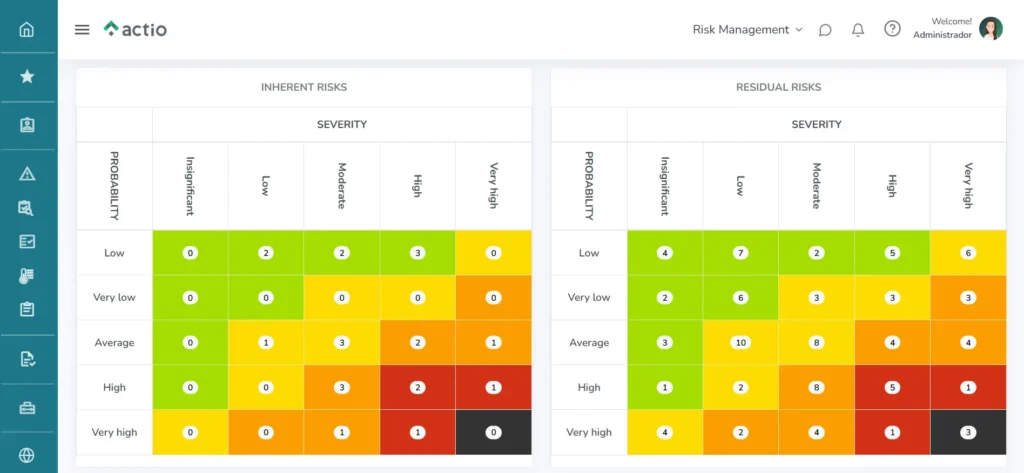
Structured assessment of risks in a heat map
Gain a clear view of risk exposure through heat maps, making it easier to identify critical points and standardize analyses with impact criteria.
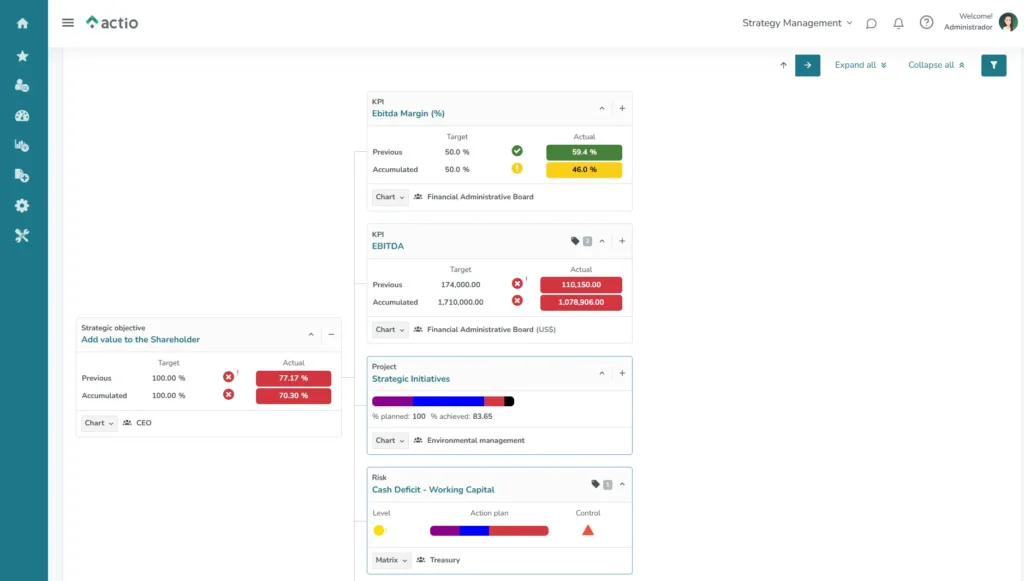

Connect the risks to the business objectives
RRisks to pStrategic priorities and objectives of the organization, providing more context for decisions and direction of efforts which way is more accurate.

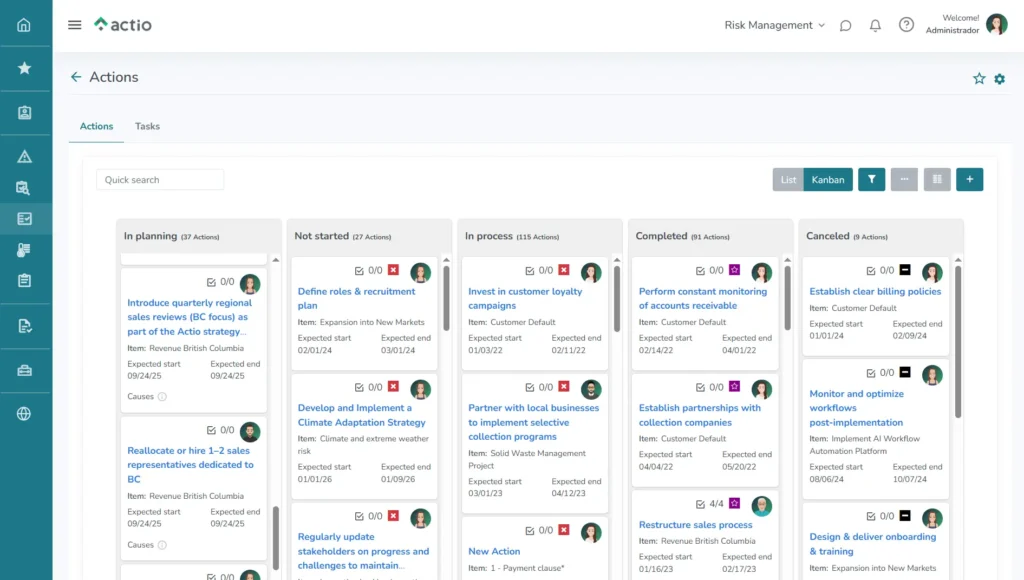
Create treatment and mitigation plans
Check the causes, consequences, and controls in one place and define action plans for risk mitigation with responsible parties, deadlines, and visibility.
Assign responsibilities with ease
Ensure clear accountability, strengthening governance and risk follow-up.
Track key risk indicators (KRIs)
Monitor warning signs and trends through indicators of risk, expanding the organization's anticipation capacity.
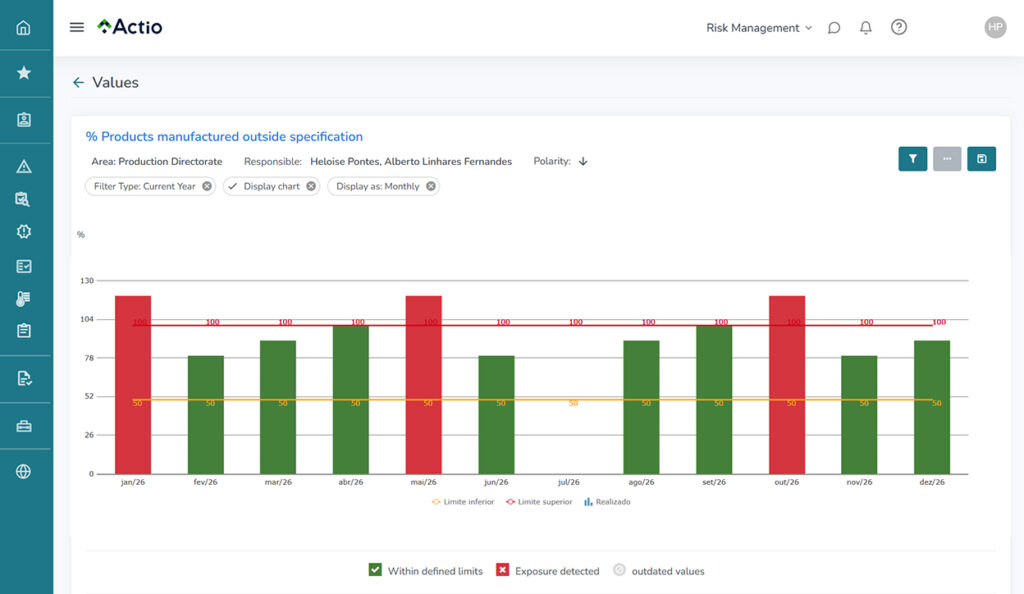
Perform continuous exposure monitoring
Track risk evolution over time and identify relevant changes before impact materializes.
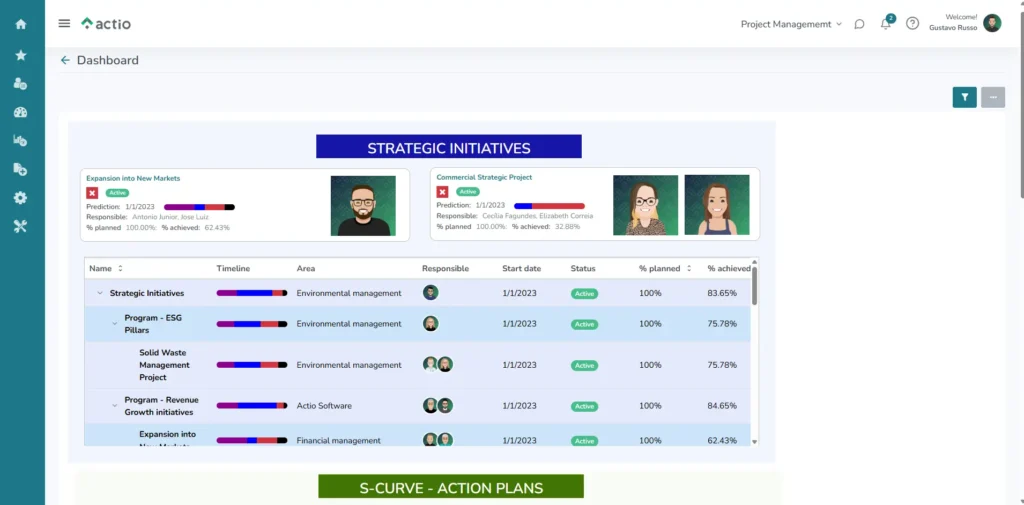
Access executive views and dashboards
Access consolidated dashboards for leadership and committees, with a clear view of exposures, trends, and priorities.


Track risks and monitor review history
Track the evolution of risks, assessments, and responses, reinforcing consistency, governance, and accountability.
Utilize IA para suporte analítico
Utilize artificial intelligence to support analyses, generate insights, and prioritize actions based on the real business exposure.

Quantify the risks that cost the business the most
Side-by-side, examine the budgetary exposure to inherited and residual risks and translate the data into the financial language already used by the CFO and leadership.
Integration with different data sources
Connect with enterprise systems and relevant data sources to enhance reliability and real-time risk information.
Enrich Your experience with Actio

Actio's ERM solution enables greater effectiveness in operational discipline. Each control allows for a holistic and continuous view of all workflows, which makes it possible to analyze evidence, frequencies, and audits so that errors and weaknesses are observed before exposure becomes a problem.
With Actio's Audit, your company ensures process compliance, identifies risks, and drives continuous improvements that guarantee integrity at all levels of the organization.
Identify failures, standardize processes, and ensure continuous compliance with Actio Control Testing and have centralized management with clarity and traceability.
Centralize and manage different versions of a document with Actio's Document Management add-on and ensure fast and secure access to the company's most up-to-date information.
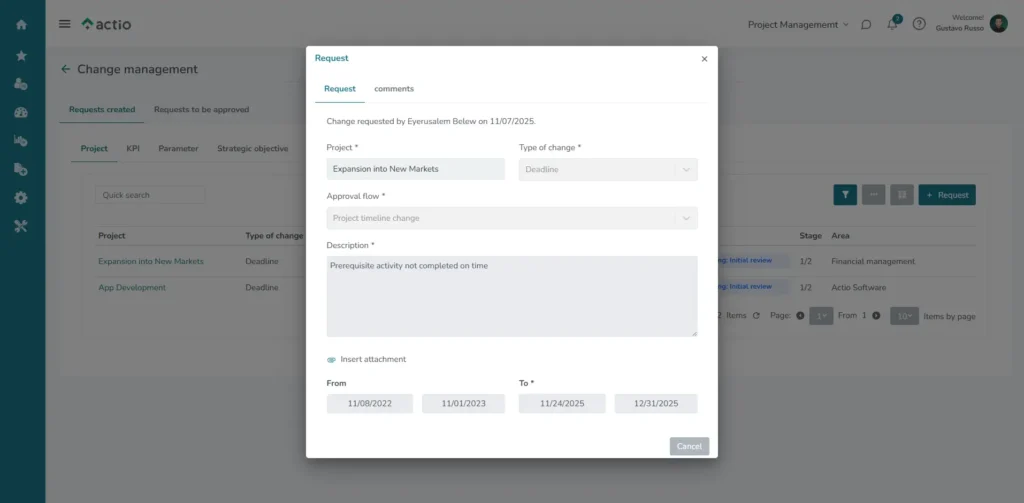
Manage different projects and portfolios in a single dashboard with Actio's Project and Portfolio Management solution and track every action taken and the potential risks of each project in real time.
Control Review
Actio's ERM solution enables greater effectiveness in operational discipline. Each control allows for a holistic and continuous view of all workflows, which makes it possible to analyze evidence, frequencies, and audits so that errors and weaknesses are observed before exposure becomes a problem.
Auditing
With Actio's Audit, your company ensures process compliance, identifies risks, and drives continuous improvements that guarantee integrity at all levels of the organization.
Control Test
Identify failures, standardize processes, and ensure continuous compliance with Actio Control Testing and have centralized management with clarity and traceability.
Document Management
Identify failures, standardize processes, and ensure continuous compliance with Actio Control Testing and have centralized management with clarity and traceability.
Project and Portfolio Management
Manage different projects and portfolios in a single dashboard with Actio's Project and Portfolio Management solution and track every action taken and the potential risks of each project in real time.

360-degree integration with your enterprise ecosystem
- Eliminate the time spent checking inconsistent data
- Simplify processes across different areas of the operation
- Ensure strategy is guided by operational reality
- Integrate natively with Microsoft tools
AI-Powered ERM
Actio’s Artificial Intelligence enhances ERM by supporting risk identification, analyzing causes and impacts, and guiding action prioritization based on real business exposure.As a result, risk management becomes a driver of more informed decisions aligned with organizational priorities.

💬 Get answers to your questions with Actio IA
For those who need to evolve corporate risk management
Risk Management Leaders
For professionals who need to consolidate risks across departments, structure assessments, and make risk management relevant to business decisions.
Executives and Directors
For decision-makers handling high-impact choices without full clarity on which risks may affect objectives, initiatives, and results.
Business Unit Leaders and Risk Owners
For those responsible for identifying, tracking, and manage operations while ensuring visibility into risk exposure.
Mid-Size and Large Organizations
For organizations that can no longer rely on spreadsheets and fragmented controls, and need centralized information and stronger governance.
For Efficient Risk Management, in Any Industry
- Healthcare & Hospitals
- Agribusiness
- Pharmaceuticals & Life Sciences
- Financial Services
- Insurance
- Energy & Utilities
- Renewable Energy
- Mining & Metals
- Logistics & Transportation
- Supply Chain & Distribution
- Textiles & Apparel
- Hospitality & Services
- Retail
- Technology & Software
- Consumer Goods
- Manufacturing
- Automotive & Machinery
- Construction & Engineering
- Real Estate & Infrastructure
- Telecommunications
- Education
- Public Sector & Government
- Non-Profit & Foundations
- Chemicals & Petrochemicals
- Oil & Gas
- Packaging & Printing
- Food & Beverage Manufacturing
Organizations that trust Actio
Trusted by risk and compliance managers
From planning to performance, Actio enables teams to align around priorities, execute with confidence, and make faster, data-driven decisions.
All of our power plants here in the USA and Canada work with Actio | Strategic Management. The system is adapted to our methodology and we have a very high level of satisfaction, an average of between 8 and 9.
Iliel Yamada
Implementation Leader
The ACTIO software empowers you to achieve results. Through it, we can focus on identifying recurring problems that hinder the achievement of goals and finding solutions.
Alessandro Rodrigues
Business Performance Coordinator
I would say that the most valuable aspects of the software today are its ability to visualize the entire cascade, from strategic objectives all the way down to projects. This is new for the City’s departments, as we did not previously have a visualization tool that truly helps us understand why we are carrying out a project, what purpose it serves for the organization, and how it contributes to the expected outcomes of our strategic objectives.
Arnaud lahouze
Coordinator, Organizational Performance, Business Intelligence & Scientific Services, City of Gatineau

Connect Risks to Strategy and Make Confident Decisions
Fill out the form and discover Actio’s ERM.
Frequently asked questions
What is Actio’s Enterprise Risk Management solution?
It is a solution designed to structure risk management by connecting risks to business objectives and providing clarity on their impact on priorities, initiatives, and results.
How does the solution connect risks to business objectives?
It links risks to strategic priorities and objectives, helping organizations understand which threats affect strategy and enabling more contextual and focused decision-making.
Can I track risk response plans?
Yes. The platform allows you to track response actions with visibility into ownership, progress, and evolution, supporting execution—not just risk identification.
Does leadership have access to an executive risk view?
Yes. It provides executive and management views that help identify key risks, prioritize exposures, and monitor how the risk landscape evolves over time.
Is the solution only for organizations with mature risk management practices?
No. It supports companies at different maturity levels—from initial structuring to more advanced, centralized, and business-aligned risk management.
Why move away from spreadsheets and fragmented controls?
Because decentralized controls make it difficult to consolidate information, compare risks, and track responses. A structured solution ensures consistency, traceability, and better decision support.
How does the solution support compliance?
It centralizes documentation, controls, and evidence, facilitating compliance with regulations while increasing transparency and consistency in risk management.