

Transform ESG management into measurable and strategic results
Connect the ESG agenda to strategy, track its evolution, and demonstrate results with transparency and traceability.
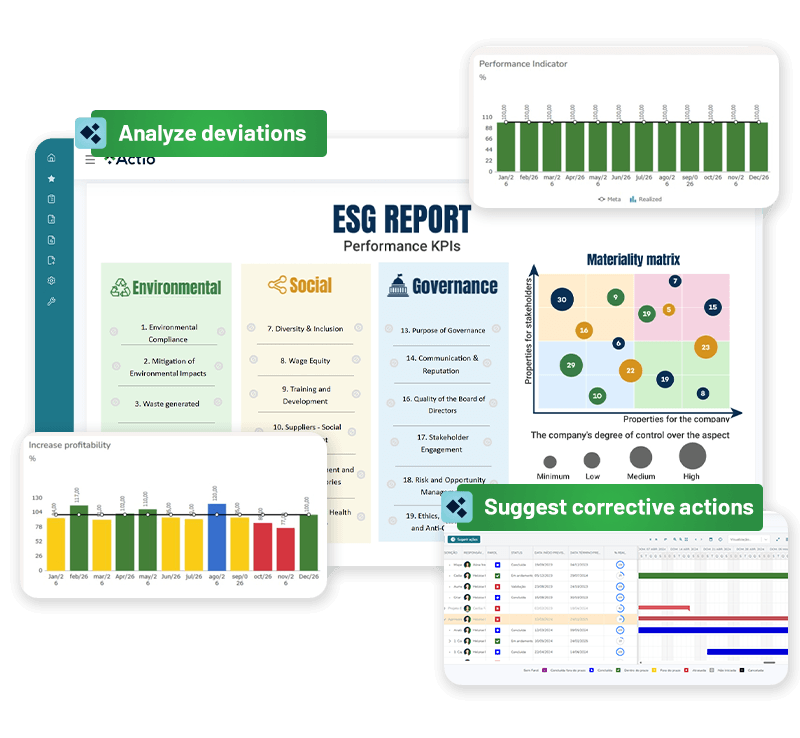
Connecting management and results in companies around the world







✦ Challenge
Do you have difficulty to turn ESG commitments into measurable results?
Key symptoms that ESG management still does not provide reliable information for decision-making:
ESG data scattered across different spreadsheets, documents, departments, and systems.
Indicators and targets without standardized criteria or clearly defined owners.
Reports that require significant manual effort in collection, validation, and consolidation.
Difficulty in proving the origin and reliability of the disseminated information.
ESG initiatives conducted in isolation, without connection to corporate strategy.
ESG risks, controls, and action plans monitored in a fragmented manner.
Leadership without a consolidated view of the evolution of undertaken commitments.
✦ Solution
Centralize your ESG agenda, reduce effort, and prove results with transparency
The Solution Environmental, Social, and Governance (ESG) structure the management of the environmental, social, and governance agenda through objectives, indicators, targets, risks, controls, projects, and action plans connected to the corporate strategy.
With different integrations, analytics, and AI, the solution reduces the effort required to consolidate the information and expands visibility into ESG results, deviations, and priorities.
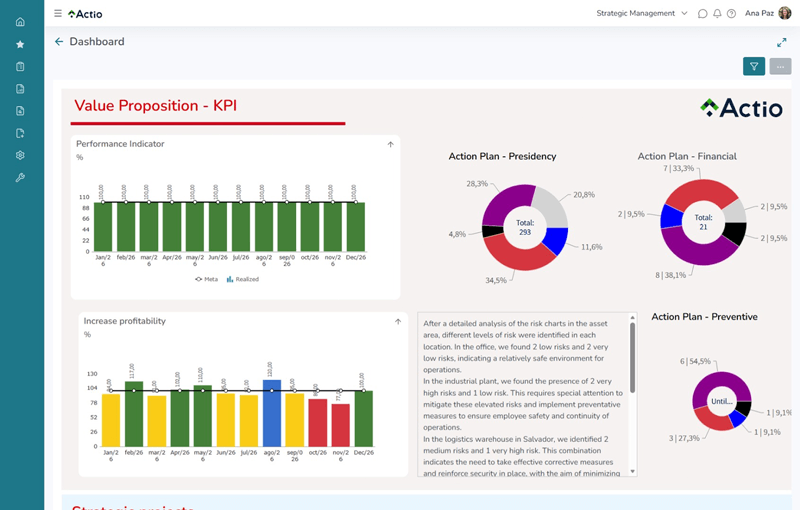
ESG connected to strategy
Objectives, indicators, targets, risks, and projects in an integrated management.
More efficiency and visibility
Consolidated data, continuous monitoring, and quick identification of deviations and priorities.
Transparency and traceability
Documents, evidence, and results organized to facilitate accountability.
✦ Implementation steps
How to structure, monitor, and report on the ESG agenda
Organize your ESG Management in just six steps, allowing for a unified view of your objectives, indicators, targets, and results.
01Structure the ESG agenda
01
Structure the ESG agenda
- Organize the environmental, social, and governance issues relevant to the organization.
- Align ESG commitments with strategic priorities and objectives.
- Define areas, responsible parties, and governance levels.
02Define indicators and targets
02
Define indicators and targets
- Register environmental, social, and governance indicators.
- Establish goals, frequencies, responsible parties, and tracking criteria.
- Standardize concepts and calculation methods across areas and units.
03Collect and consolidate information
03
Collect and consolidate information
- Integrate data from different areas, systems, and sources.
- Centralize results, documents, and evidence.
- Ensure quality, consistency, and traceability of information.
04Assess ESG risks and controls
04
Assess ESG risks and controls
- Identify risks related to environmental, social, and governance commitments.
- Evaluate the controls adopted to prevent or reduce these risks.
- Record tests, evidence, deficiencies, and improvement needs.
05Manage initiatives and action plans
05
Manage initiatives and action plans
- Create projects and actions linked to ESG goals and indicators.
- Define responsibilities, deadlines, resources, and deliverables.
- Monitor deviations and implement corrective measures.
06Monitor results and report back
06
Monitor results and report back
- Consolidate the evolution of indicators, targets, and initiatives.
- Generate analytics and executive insights for leadership.
- Support the preparation of reports for investors, regulators, and other stakeholders.
- Demonstrate results with reliable and traceable information.
Who is this solution for?
The solution connects the different roles involved in defining ESG commitments, tracking indicators and targets, managing risks, and executing actions to evolve results.
Responsible for the sustainability and ESG agenda and for its connection to the strategy.
Accountable leader to regulators, investors, and other stakeholders.
Manager that coordinates ESG indicators, goals, and initiatives across different areas.
Professional responsible for consolidating data and ensure the traceability of the information.
Responsible for risk, controls, audit, or compliance related to the ESG agenda.
✦ Features
Resources for manage indicators, risks, initiatives, and results
Centralize the necessary elements to connect the ESG agenda to the strategy, track commitments and goals, and transform analyses, risks, and deviations into monitorable actions.

Strategic map

Strategic objectives

Indicators

Risks and controls
Strategic initiatives

Action plan

Deviation Report (FCA)

Continuous Feedback

Custom dashboards

Power BI
Executive presentations

Meetings
✦ Schedule your demo
Bring the ESG agenda to the center of strategic decisions.
Discover Actio's Environmental, Social, and Governance (ESG) Management solution in a personalized demonstration.
✦ Frequently Asked Questions
Get your questions answered about Environmental, Social, and Governance (ESG) Management
Objective answers to the main questions of those who need to elevate their organization's performance.
What is ESG management software?
It is a solution that centralizes objectives, indicators, targets, risks, controls, projects, action plans, documents, and evidence related to the environmental, social, and governance agenda, facilitating the monitoring and management of ESG results.
How does the solution connect the ESG agenda to the company's strategy?
The platform allows linking ESG objectives and commitments to the organization's indicators, targets, risks, and strategic initiatives, making it clearer how each action contributes to corporate priorities.
What ESG indicators, targets, and commitments can be tracked?
The solution makes it possible to track different environmental, social, and governance indicators, according to the organization's priorities and needs, with the definition of goals, assignees, deadlines, and the evolution of results.
How does the software help in the management of risks, controls, and ESG action plans?
The platform centralizes risks, controls, deviations, and corrective actions in a single environment, allowing you to track owners, deadlines, and initiative statuses in a structured and traceable manner.
Is it possible to centralize documents, evidence, and information from different areas?
Yes. The solution allows for the gathering of documents, evidence, and data from different areas, reducing information dispersion and facilitating consultations, audits, and accountability processes.
How do integrations, analytics, and artificial intelligence support ESG management?
These features help automate information consolidation, broaden the view of indicators and results, identify deviations, and support analyses and decisions with greater agility.
How does the solution facilitate accountability and the demonstration of ESG results?
By keeping indicators, goals, owners, documents, evidence, and action history organized in a single environment, the solution enhances the transparency and traceability of the information used in communicating ESG results.