

Structure risk management based on the guidelines of ISO 31000
Implement a structured, consistent, and integrated risk management process in decision-making, following an internationally recognized framework.
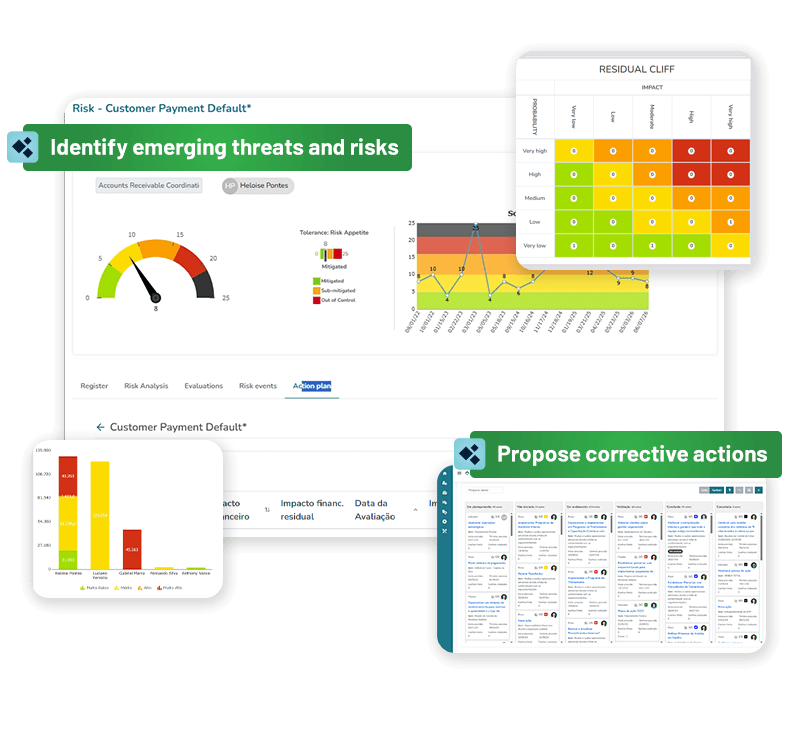
Connecting management and results in companies around the world







✦ Challenge
Your organization it still doesn't have a structured risk management process in accordance with ISO 31000?
Symptoms that your organization’s risk management is still not compliant with ISO 31000:
Risk management practices do not follow a recognized and consistent framework.
Each area uses different criteria to identify, assess, and prioritize risks.
The organization has difficulty demonstrating the maturity of its risk management.
The policies exist, but they are not applied uniformly in day-to-day life.
The risk appetite defined by senior management is not translated into operational criteria and limits.
The relevant decisions do not have clear evidence that the risks were considered.
✦ Solution
Strengthen risk management with the guidelines of ISO 31000
The Risk Management solution guides and structures the risk management process based on the guidelines of ISO 31000, supporting the organization in defining the context, identifying, analyzing, evaluating, treating, monitoring, and communicating risks.
It centralizes methodologies, criteria, matrices, responsible parties, controls, treatment plans, and evidence, promoting consistent application across the various areas.
Standardization guided by recognized guidelines
Establish common criteria, methodologies, and responsibilities so that the different areas adopt a consistent approach.
Visibility on exposure and priorities
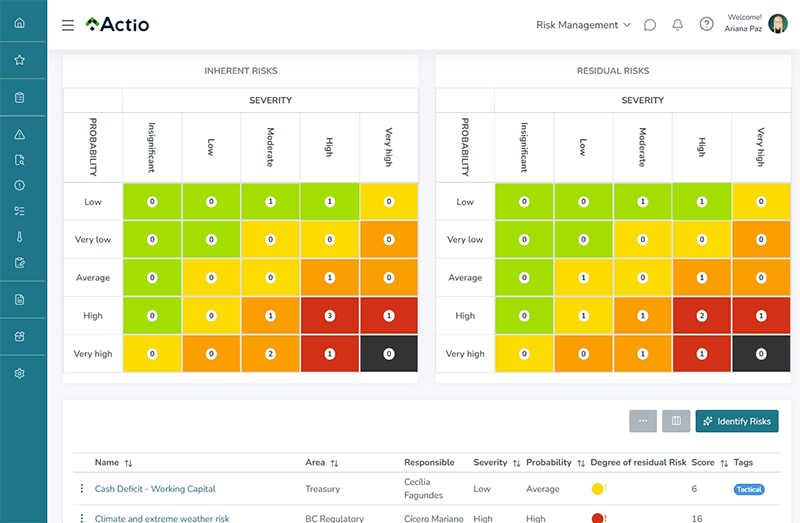
Compare probability, impact, controls, and risk levels to identify what requires priority treatment or follow-up.
Traceability for decisions and governance
Centralize evaluations, evidence, controls, and treatment plans, maintaining the history of decisions and the changes made.
✦ Implementation steps
How to structure, evaluate, and monitor risks consistently
Structure risk management in connected stages, from the definition of the context, criteria, and risk appetite to the identification, assessment, treatment, monitoring, and communication of exposures.
01Defining scope, context, and criteria
01
Defining scope, context, and criteria
- Establishing the scope of risk management.
- Understanding the internal and external contexts of the organization.
- Define categories, probability criteria, impact, and criticality.
- Translate the appetite for risk into operational limits and criteria.
- Formalize roles, responsibilities, and approval levels.
02Identifying the risks
02
Identifying the risks
- Record risks that may affect the objectives of the organization.
- Identify causes, events, consequences, and affected areas.
- Relate risks to objectives, processes, projects, and documents.
- Involve managers and experts from the fields in the identification.
03Analyzing and evaluating the risks
03
Analyzing and evaluating the risks
- Assess the probability and impact of risks.
- Consider existing controls and their effectiveness.
- Compare the inherent and residual risk levels.
- Prioritize risks that require treatment or follow-up.
04Defining and monitoring the treatment
04
Defining and monitoring the treatment
- Select the appropriate responses for each risk.
- Map out controls and create treatment plans.
- Define responsibilities, deadlines, resources, and expected results.
- Evaluate whether the residual risk is within the established limits.
05Monitor and review
05
Monitor and review
- Involve the stakeholders throughout the process.
- Centralize policies, methodologies, records, and evidence.
- Consolidate information for managers, committees and the board.
- Use Analytics and AI to identify trends, inconsistencies, and emerging risks.
- Maintain the traceability of the decisions and changes made.
06Communicate, consult and report
06
Communicate, consult and report
- Monitor key risk indicators and their tolerance thresholds.
- Conduct self-assessments of risks and controls.
- Periodically review assessments, treatments, and changes in the context.
- Record incidents, losses, and changes in exposure.
Who is this solution for?
For professionals and areas that work in risk management and need to apply criteria, controls, and responsibilities consistently, in accordance with the guidelines of ISO 31000.
Risk Management Manager
It structures and standardizes the corporate risk model.
Governance, Risk and Compliance Leadership
It links policies, methodologies, and responsibilities to the guidelines of ISO 31000.
Area manager or risk owner
Applies the criteria defined in the identification, assessment, and treatment of risks.
Risk and Control Professional
It includes records, evidence, controls, and treatment plans.
Internal Audit and Compliance
They assess the consistency and implementation of the practices adopted by the organization.
✦ Features
Resources for to identify, assess, treat and monitor risks in accordance with ISO 31000
Resources to centralize risks, controls, assessments, and treatments and to connect risk management to the objectives, processes, and decisions of the organization.

Strategic objectives

Processes

Risks and Controls

Risk Matrix
Assessments

Treatments

Key Risk Indicators (KRI)
Risk events
Contingency plans:

Action plan
Continuous Feedback

Self-Assessment Control
Control Tests

Documents

Custom dashboards

Power BI
Executive presentations

Meetings
✦ Schedule your demo
Put the guidelines of ISO 31000 into practice
Learn about the Risk Management solution from Actio and discover how to structure criteria, assessments, controls, and treatment plans in an integrated and traceable process.
✦ Frequently Asked Questions
Clear your doubts about Risk Management and ISO 31000
Check out the main questions about how to structure and monitor risk management based on the guidelines of ISO 31000.
What is ISO 31000?
ISO 31000 is a risk management framework that guides organizations in structuring principles, processes, and practices for identifying, analyzing, evaluating, managing, monitoring, and communicating risks.
How does the Actio solution support the implementation of ISO 31000?
The solution structures the main steps of the risk management process and centralizes methodologies, criteria, matrices, responsible parties, controls, treatments, and evidence in a single environment.
Is it possible to define different criteria for assessing risks?
The platform allows for the structuring of categories and criteria of probability, impact, and criticality, creating a consistent methodology for the evaluation and prioritization of risks.
Does the solution allow for monitoring inherent and residual risk?
Yes. It is possible to consider the existing controls and their effectiveness, compare the levels of inherent and residual risk, and assess whether exposure remains within the limits established by the organization.
How can the appetite for risk be incorporated into the process?
The organization can translate its appetite for risk into operational criteria and limits, supporting prioritization, approval levels, and decisions related to the management of risks.
Is it possible to create and track treatment plans?
Yes. The solution allows you to define responses to risks, map out controls, and structure treatment plans with responsible parties, timelines, resources, and expected outcomes.
Does the solution allow risks to be linked to objectives and processes?
Yes. The risks can be related to strategic objectives, processes, projects, and other relevant elements, broadening the view on their possible impacts on the organization.
How does the platform help with risk monitoring?
The solution allows for the monitoring of key risk indicators, tolerance limits, assessments, controls, treatment plans, incidents, and changes in exposure over time.