

Make the execution of the strategy more agile with OKRs
Transform strategic priorities into agile execution cycles, with focus, alignment, and continuous adaptation.
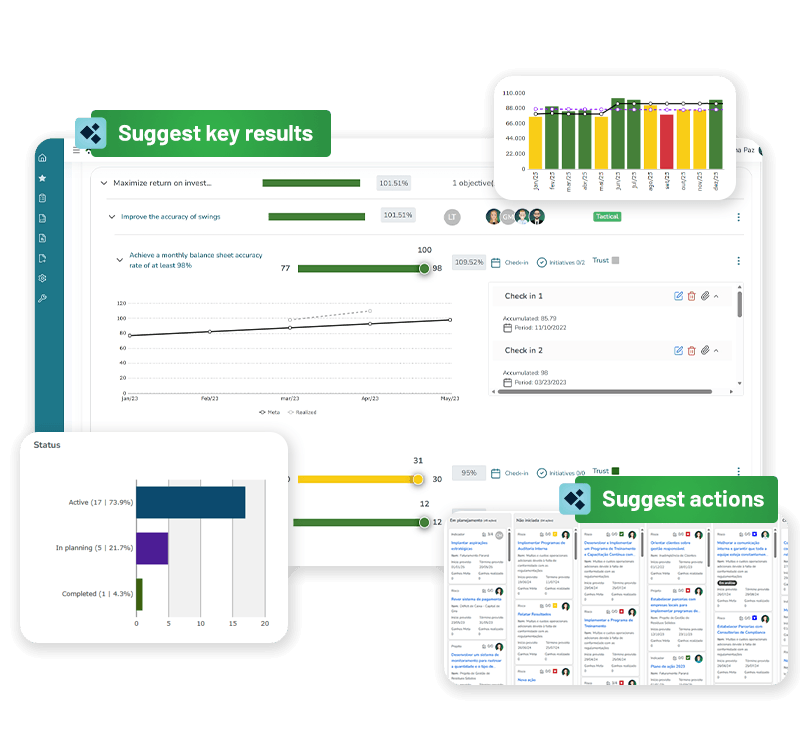
Connecting management and results in companies around the world







✦ Challenge
Your organization can adapt the execution when priorities change?
Symptoms that the execution of your organization’s strategy is still not an agile and efficient process:
Teams work on many initiatives without clarity about priorities.
Goals are generic and do not have measurable results.
Corporate priorities do not quickly translate into the work of the departments.
OKRs are defined at the beginning of the cycle, but they are not frequently followed up.
Areas set out isolated, duplicate or conflicting objectives.
Changes in context do not lead to coordinated adjustments in execution.
The methodology is used only as a record of goals, without promoting focus and learning.
✦ Solution
Connect priorities, teams, and results in continuous cycles of execution
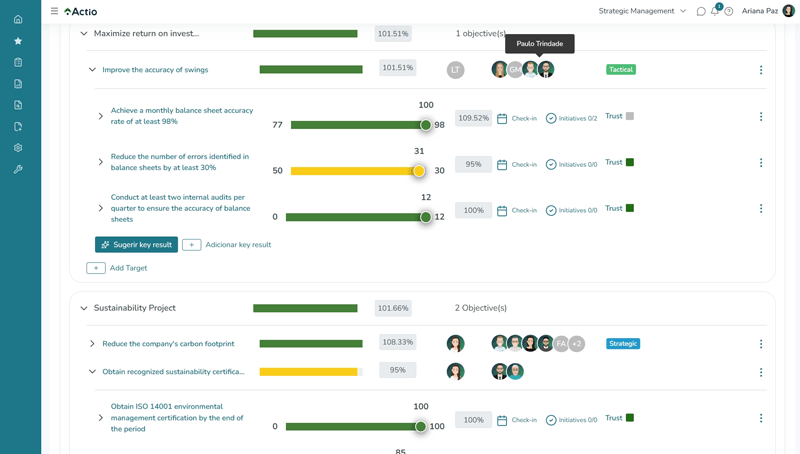
The solution of Agile Strategy Execution with OKRs Apply the Objectives and Key Results (OKR) methodology to translate strategic priorities into inspiring objectives and measurable key results. It allows for structuring shorter cycles, aligning corporate, departmental, team, and individual OKRs, tracking progress through check-ins, and connecting initiatives and projects to expected outcomes. With continuous feedback, integrations, analytics, and artificial intelligence, it enhances visibility into cycle evolution and supports rapid adjustments in response to changing contexts.
Focus on priorities
Translate the strategy into clear objectives and key results that guide efforts towards what truly matters in each cycle.
Alignment between teams
Connect corporate, departmental, team, and individual OKRs to visualize how each level contributes to the organization’s goals.
Continuous monitoring
Perform check-ins, track the progress of key results, and quickly identify where adjustments or route corrections are needed.
✦ Implementation steps
How to turn strategic priorities into execution cycles with OKRs
Structure a continuous process to define priorities, align responsibilities, track results, and incorporate learnings into the next cycles.
01Structuring the strategic direction
01
Structuring the strategic direction
- Define purpose, perspectives, themes, and strategic objectives.
- Identify the priorities that require greater focus in the cycle.
- Establish indicators and long-term expected results.
02Translate priorities into OKRs
02
Translate priorities into OKRs
- Create clear, inspiring, and results-oriented goals.
- Define measurable key results.
- Relate the OKRs to the corresponding strategic objectives.
- Define responsibilities, cycles and monitoring criteria.
03Aligning areas, teams, and people
03
Aligning areas, teams, and people
- Create corporate, departmental, team, or individual OKRs.
- View the contribution relationships between the different levels.
- Identify conflicting, duplicate, or unaligned objectives.
- Negotiate and validate the commitments of the cycle.
04Connecting OKRs to execution
04
Connecting OKRs to execution
- Link projects, initiatives, and action plans to key results.
- Distinguish activities performed from the results effectively achieved.
- Track relevant responsibilities, deadlines, and deliverables.
05Following the cycle
05
Following the cycle
- Update the progress of key results.
- Conduct regular check-ins.
- Registering trust, obstacles, and learnings.
- Identify objectives that require attention or route correction.
06Reviewing results and adapting priorities
06
Reviewing results and adapting priorities
- Evaluate the achievement of the OKRs at the end of the cycle.
- Record learning outcomes and the causes of the results.
- Reprogram, terminate or replace objectives.
- Use the learnings to define the next cycle.
Who is this solution for?
The solution connects the different roles involved in defining, unfolding, and executing priorities, providing visibility into how each area and person contributes to organizational results.
Responsible for Strategy
It connects strategic planning to the OKRs cycles.
Executive leadership
It defines priorities and monitors organizational results.
Area manager
It breaks down priorities into key objectives and results for your team.
Responsible for OKRs
It facilitates the cycles, guides the teams, and ensures methodological consistency.
Collaborator
He/She understands his/her contribution and monitors the results under his/her responsibility.
✦ Features
Resources for Define, align and track OKRs
Centralize the resources needed to turn priorities into measurable objectives, connect execution to the expected results, and track the evolution of the cycles in a single environment.

OKRs

Projects

Indicators

Action plan

Continuous Feedback

Custom dashboards

Power BI
Executive presentations

Meetings
✦ Schedule your demo
Give more agility to the execution of the strategy
Learn about the Agile Execution solution of the Strategy with Actio’s OKRs and discover how to align priorities, teams, and results in faster and more results-oriented cycles.
✦ Frequently Asked Questions
Clear your doubts about OKR management
Objective answers for organizations that want to structure clearer, aligned, and connected OKRs cycles to the execution of the strategy.
OKRs são Objetivos e Resultados-Chave.
OKRs combine Objectives, which define what the organization wants to achieve, and Key Results, which establish measurable criteria for monitoring progress towards those objectives.
How does Actio help implement OKRs?
The solution allows you to structure cycles, create objectives and key results, define responsibilities, connect different levels of the organization, and track progress through periodic check-ins.
Is it possible to connect OKRs to the organization’s strategy?
Yes. OKRs can be related to strategic objectives, allowing you to visualize how the priorities of areas, teams, and people contribute to organizational results.
The platform allows for corporate and team OKRs?
Yes. It is possible to structure corporate, departmental, team, and individual OKRs and visualize the contribution relationships between them. okr
How is the monitoring of OKRs done?
Key results can be updated throughout the cycle through periodic check-ins, allowing progress, confidence, obstacles, and learnings to be recorded. okr
Is it possible to relate projects and initiatives to the OKRs?
Yes. Projects, initiatives, and action plans can be associated with key results, helping to differentiate the activities performed from the results actually achieved. okr
What happens at the end of each cycle?
The organization can evaluate the achievement of the OKRs, record learnings, and decide whether certain goals should be reprogrammed, terminated, or replaced before the next cycle is set.