
Enterprise Risk Management to anticipate threats and make safer decisions
Strengthen the involvement of the risk area in strategic decisions with a consolidated and updated view of the corporate exposure.

Connecting management and results in companies around the world







✦ Challenge
Do you have difficulty to integrate the risk area into strategic decision-making?
Key symptoms that risk management is not yet an integrated process within the strategy:
Risks are handled in isolation by each area, without an integrated corporate view.
Senior management does not have a consolidated and updated map of the organization's main risks.
Strategic decisions are made without formally considering risk exposure.
Many risks are only perceived after the occurrence of the event and its impacts on the organization's results.
✦ Solution
Risk management with participation, context, and visibility
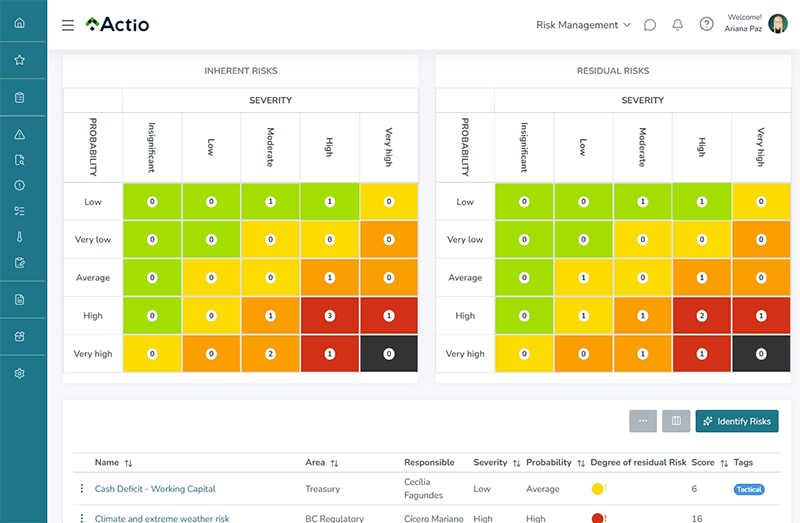
The solution of Enterprise Risk Management (ERM) From Actio, it centralizes the identification, assessment, and treatment of risks and aligns them with the strategy of its corporation, allowing it to analyze how exposure affects the company's objectives.
Have structured information for planning, executive committees, and results meetings, making risk an effective input for decision-making.
Strategic alignment
Relate risks to objectives, indicators, initiatives, and results to evaluate how exposure can affect business priorities.
Consolidated data
Centralize assessments, controls, and treatment plans to track risk exposure across the organization.
Safer decisions
Support planning, results meetings, and executive committees with structured information on corporate risks.
✦ Implementation steps
How to structure, evaluate, and monitor corporate risks
Organize corporate risk management in just six steps and keep the controls that are part of your routine close at hand.
01Structure the risk management model
01
Structure the risk management model
- Define categories, evaluation criteria, and criticality levels.
- Configure probability and impact matrices.
- Establish responsibilities, approval workflows, and access levels.
- Adapt the methodology to the organization's policies and risk appetite.
02Identify and contextualize the risks
02
Identify and contextualize the risks
- Register strategic, operational, financial, and compliance risks.
- Identify causes, events, consequences and areas involved.
- Link risks to strategic objectives, processes, projects, and documents.
- Define owners and responsible parties for follow-up.
03Evaluate and prioritize risks
03
Evaluate and prioritize risks
- Assess the probability and impact of risks.
- Compare the inherent and residual risk levels.
- Consider the existence and effectiveness of the controls.
- Prioritize the risks that require the greatest management attention.
04Define treatments and controls
04
Define treatments and controls
- Select the most appropriate response for each risk.
- Map preventive, detective, and corrective controls.
- Create action plans to reduce exposure.
- Define owners, deadlines, and evidence for the treatment.
05Monitor exposure and business continuity
05
Monitor exposure and business continuity
- Monitor key risk indicators and their tolerance thresholds.
- Register losses, incidents, and changes in context.
- Periodically reassess risks and control effectiveness.
- Map critical risks to business continuity plans.
06Report and support decisions
06
Report and support decisions
- Consolidate the corporate risk map.
- Present trends, criticality, treatments, and controls.
- Make information available to committees, management, audit, and the board.
- Use analytics and AI to identify patterns, summarize scenarios, and support prioritization.
Who is this solution for?
The solution connects the different roles involved in the identification, treatment, execution of controls, and supervision of operational risks.
Risk Management Manager
Structures the methodology and coordinates the risk process across the organization.
Executive leadership
Use the consolidated view of risks to support strategic decisions and define priorities.
Area manager or risk owner
Identifies, assesses, treats, and monitors the risks under their responsibility.
Risk and Controls Professional
Consolidates records, tracks treatment plans, controls, and risk indicators.
Committees and councils
They monitor corporate exposure and assess whether risks are within acceptable levels.
✦ Features
Resources for identify, evaluate, treat, and report corporate risks
Centralize the necessary elements to relate risks to strategy, track controls, and transform assessments, events, and decisions into monitorable actions.

Strategic map

Strategic objectives

Indicators

Risks and Controls

Risk Matrix
Auditing

Documents

Action plan
Continuous Feedback

Custom dashboards

Power BI
Executive presentations

Meetings
✦ Schedule your demo
Bring risk management to the center of strategic decisions.
Discover Actio's Enterprise Risk Management (ERM) in a personalized demonstration.
✦ Frequently Asked Questions
Get your questions answered about enterprise risk management
Objective answers to the main questions of those who need to bring risk management to operational areas.
What is Actio’s Enterprise Risk Management solution?
It is a solution designed to structure risk management by connecting risks to business objectives and providing clarity on their impact on priorities, initiatives, and results.
How does the solution connect risks to business objectives?
It links risks to strategic priorities and objectives, helping organizations understand which threats affect strategy and enabling more contextual and focused decision-making.
Can I track risk response plans?
Yes. The platform allows you to track response actions with visibility into ownership, progress, and evolution, supporting execution—not just risk identification.
Does leadership have access to an executive risk view?
Yes. It provides executive and management views that help identify key risks, prioritize exposures, and monitor how the risk landscape evolves over time.
Is the solution only for organizations with mature risk management practices?
No. It supports companies at different maturity levels—from initial structuring to more advanced, centralized, and business-aligned risk management.
Why move away from spreadsheets and fragmented controls?
Because decentralized controls make it difficult to consolidate information, compare risks, and track responses. A structured solution ensures consistency, traceability, and better decision support.
How does the solution support compliance?
It centralizes documentation, controls, and evidence, facilitating compliance with regulations while increasing transparency and consistency in risk management.