Choosing a strategic planning tool no longer was a IT decision and became a governance decision.
In a research published in December 2025, the PMI pointed out the disconnect between planning and execution as the main barrier to business reinvention, cited by 35% of the executives surveyed.
In this article, we will examine where the current model fails, what criteria should be required of a solution, and how to conduct the migration without losing the company's methodological memory.
What is a strategic planning tool and how does it differ from spreadsheets?
A strategic planning tool is a platform that centralizes objectives, indicators, initiatives, and action plans into a single management model.
Unlike spreadsheets, it ensures traceability, access control, automatic alerts, and consolidated view of execution, supporting governance across multiple areas simultaneously.
The value lies in connecting the strategic map to KPIs, projects, and monitoring routines, so that each tactical decision can be traced back to the choice that originated it. It is this logic that underpins the strategic management in companies of a larger size.
Essential components of a strategic planning tool
The maturity of a solution is measured less by the interface and more by the functional coverage. Among the planning tools available on the market, executives should require at least:
- Strategic map with explicit cause-and-effect relationships between objectives;
- Waterfall of KPIs, from the corporate level to the individual level;
- Portfolio of projects and action plans with responsible parties, deadlines and dependencies;
- Management rituals, such as result meetings, alerts, and the decision trail;
- Analytical dashboards connected to the company's data ecosystem.
Strategic planning and spreadsheets: where the model starts to fail
In the strategic planning spreadsheet format, the failure occurs when complexity exceeds the capacity for manual control: divergent versions, formulas without auditing, outdated data, and the absence of alerts.
The result is a registered strategy, but not managed, with low visibility for the high leadership of the group.
It is not a question of belittling Excel, which is irreplaceable for ad hoc analyses; the issue is adequacy. A strategic planning spreadsheet works well for a first cycle, with few areas and low interdependencies, but loses its robustness when dozens of managers and hundreds of indicators become dependent on it.
Data integrity and operational risk
The academic literature is consistent regarding the fragility of spreadsheets. A review by Raymond Panko of the University of Hawaii shows that 88% of the 113 spreadsheets audited in seven studies The surveys conducted since 1995 contained errors.
The work does not address strategic planning, but the finding is relevant: a strategy based on manual files inherits the same risk.
In practice, the symptoms are known to the executive committee:
- Parallel versions of the same plan circulating via email;
- Indicators with formulas modified without registration;
- Dependence on a key person to consolidate results.
Lack of a closed cycle between strategy and operation
Kaplan and Norton, in an article in Harvard Business Review, They argue that execution requires a closed-loop management system that links strategy and operations, starting with operational planning, followed by monitoring and reviewing the assumptions.
It records the plan, but does not impose a cadence, does not charge for deviations, and does not preserve the learning between cycles. Therefore, the stages of the planning cycle They tend to break down precisely between the diagnosis and the follow-up.
Strategic planning software: evaluation criteria for the board
When selecting strategic planning software, the board should evaluate five key factors: methodological adherence, integration with the data ecosystem, governance and security, analytical capabilities, and ease of adoption.
These criteria reduce the risk of investing in a system that merely replicates the spreadsheet in a digital environment.
The following table summarizes the typical differences between the two models.
| Criterion | Table | Strategic planning tool |
| Data source | Multiple files and versions | Single base and governed |
| Traceability | It depends on the individual discipline | Change history and responsible parties |
| Goal Breakdown: Simplify Your Objectives | Manual, by copy of tabs | Waterfall of KPIs, OKRs and projects |
| Alerts and collection | Non-existent or manual | Automatic notifications of deadlines and deviations |
| Executive overview | Periodic and outdated consolidation | Real-time dashboards |
| Scalability | Degrades with volume and users | Designed for multiple areas and levels |
| Security | Control by file | Access profiles, SSO and encryption |
Methodological adherence and flexibility
Large organizations rarely operate with a single methodology. Balanced Scorecards at the corporate level, OKRs in product areas, and goal-based management in operations often coexist. The platform needs to accommodate this coexistence without forcing the company to rewrite its management model.
Integration, security and governance
Integration with the corporate ecosystem is a disqualifying criterion. Check connectors with Microsoft 365, integrations via API documented, SSO/SAML, multi-factor authentication, in-transit encryption, and compliance with the LGPD.
Without this, the strategic planning tool becomes a new silo. It is also worth evaluating the layer of analytics with Power BI, This ensures that the executive dashboard reflects the same data that feeds the operation.
How the strategic planning tool accelerates the execution of the strategy
The strategic planning tool accelerates execution by turning choices into trackable initiatives, linking goals to accountable parties, and instituting a data-driven review cadence.
With this, deviations appear early, resources are reallocated quickly, and leadership decides with updated and reliable information.
The McKinsey study on the so-called Strategy Champions, The study, which analyzed more than 400 companies, indicates that those with the best performance excel in mobilizing resources: they translate the strategy into granular initiatives, allocate resources, and incorporate them into plans and budgets.
In the 2024–2025 survey, only 21% of the executives stated that their strategies meet four or more of the Ten Tests of Strategy.
This is the area where a platform stands out. It shortens the execution gap described in the guide about strategy execution, Because it makes visible, in each cycle, the distance between what was decided and what was delivered.
Goal-setting and KPI cascade
The gap is the point where most plans fall short. A robust strategic planning tool links corporate objectives to value chain indicators, projects, and individual goals.
Thus, the strategy deployment it ceases to be an annual exercise and becomes a living relationship between the different areas.
Results meetings and handling of deviations
Outcome meetings often degenerate into disputes over divergent numbers. With real-time data, the committee devotes time to decision-making.
When the goal is not achieved, the recording of the facts, the analysis of causes, with Ishikawa, 5 Porquês or GUT Matrix, and the corrective plan are documented.
The communication of these decisions also gains method. The material on presentation to the board shows how to structure message, choices, and risks in an executive narrative.
Artificial intelligence as a support layer for decision-making
In the PMI survey, 72% of the executives cited AI and automation as the main drivers for rethinking their operational model. In strategic management, the gain lies in analyses and recommendations regarding projects and indicators, a topic detailed in Artificial intelligence in strategic management.
How to migrate from the strategic planning spreadsheet to a digital platform
The migration of the strategic planning spreadsheet to a platform should follow four steps: map the existing management model, clean and consolidate indicators, configure the goal chain and rituals, and conduct the adoption in waves, while preserving the methodology and reducing resistance.
- Map the existing model. Document perspectives, objectives, indicators and responsible parties, connecting them to the flow described in the guide on strategy, tactics and operation;
- Cleanse the data. Eliminate duplications, standardize formulas, and assign a owner to each indicator;
- Configure cadence and alerts. Define meetings, periodicity and escalation rules. Also integrate the risks of the strategy in the same environment;
- Sail by waves. Start with a pilot program, validate the model, and expand with explicit executive sponsorship.
The most common mistake is to digitize the spreadsheet layout instead of rethinking the management model. The platform should raise the level of discipline, not just replace the file with a screen.
Would you prefer to delve deeper before deciding? Visit the Free materials from Actio.
Actio’s Strategy Management: from the plan to disciplined execution
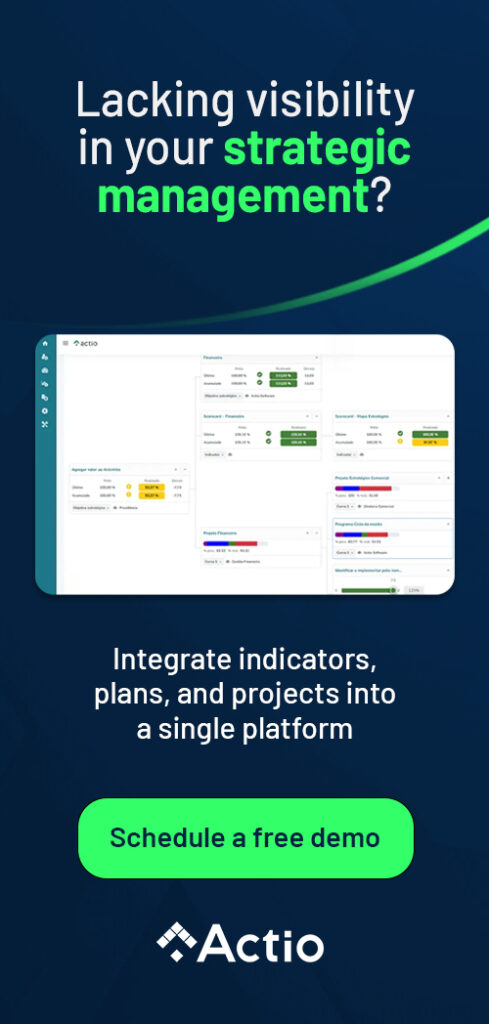
The Actio Strategy Management module is a strategic planning tool that brings together strategic maps, KPI cascades, OKRs, projects, action plans, and dashboards in a single platform.
It supports Balanced Scorecard, OKRs and goal-based management, adapting to the company’s management model, and not the other way around.
Among the most relevant capabilities for the executive audience:
- Dynamic strategic maps that communicate objectives and causal relationships;
- Treatment of deviations, with recording of facts, causes and corrective actions;
- Action plans with Gantt and Kanban views for the PMO;
- Presentation mode, which organizes results meetings with live data;
- Integration with Microsoft 365 and Power BI, plus the virtual consultant Actio IA.
In terms of security, the platform includes multi-factor authentication, SSO/SAML, TLS encryption, and compliance with the LGPD, requirements that are non-negotiable for large companies.
The strategic planning tool as a governance decision
Spreadsheets fulfill their role in the early cycles, but sustaining the strategy on a larger scale requires more.
The appropriate strategic planning tool provides a single data base, the breakdown of goals, the cadence of review and the handling of deviations, turning the plan into a management routine.
For the board, the choice is less about technology and more about the company's ability to govern its choices over time.
Meet the Actio Strategy Management and schedule a demonstration to see how this discipline works in practice.