Artificial intelligence has moved beyond operational support to become a true growth driver. According to PwC (2024), the technology is expected to add $15.7 trillion to the global economy by 2030, with 72% of companies already using some form of AI. The central question, therefore, is not “whether to adopt” but how to integrate AI into strategic management processes to predict risks, optimize resources, and align execution with long-term vision.
From Pain Points to Solutions: How AI Transforms Strategic Decisions
Organizations face challenging obstacles amidst the context of rapid digital business transformation. Data overload without actionable insights, difficulty in projecting future scenarios, slowness in critical decisions, and low personalization in client or talent management are some of the most recurring examples. It is precisely in these cases, where technology and data seem insufficient, that AI steps in as a catalyst, with:
- Trend forecasting to guide investments and portfolios.
- Automation of strategic workflows to reduce bottlenecks.
- Real-time feedback and intelligent recommendations that support leaders.
- Integration of dispersed data into holistic diagnostics, connecting performance, culture, and outcomes.
Research from the Project Management Institute (2024) shows that 81% of professionals already feel the direct impact of AI on project and performance management, while Bain & Company (2024) highlights up to 40% improvement in financial forecasting accuracy among organizations applying predictive AI.
Global Cases of Strategic Application
- Amazon – Predictability as a Revenue Engine:Before AI, product recommendations were limited to static rules. With analytical algorithms, Amazon began anticipating individual preferences in real time. Today, 35% of its sales come from intelligent recommendations,turning AI into both a customer experience optimizer and a direct revenue driver.
- Gymshark – Personalization at Scale:The UK sportswear brand sought loyalty in a saturated market. By integrating generative and cognitive AI into its data platform, Gymshark scaled personalized interactions, boosting retention and digital engagement.This proves that well-managed data becomes sustainable competitive advantage.
- IHG Hotels & Resorts – Experience and Efficiency Combined :The global hotel chain needed to cut costs without harming guest experience. The solution came through generative chatbots, capable of tailoring experiences and answering queries in real time. The result was twofold: reduced customer service costs and improved satisfaction scores..
- Coca-Cola – AI-Powered Product Innovation:According to Bain & Company (2024), Coca-Cola uses generative AI to design new products and market strategies. This accelerated innovation cycles, enabling the company to test flavors and digital campaigns with unprecedented speed.
These cases prove that AI is not a future concept but a present resource connecting strategy to execution. At the same time, they raise the bar, heighten responsibility, and shrink the margin for error—demanding more robust, intelligent processes that link strategy to risk management. For deeper insights, access the e-book Strategic Management + Risk Management and explore the stages of smart integration that strengthen business resilience.

Culture and Governance: Conditions for Real Results
Technology alone cannot sustain change. Companies that thrive with AI build environments of trust: they create governance frameworks, invest in training, and foster a data-driven culture. FGV (2024) highlights that organizations aligning digital governance with training programs reduce internal resistance and accelerate ROI.
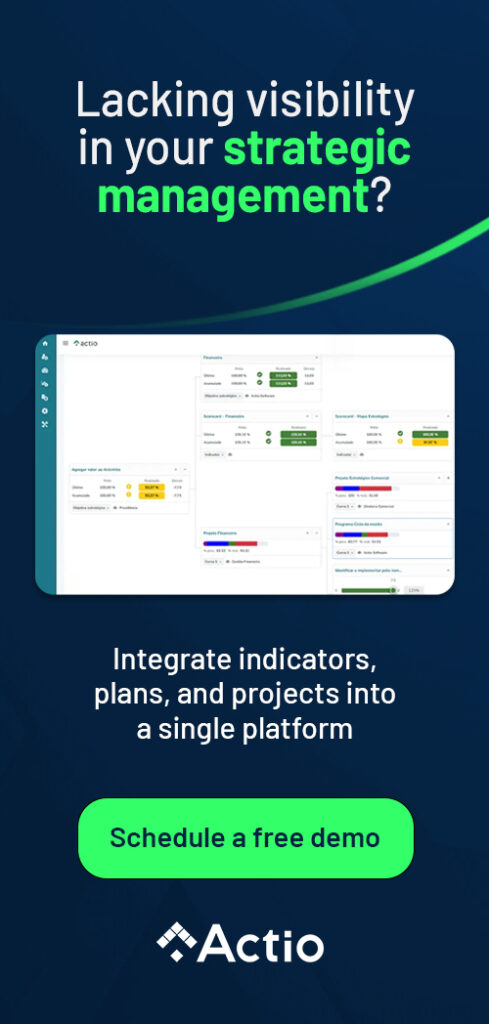
But for one assertive application, In addition to the right mindset, it is necessary to have in hand technology that allows the use of AI with strategy and longevity. Faced with this demand, Actio | Strategic Management stands out with it's virtual consultant, Actio I.A.Through Actio I.A., companies can transform data into practical decisions and align execution with strategic priorities
In Troubleshooting, the consultant acts by identifying the causes of non-compliance with indicators and highlighting critical points that require attention. In Action Plans (Gantt), suggest specific initiatives to improve performance and accelerate goal achievement. In Projects, generates relevant insights for execution, presenting risks, suggestions for improvements, and analyses that make monitoring more precise. Already in our OKRs, recommends objectives aligned with the corporate strategy, making the goal-setting process more agile and assertive.
With this integration, Actio I.A is not just a feature. It acts as a intelligent virtual partner, capable of boosting performance, reducing uncertainties, and strengthening strategic management as a pillar for sustainable results. If you wish to see all these applications in practice, with real and sustainable impact for your results, take the first step today. Schedule a demo and check out the specifics of implementation for your reality:

Connecting the Dots: Key Takeaways and Next Steps
AI has already proven its ability to increase predictability, accelerate decisions, and reduce inefficiencies. What sets leading companies apart is their ability to unite culture, governance, and technology into a single strategic flow. From retail to hospitality, the results are clear: when applied strategically, AI stops being a promise and becomes a lasting competitive edge.
Practical Checklist for Strategic AI Application
- Assess governance gaps and digital maturity.
- Map strategic pain points and match them to AI functions.
- Develop training programs focused on data-driven decision-making.
- Launch pilots in critical areas and measure impact on strategic KPIs.
- Scale with integrated platforms like Actio | Strategic Management. Actio | Strategy Management.
Don’t miss our e-book “Strategic Management + Risk Management” to take the first step toward innovative and resilient management.
Follow us on LinkedIn to get weekly access to valuable insights for your business journey.