

Ensure the continuity of the critical positions of your organization
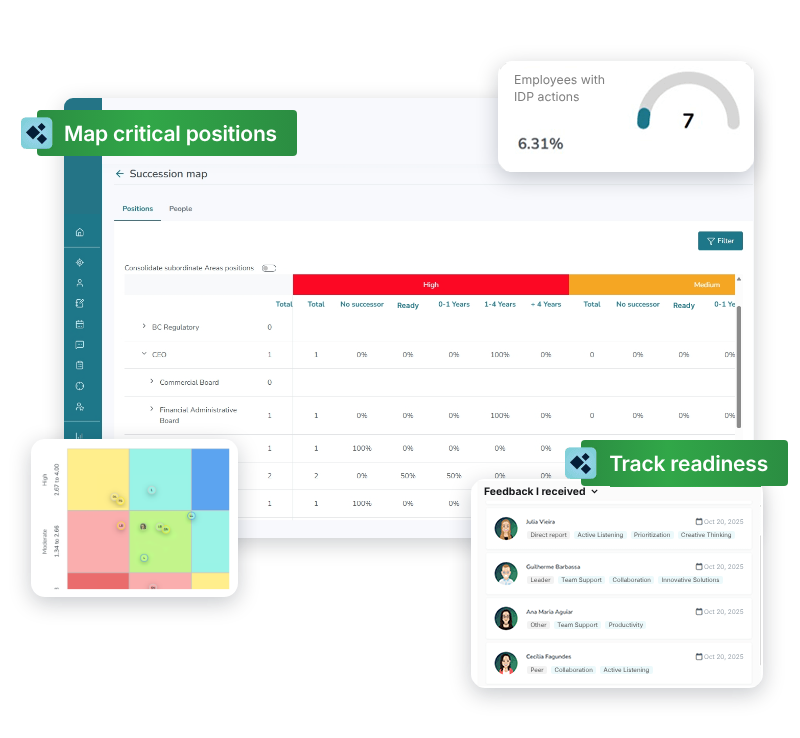
Map out critical positions, identify successors, and monitor their readiness to anticipate leadership gaps and reduce the impact of the departure of key professionals.
Connecting management and results in companies around the world







✦ Challenge
Your organization is ready to replace professionals in critical positions?
Symptoms that the continuity of critical positions is not yet guaranteed:
The organization is unclear about which positions are critical.
Departures of leaders or experts cause discontinuity and impact on results.
Successors are discussed only when an urgent need arises.
The indications depend excessively on the individual perception of the managers.
Some positions have several candidates, while others have none.
There are no common criteria for assessing potential and readiness.
Succession maps are built, but they become outdated.
The leadership is unable to visualize the main succession risks.
✦ Solution
Anticipate leadership gaps and strengthen the pipeline of successors
The solution of Succession Planning identifies critical positions and their succession risks, maps internal candidates and assesses their readiness based on structured performance, potential, skills, and experience criteria.
With succession maps, readiness levels, replacement scenarios, and periodic follow-up, it enables you to anticipate gaps, prioritize preparedness efforts, and provide leadership with a reliable view of the continuity of essential positions for the organization.
Critical positions mapped
Identify the essential positions and the risks associated with the loss of key professionals.
Preparedness with clear criteria
Evaluate the potential and readiness of successors using structured and calibrated criteria.
Pipeline always up to date
Follow the coverage of the positions and the evolution of the successors with periodic reviews.
✦ Implementation steps
How to structure a continuous succession planning
Structure a process to identify critical positions, map and evaluate successors, build replacement scenarios, and track the evolution of the pipeline over time.
01Identifying critical positions
01
Identifying critical positions
- Structuring competencies and behaviors expected by a position or function.
- Define individual deliveries and goals.
- Link the employee’s goals to the priorities of the area and the organization.
- Establish clear evaluation and recognition criteria.
02Defining criteria and governance
02
Defining criteria and governance
- Perform evaluations at 90°, 180° or 360°.
- Consider competencies, behaviors, deliverables, and goal achievement.
- Record comments and evidence that support the evaluations.
- Using AI to support clearer and more consistent evaluations.
03Mapping talents
03
Mapping talents
- Compare the results between teams, areas, and managers.
- Correct possible distortions in the application of the criteria.
- Positioning employees in 9Box based on performance and potential.
- Consider delivery and goals when composing the performance axis.
- Record decisions and changes made in the people committees.
04Evaluate potential and readiness
04
Evaluate potential and readiness
- Share results and align expectations with the employee.
- Record the strengths and opportunities for development.
- Create PDIs based on the gaps and aspirations identified.
- Define actions, responsibilities, deadlines and evidence of progress.
- Track feedback and development actions throughout the cycle.
05Building successor scenarios
05
Building successor scenarios
- Identify critical positions and possible successors.
- Evaluate potential, readiness, and development gaps.
- Relate candidates for succession to their respective PDIs.
- Support decision-making regarding the promotion, movement and preparation of talents.
06Monitoring the succession pipeline
06
Monitoring the succession pipeline
- Using evaluation results and targets as parameters for the bonus.
- Combine corporate, collective and individual results.
- Apply weights, bands, eligibility criteria and payment rules.
- Ensure traceability between performance, goals, and calculated value.
- Provide a clear memory of the results and criteria considered.
Who is this solution for?
The solution connects the different roles involved in identifying, evaluating, and preparing successors, offering a shared view of the risks and coverage of critical positions.
Responsible for Succession Planning
It structures the process and monitors the succession risks.
HR leadership
It defines criteria of potential, readiness, and criticality.
People manager
It indicates candidates and monitors their preparation.
Committee of People
Calibra evaluates and validates successor maps.
Senior management
It accompanies the coverage of critical positions and the risks of continuity.
People Analytics Professional
Consolidates information and indicators from the succession pipeline.
Responsible for Performance Management
It structures the criteria and coordinates the evaluation cycles.
Human Resources Professional
It accompanies the execution and consolidates the results.
People manager
Evaluates the contribution of employees based on criteria and evidence.
Collaborator
It understands the expectations and how its deliveries contribute to the goals of the area.
Executive leadership
It tracks individual performance and its relationship with organizational results.
✦ Features
Resources for Map, evaluate and prepare successors
Centralize resources in a single environment to identify critical positions, assess potential and readiness, and monitor the preparation of successors.

Individual Development Plans (IDP)

Methodology 70:20:10

Share library

Banknote block

1:1s

Continuous Feedback

Compliments

Results of the cycles

Succession map

Matriz 9box

Duties

Evaluation of experience
✦ Schedule your demo
Prepare today the leaders of tomorrow
Learn about the Succession Planning solution from Actio and discover how to map critical positions, identify successors, and monitor their readiness to ensure the continuity of the organization.
✦ Frequently Asked Questions
Clear your doubts about succession planning
Objective answers for organizations that want to ensure the continuity of critical positions with identified and prepared successors.
How to identify which positions are critical?
By assessing impact, skills shortages, difficulty in replacement, and the risks associated with the loss of key professionals, to prioritize the positions that need succession coverage.
What criteria are used to evaluate the successors?
Structured criteria for performance, potential, competencies, and experience, in addition to eligibility rules defined by the organization.
How does the readiness assessment work?
Candidates are classified by level of readiness, with preparation horizons and identification of gaps in relation to the requirements of the position.
Is the 9-box matrix part of the process?
Yes. The talents are positioned in the 9-box matrix, and the evaluations are calibrated between managers and committees.
Is it possible to plan for emergency succession?
Yes. The solution allows you to create scenarios for planned and emergency succession, with priority successors and replacement alternatives.
Are the succession information confidential?
The organization defines the participants, the approvals, and the levels of confidentiality of the process.
How do I keep successor maps up to date?
With periodic reviews of positions, candidates and risks, monitoring the readiness of successors and recording the decisions of the people's forums.