

Transform performance data into integrated talent decisions
Connect goals, competencies, and assessments in a single view of each employee’s contribution and support decisions with more consistency, transparency, and evidence.
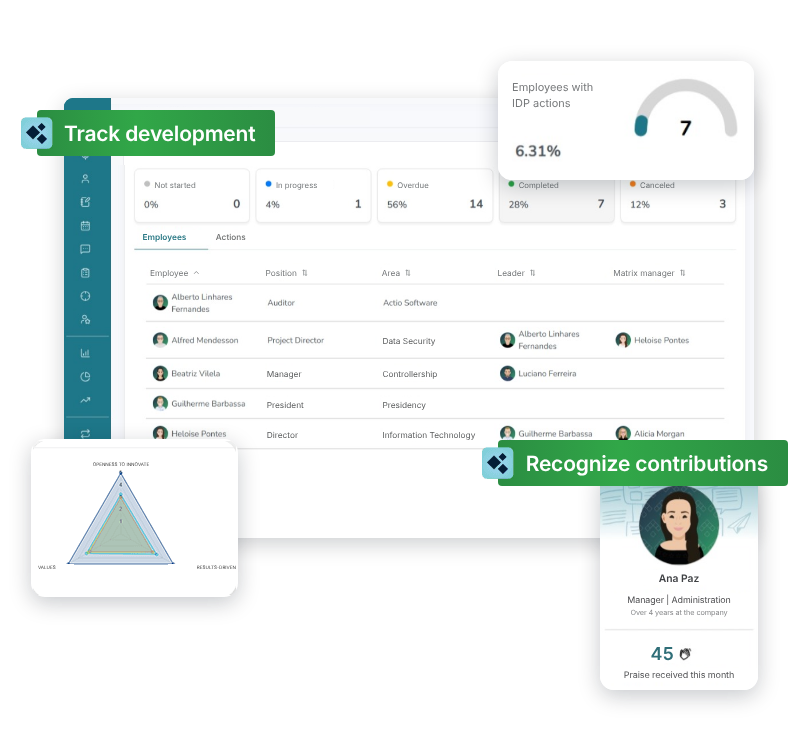
Connecting management and results in companies around the world







✦ Challenge
Your organization takes decisions about talents based on consistent data?
Symptoms that performance data still do not support integrated decisions about people:
Data on goals, competencies, deliverables, and assessments are scattered across different processes.
HR needs to manually consolidate the information to analyze the talent pool.
The positioning in the 9-box matrix depends excessively on the perception of the managers.
Contributors with similar contributions receive different ratings and decisions.
The results of the evaluations are not used as parameters in other HR processes.
Decisions about talent are made without a complete view of the performance history.
The organization cannot explain what information formed the basis of each decision.
✦ Solution
Link goals, competencies, and assessments in an integrated view of performance
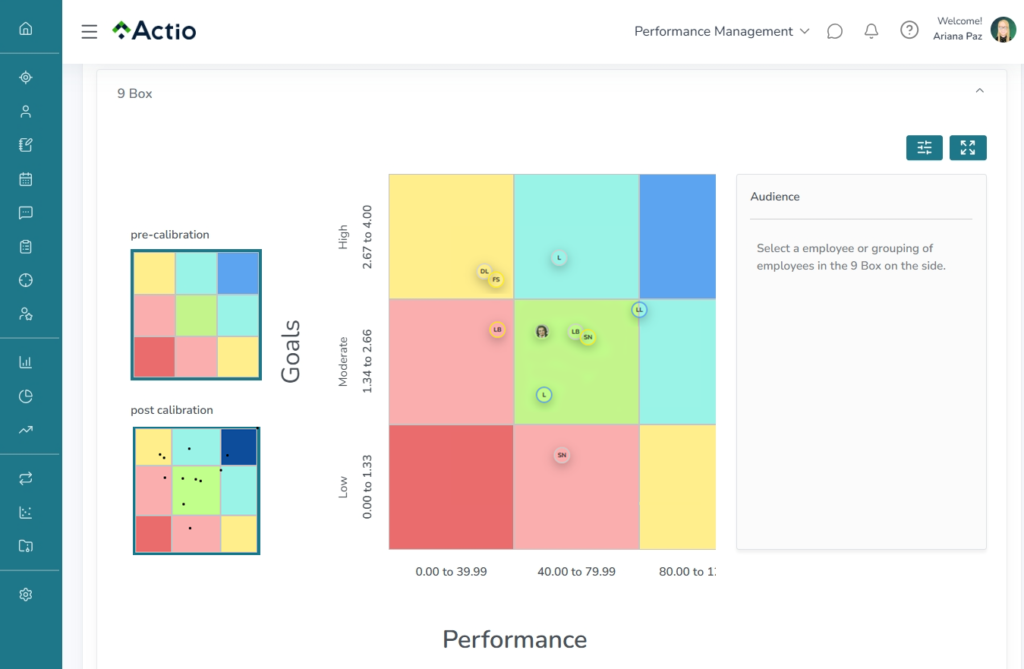
The solution of Development and Performance Consolidates results of goals, deliverables, competencies, and assessments into an integrated view of each employee’s performance, supporting calibrations and positioning in the 9-box matrix with structured criteria.
This information now guides other HR processes, providing parameters for development plans, succession, moves, and variable remuneration, without replacing the specific management of each of these processes.
Integrated vision
Gather goals, deliverables, competencies, and assessments in a single view of each employee’s performance.
Consistent decisions
Support calibrations and positioning in the 9-box using structured criteria, and not just in the perception of managers.
Traceability
Link performance to development, succession, and compensation, with clarity about what informed each decision.
✦ Implementation steps
How to turn performance data into talent decisions
Structure a continuous cycle to define expectations, evaluate results, calibrate talent, and connect performance to development, succession, and compensation.
01Defining expectations, competencies and goals
01
Defining expectations, competencies and goals
- Structuring competencies and behaviors expected by a position or function.
- Define individual deliveries and goals.
- Link the employee’s goals to the priorities of the area and the organization.
- Establish clear evaluation and recognition criteria.
02Evaluating skills and results
02
Evaluating skills and results
- Perform evaluations at 90°, 180° or 360°.
- Consider competencies, behaviors, deliverables, and goal achievement.
- Record comments and evidence that support the evaluations.
- Using AI to support clearer and more consistent evaluations.
03Calibrating and identifying talents
03
Calibrating and identifying talents
- Compare the results between teams, areas, and managers.
- Correct possible distortions in the application of the criteria.
- Positioning employees in 9Box based on performance and potential.
- Consider delivery and goals when composing the performance axis.
- Record decisions and changes made in the people committees.
04Offering feedback and developing people
04
Offering feedback and developing people
- Share results and align expectations with the employee.
- Record the strengths and opportunities for development.
- Create PDIs based on the gaps and aspirations identified.
- Define actions, responsibilities, deadlines and evidence of progress.
- Track feedback and development actions throughout the cycle.
05Support succession and movements
05
Support succession and movements
- Identify critical positions and possible successors.
- Evaluate potential, readiness, and development gaps.
- Relate candidates for succession to their respective PDIs.
- Support decision-making regarding the promotion, movement and preparation of talents.
06Recognizing and rewarding performance
06
Recognizing and rewarding performance
- Using evaluation results and targets as parameters for the bonus.
- Combine corporate, collective and individual results.
- Apply weights, bands, eligibility criteria and payment rules.
- Ensure traceability between performance, goals, and calculated value.
- Provide a clear memory of the results and criteria considered.
07Analyzing the evolution
07
Analyzing the evolution
- Consolidate information about performance, potential, development, and remuneration.
- Compare results by area, position, unit, and period.
- Identify gaps in critical skills and talents.
- Support decisions and investments in human development.
Who is this solution for?
The solution connects the different roles involved in evaluation, calibration, and talent decisions, providing a common basis of information for development, succession, and compensation.
Responsible for Development and Performance
It integrates information and structures the criteria for decisions regarding talent.
HR professional
It consolidates results, conducts calibrations and supports managers.
People manager
Analyzes deliveries, competencies, and performance to inform decisions.
Committee of People
It calibrates results and assesses the positioning of talents.
Responsible for Remuneration
It uses targets and evaluations as parameters for incentive programs.
Executive leadership
It accompanies the distribution of performance, potential and critical capabilities.
Responsible for Performance Management
It structures the criteria and coordinates the evaluation cycles.
Human Resources Professional
It accompanies the execution and consolidates the results.
People manager
Evaluates the contribution of employees based on criteria and evidence.
Collaborator
It understands the expectations and how its deliveries contribute to the goals of the area.
Executive leadership
It tracks individual performance and its relationship with organizational results.
✦ Features
Resources for evaluate, develop and recognize Talents
Centralize resources in a single environment to set goals, assess competencies, calibrate results, and connect performance to development, succession, and compensation.

Goal Negotiation

Goal card

Bonus management

Initiatives

Indicators

Action plan

Deviation Report (FCA)

Assessment of competencies

Individual Development Plans (IDP)

Banknote block

1:1s

Continuous Feedback

Compliments

Results of the cycles

Succession map

Matriz 9box

Calibration

Evaluation of experience
✦ Schedule your demo
Make decisions about talent with more consistency
Learn about the Development and Performance solution from Actio and discover how to connect goals, competencies, and assessments with decisions about development, succession, and remuneration.
✦ Frequently Asked Questions
Clear your doubts about development and performance
Objective answers for organizations that want to turn performance data into more consistent decisions about talent.
What types of assessments can I perform?
Assessments 90°, 180° or 360°, considering competencies, behaviors, deliverables and goal achievement, with recording of comments and evidence.
How do goals enter into performance evaluation?
Deliverables and goals form the performance axis alongside competencies, and individual goals connect to the priorities of the area and the organization.
How does the calibration work?
The results are compared between teams, areas, and managers to correct distortions, and the decisions and changes of the people committees are recorded.
How is positioning done in the 9-box matrix?
Employees are positioned based on performance and potential, using structured criteria that consider deliverables and goals.
Does the solution support succession plans?
Yes. She identifies critical positions and potential successors, assesses potential, readiness, and gaps, and correlates candidates to their PDIs.
How does performance relate to variable remuneration?
Results from evaluations and targets serve as a benchmark for the bonus, with weights, ranges, eligibility criteria, and traceability down to the calculated value.
Does the solution replace the development, succession and remuneration processes?
No. It provides parameters for these processes without replacing the specific management of each one.