
Since its creation, the Balanced Scorecard (BSC) methodology has been essential for the advancement of organizations worldwide, proving to be an invaluable ally in business management.
But after all, do you know what the purpose of the BSC is? Does it only serve to provide a clear view of the company's needs to achieve its goals and measure the results of ongoing work?
The truth is that the Balanced Scorecard methodology goes beyond that. And when applied effectively, its implementation drives significant improvements in results, as it empowers leaders to implement action plans aligned with their preferences and the specificities of the global business context.
With that in mind, we created this article so that you can better understand how the BSC works and its benefits. Enjoy reading!
What Is Balanced Scorecard? Benefits and Examples

Actio’s Balanced Scorecard, which means Balanced Performance Indicators, In Portuguese, it is an essential methodology in the strategic management of companies. After all, the tool helps assess progress towards long-term goals, transforming the strategy into objectives, indicators, targets, and strategic initiatives.
The difference of this approach lies in its emphasis on measuring results, going beyond the traditional use of financial indicators. In this case, the KPIs They play a crucial role because they represent numbers, percentages, or ratios that measure specific aspects of performance and allow for comparison with previously established goals.
In the context of the Balanced Scorecard (BSC), performance indicators serve as tools for evaluating progress towards goals. However, it is important to understand the difference between goals and objectives:
- Objectives: they are clear and qualitative descriptions of what the organization intends to achieve;
- Goals: They are self-imposed challenges, defined in terms of time frame, quantity or quality, with the purpose of achieving the established objectives.
In addition to all the benefits mentioned above, the Balanced Scorecard also represents a long-term strategic approach, supported by a system for organizational management, communication, and performance measurement. In this way, its implementation allows for the creation of a comprehensive vision of the company's objectives, reaching all levels of the organization and providing a solid foundation for strategic decision-making.
What is the objective of the BSC?

As we mentioned above, the BSC methodology’s main objective is to align a company’s operational activities with its strategic goals. strategic planning. This is done through the representation of the organization’s strategy and mission through measures and objectives that are translated into indicators. Thus, these indicators facilitate the evaluation of results and provide information to employees about the positive and negative aspects, which helps to involve them in the pursuit of long-term goals.
To achieve this result, it is necessary to follow specific actions that reflect the central objectives of the BSC, such as:
1. Translate and clarify the strategy
The organization's objectives can only be fully achieved when understood in terms of the strategic mission. This requires all managers to work with indicators and goals related to each department, ensuring a common understanding among employees, managers, and business operations.
2. Establish, plan goals, and align strategic initiatives
Setting goals is a responsibility of managers, who also need to plan processes, develop financial planning, and determine the expected pace of company growth. Therefore, it is essential that these plans are realistic, taking into account organizational capacity and performance expectations.
3. Improve strategic learning and feedback
The review and feedback process analyzes the performance of the company’s strategy and the established goals. In this way, it helps optimize the knowledge and skills of employees, making it easier to monitor and control the business from its four central perspectives.
Also read: Positive and negative feedback
4. Associate and communicate strategic measures and objectives
It is the responsibility of managers to communicate strategies, linking overall objectives with the specific needs of each company sector. This way, it ensures that all levels of the organization understand the long-term strategies established and that the objectives of each sector and individual are aligned.
5. Promote organizational alignment and a high-performance culture
In addition to translating strategy, the BSC seeks to integrate all business units and support areas around shared priorities. By linking individual performance to the company’s overall goals, the method eliminates operational silos, engages teams, and builds a culture focused on sustainable results and continuous improvement.
What are the four perspectives of the Balanced Scorecard?
The Balanced Scorecard (BSC) uses four distinct perspectives to address essential areas of strategic implementation, promoting integration between them to achieve organizational objectives.
These are:
- Financial perspective: the impacts of strategic decisions are assessed on long-term financial goals. It is crucial to establish financial objectives and connect them to an action plan that encompasses financial aspects, customers, internal processes, and human resources;
- Customer Perspective: It considers both the company's market share and customer satisfaction. It is essential to identify the stakeholders and define the results to be evaluated, such as loyalty, satisfaction, profitability, acquisition and market share;
- Internal process perspective: the focus is on improving the quality of internal processes, covering innovation, operations and after-sales service. This translates into indicators such as productivity, costs, adoption of technology and development time;
- Learning and growth perspective: It assesses the internal satisfaction of employees and covers intangible assets such as engagement, training, and team satisfaction. It is important to measure employee turnover (turnover) and the impact of training programs, including the infrastructure objectives necessary to achieve effective results.
But, after all, how does the Balanced Scorecard work?

The Balanced Scorecard (BSC) is an approach that is based on four essential components to help organizations define, monitor, and achieve their strategic goals. These components are:
- Objectives: They are the specific goals and achievements that the organization wishes to achieve in each of the four strategic perspectives of the BSC (Finance, Customers, Internal Processes, and Learning and Growth). For example, a goal from the perspective of the Customer may be to increase market share;
- Indicators: They are quantifiable measures that reflect the organization's performance in relation to its objectives. Furthermore, they help evaluate whether the strategy is being successful or not;
- Goals: represent the desired performance levels for each indicator. Remember: setting clear and measurable goals is essential to track progress towards strategic objectives;
- Strategic initiatives or projects: These are the planned actions and interventions that the organization must execute to achieve the established performance goals. That is, these initiatives can encompass a wide range of activities, from marketing campaigns to the implementation of customer relationship management (CRM) systems.
BSC allows strategies to be detailed down to the operational level, providing clarity about the steps required to achieve strategic objectives. For example, if the strategic objective is to increase market share, this can be broken down into sales indicators, generation of leads and online traffic, with specific targets for each indicator.
Strategic initiatives, in turn, can include content production, digital marketing campaigns, training of the sales team, and the implementation of CRM systems.
What are the main advantages of implementing BSC in management?
Adopting the Balanced Scorecard as a central tool for strategic management brings profound transformations to the company's executive and operational routines. After all, by going beyond traditional accounting reports, the methodology provides:
- Holistic and integrated view of the business: it allows you to monitor financial health while keeping operational and human factors that support growth in view;
- Improved communication and transparency: translates abstract planning terms into transparent goals for all departments;
- Focus and prioritization of resources: helps to target investments and efforts towards initiatives that truly generate impact in the overall strategy;
- Decision-making based on real data: it replaces “achismo” with updated and measurable performance indicators;
- Greater agility in route correction: It enables operational bottlenecks to be identified before they affect the final financial result.
What technological resources are necessary to implement the Balanced Scorecard?
The Balanced Scorecard is a valuable tool for organizations that want to measure and manage their performance comprehensively and in alignment with their strategy. This is because by considering the four perspectives and establishing clear indicators, goals, and initiatives, companies can improve their performance, promote continuous learning, and achieve their strategic objectives effectively.
However, although BSC is a powerful approach, it is important to remember that its implementation requires commitment, planning, and involvement from the entire organization.
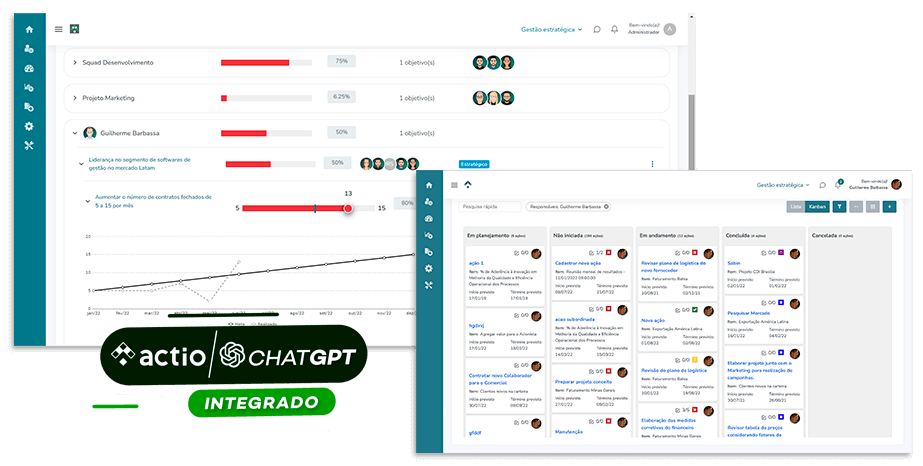
Therefore, using the right technology for your management processes is essential to ensure maximum effectiveness. Learn more Actio Strategy Management, Actio software for managing the BSC in your company. With it, you ensure full control over all information, goals, and actions.
Did you like the content? Don't forget to follow Actio on Instagram, LinkedIn and Facebook!
Frequently Asked Questions about the Balanced Scorecard (BSC)
Check out some of the most common questions on the topic below:
In BSC, objectives describe what the company wants to achieve; indicators (KPIs) are the metrics used to measure performance; targets are the numerical values desired within a given timeframe; and initiatives are the projects and action plans implemented to achieve these targets.
The BSC is a comprehensive and long-term strategic governance system that seeks the continuous balance of the business through 4 perspectives. The OKRs (“Objectives and Key Results,”) are an agile methodology focused on short-term goals (usually quarterly).
Both are complementary and can be used together.
The BSC indicators and initiatives should be continuously monitored in periodic strategic analysis meetings (monthly or quarterly) to correct deviations from the roadmap. The Strategic Map and the major objectives should undergo a formal review annually to incorporate new market changes.
The most frequent errors are: creating an excessive number of indicators without prioritization, not communicating the strategy clearly to the operational level, treating the BSC as a static document and trying to control the entire system through manual spreadsheets.

