Each company operates uniquely, with its own rules, systems, and values. Therefore, it's important to thoroughly understand how a business functions and identify where problems might exist and how to control them, which we call “risk mapping.”.
To do this effectively and reap the benefits, the company needs to look inward and identify the most important and sensitive parts of its operations. Then, using that understanding, it can map out potential problems that might occur.
But do you really know how this process works? In this blog, we'll explain what risk mapping is, why it's so important, and the step-by-step of how to apply it in your organization. We'll also talk about how technology can be useful in this process. Keep reading and understand!
But in the end, what is risk mapping?

Risk mapping is a fundamental process in business management, as it aims to identify and evaluate potential threats that could cause operational and financial damage to an organization. By doing so, it seeks to ensure business continuity and prevent possible losses.
Through this process, decision-makers are empowered to direct their efforts toward strategic actions aimed at avoiding, reducing, or monitoring previously identified risks.
Furthermore, this action is taken in compliance with ethical principles and legal requirements. This way, it provides greater operational integrity, corporate recognition, and more effective management of existing risks, which contributes to the constant improvement of the production system's performance.
The objective of risk mapping is to identify, assess, and prioritize potential risks that could affect an organization or project. This allows for a better understanding of the likelihood and impact of each risk, enabling the development of appropriate mitigation strategies and contingency plans.
The objective of risk mapping is to provide a clearer understanding of potential obstacles and supply information for informed decision-making that helps minimize losses, protect assets, and ensure the continuity and improvement of business operations.
After identifying business risks, it becomes easier to focus on preventive actions.
Main types of risks a company is exposed to

Certain risks permeate the business landscape, spanning different areas that demand strategic attention and a more elaborate mapping process. Here are:
1- Strategic risks
Think of business strategies as a plan for the company to be successful for a long time. However, there are risks that can hinder these plans. These are strategic risks, which are influenced by things that happen outside the company, such as:
- What's happening in the country's politics?;
- How is the economy?;
- New technologies that emerge;
- Changes to the game rules.
To understand and control these risks, it is important to thoroughly comprehend everything that affects the company's value. For example, ignoring new technologies can be detrimental to the company's future.
Remember also that strategic risks include issues that can tarnish the company's reputation, such as image-related matters. How the company is managed and how it contributes to society are also part of this.
2- Financial Risks
Sometimes, situations arise that directly affect the money a company earns, leaving it with little financial reserve. This is called financial risk. Some examples are:
- The company owes a lot of money.;
- Not having enough money to pay the bills.
To avoid these problems, it's good to create regular reports on the company's finances. This helps leaders understand how money is being spent.
3- Operational risks
Operational risks are problems that can arise in a company's daily activities, causing many obstacles. These problems can occur internally within the company or be influenced by external factors. For example, not backing up important documents is an operational risk.
These risks are more harmful when they cause problems that force the company to redo work, delaying deadlines and goals. Furthermore, as a consequence, it can cause the company to lose customer trust.
One way to deal with this is to have clear rules and processes in the company, ensuring things are done the same way every time. Using computer programs to help with management is also a good practice.
Understanding and facing these types of risks is fundamental for any company. It helps the company grow and remain strong, even in the face of challenges.
Looking for risk management software? Learn about Actio Risk Management!
Mapping risks is important for several reasons. It helps organizations identify potential threats and vulnerabilities, assess their likelihood and impact, and develop strategies to mitigate them. This proactive approach can prevent or minimize losses, protect assets, and ensure business continuity.
Risk mapping is fundamental to ensuring a company's health, as it allows for the identification, assessment, and control of potential threats to operations. By understanding the probability and impacts of these risks, the company gains a more comprehensive view of its vulnerabilities, enabling more effective management. Therefore, check out the step-by-step guide below on how to apply risk mapping in your organization.
Learn how to apply risk mapping in your business
To ensure the success of preventive actions, it is fundamental for a company to deeply understand its potential threats. Below, we have separated 4 practices to facilitate risk mapping:
Brainstorming with experts: Gather managers from various areas to identify and evaluate potential risks that could affect the company. Additionally, a free and stimulating discussion, guided by a facilitator, will lead to a more precise and comprehensive list of relevant risks.
2- Establish compliance rules: After identifying the risks, evaluate the impact of each one on operations, considering their severity and possible consequences. Align risk analysis with company compliance policies and identify unacceptable conduct deviations. This will provide better operational control and awareness of potential impacts.
3- Background check: Perform thorough checks on suppliers, partners, and others involved with the company. This helps identify potential financial, legal, or criminal irregularities that may pose risks. In addition, automating this process with artificial intelligence tools speeds up the collection and validation of relevant information.
4- Continuous monitoring: Risk mapping is not a one-time task. Constant vigilance is essential to adapt to changing circumstances. A reliable business partner today can face challenges in the future. Regular monitoring will allow for continuous refinement of strategies and ensure that suppliers and partners meet the necessary standards. An effective solution for this can be the adoption of a risk management, which simplifies and automates the monitoring process.
Rely on risk management software
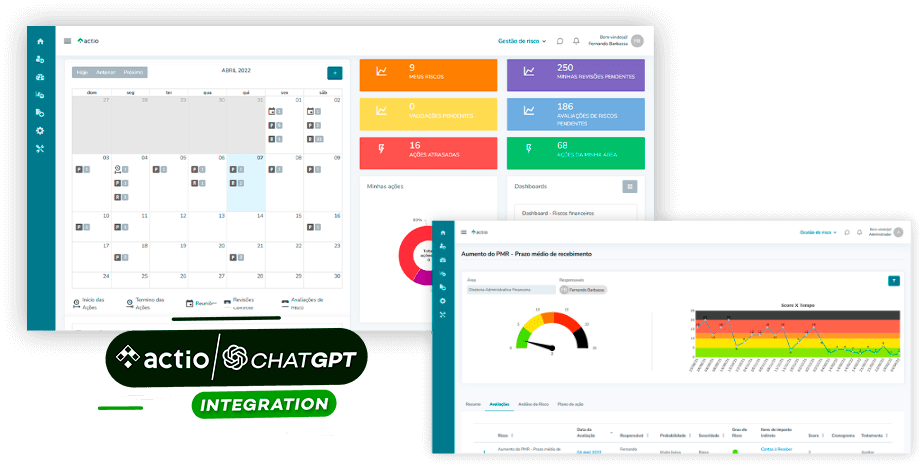
In a scenario where different areas need to work together, it is fundamental to have an organized approach to risk mapping in your organization. One way to do this efficiently is by using tools that track safety indicators, as this facilitates the internal functioning of the company.
In this way, the suggestion is to adopt management software that can consolidate and organize all information. With this solid foundation, the company can effectively manage employee health and safety risks. The Actio Risk Management, risk management software, is an interesting option in this regard.
An additional advantage is that Actio Risk Management helps to understand risks in each activity more precisely. This allows for better planning to reduce these risks and implementing controls that truly work.
Like the content? Don’t forget to follow Actio on Instagram, Linkedin and Facebook.