One of the biggest challenges for companies isn't defining a good strategy, but rather executing it consistently in their day-to-day operations. It's common to find organizations with well-structured plans that struggle when it comes to transforming them into practical actions and concrete results.
The Balanced Scorecard emerges precisely to solve this problem, and the strategy map is one of the most important components of this methodology. It functions as a visual representation of the strategy, clearly showing how each objective is connected and how the company's areas contribute to the final result.
More than a drawing, the strategy map helps translate abstract decisions into something that can be understood, tracked, and executed by the entire organization.
What is the Balanced Scorecard?
The Balanced Scorecard is a strategic management methodology created to help companies transform their vision and strategy into measurable objectives. Unlike traditional models, it does not focus solely on financial indicators but proposes a more complete view of the business.
This approach is structured in four complementary perspectives that help the company grow sustainably.
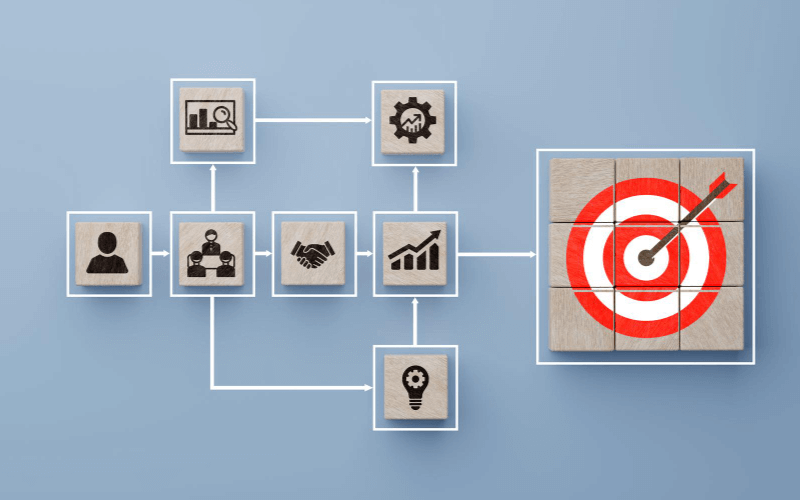
Financial perspective:
The financial perspective assesses whether the strategy is generating concrete results. This includes indicators like revenue, profitability, growth, and return on investment. It's the final reflection of everything that has been executed.
Customer perspective
This perspective analyzes how the company is perceived by the market. It involves factors such as customer satisfaction, experience, retention, and loyalty. Companies that ignore this point tend to lose competitiveness.
Internal processes perspective:
Here, the focus is on operational efficiency. The company needs to understand which processes are critical for delivering customer value and where there are bottlenecks that need to be corrected.
Learning and growth perspective:
This is the foundation of everything. It involves people development, organizational culture, innovation, and adaptability. Without internal evolution, the company cannot sustain long-term growth.
What is a strategic map
The strategy map is the visual representation of the objectives defined within the Balanced Scorecard. It organizes these objectives logically, showing the cause-and-effect relationship between them.
In practice, it helps answer a crucial question: how will the company achieve its goals?
How the strategic map works
The map follows a structure that connects the four perspectives of the BSC. It typically starts with learning and growth, moves through internal processes, impacts the customer, and finally reaches financial results.
This shows that results don't happen by chance. They are the consequence of a chain of well-structured actions.
For example, when a company invests in staff training, it improves its internal processes. With more efficient processes, it can deliver more value to the customer. Satisfied customers tend to buy more, which directly impacts revenue.
Why is the strategic map important
Many companies fail in execution because the strategy is not clear. The strategy map solves this by making everything more visual, simple, and connected.
It allows everyone to understand not only what needs to be done, but why it's important.
Impact on the company's day-to-day operations
When applied well, the strategic map improves alignment between areas, reduces priority conflicts, and makes decision-making more assertive.
Additionally, it makes it easier to track results. With clear goals, it becomes easier to identify what is working and what needs to be adjusted.
Another important point is engagement. When people understand the impact of their work, they tend to engage more with the results.
A strategic map is a visual tool that shows the cause-and-effect relationships between objectives in an organization. It's usually organized into four perspectives: Financial, Customer, Internal Processes, and Learning & Growth.Here's a practical example for a retail company aiming to improve profitability:**1. Financial Perspective:*** **Objective:** Increase Profitability * **Cause:** Increase Revenue * **Cause:** Reduce Costs**2. Customer Perspective:*** **Objective:** Increase Revenue (This is a cause for "Increase Profitability" in the Financial Perspective) * **Cause:** Improve Customer Satisfaction * **Cause:** Increase Market Share * **Cause:** Enhance Brand Loyalty**3. Internal Processes Perspective:*** **Objective:** Improve Customer Satisfaction (This is a cause for "Improve Customer Satisfaction" in the Customer Perspective) * **Cause:** Optimize Inventory Management * **Cause:** Enhance the In-Store Shopping Experience * **Cause:** Improve Online Shopping Experience * **Objective:** Increase Market Share (This is a cause for "Increase Market Share" in the Customer Perspective) * **Cause:** Develop New Product Offerings * **Cause:** Implement Effective Marketing Campaigns * **Objective:** Reduce Costs (This is a cause for "Reduce Costs" in the Financial Perspective) * **Cause:** Streamline Supply Chain Operations * **Cause:** Reduce Operational Waste**4. Learning & Growth Perspective:*** **Objective:** Enhance the In-Store Shopping Experience (This is a cause for "Enhance the In-Store Shopping Experience" in the Internal Processes Perspective) * **Cause:** Improve Employee Training and Development * **Cause:** Foster a Customer-Centric Culture * **Objective:** Improve Online Shopping Experience (This is a cause for "Improve Online Shopping Experience" in the Internal Processes Perspective) * **Cause:** Invest in E-commerce Technology * **Cause:** Enhance Website Usability * **Objective:** Optimize Inventory Management (This is a cause for "Optimize Inventory Management" in the Internal Processes Perspective) * **Cause:** Implement Advanced Inventory Software * **Objective:** Develop New Product Offerings (This is a cause for "Develop New Product Offerings" in the Internal Processes Perspective) * **Cause:** Enhance Market Research Capabilities * **Objective:** Improve Employee Training and Development (This is a cause for "Improve Employee Training and Development" in the Learning & Growth Perspective) * **Cause:** Invest in Learning Management Systems**How to Read This Strategic Map:*** The arrows indicate cause-and-effect relationships. For example, improving employee training and development leads to a better in-store shopping experience. * A better in-store shopping experience, along with other factors, contributes to improved customer satisfaction. * Improved customer satisfaction, in turn, helps increase revenue. * Ultimately, increased revenue and reduced costs lead to the desired outcome of increased profitability.This visual representation helps stakeholders understand how individual objectives contribute to the overall strategy and the company's success.
Imagine a company that wants to grow its revenue. Instead of focusing solely on sales, it structures its strategy more intelligently.
First, invest in team training. This improves the quality of internal processes, making operations more efficient.
With better processes, the company can deliver more value to the customer, increasing satisfaction.
Satisfied customers buy more and stay longer, which generates financial growth.
This chain of actions is what the strategic map clearly shows.
Importance of the Strategy Map in the Balanced Scorecard
Using a strategy map within the Balanced Scorecard brings several benefits to business management.
The strategy map allows all employees to clearly and objectively understand the organizational strategy. It helps connect individual and departmental goals with the company’s overall objectives, ensuring everyone moves in the same direction.
With a visual overview of the cause-and-effect relationships between strategic objectives, managers can make more informed decisions. This enables the prioritization of strategic initiatives based on impact and relevance, optimizing resources and time.
The strategy map facilitates monitoring the progress of strategic objectives, allowing for quick adjustments and identification of deviations. Additionally, it helps define key performance indicators (KPIs) for each objective, allowing for more precise tracking.
Moreover, the strategy map's graphic representation makes it more comprehensible to all internal or external stakeholders. It simplifies the explanation of the company’s vision, promoting greater engagement and alignment among teams, leaders, and investors.
How to Create an Effective Strategy Map?

How to create an effective strategy map
Creating a strategic map requires clarity and organization. It's not enough to list disconnected objectives; it's necessary to build a logic that makes sense for the business.
**Visão:** A visão descreve o futuro desejado de uma organização. Ela responde à pergunta: "Onde queremos estar?" ou "O que queremos nos tornar?". Uma visão é inspiradora, ambiciosa e de longo prazo.**Missão:** A missão descreve o propósito fundamental de uma organização. Ela responde à pergunta: "Por que existimos?" ou "O que fazemos?". Uma missão é clara, concisa e orientada para a ação, definindo o escopo das atividades e o público-alvo.
It all starts with the company's direction. The vision shows where you want to go, while the mission defines the purpose of the business. These elements guide all strategic decisions.
Establish strategic objectives
With the direction set, the next step is to translate that into clear objectives within the four BSC perspectives.
These objectives need to be connected to the company's reality and the results it wishes to achieve.
Build the cause-and-effect relationship
This is the most important point on the map. Here you connect the objectives and show how one impacts the other.
It is this relationship that truly transforms the map into a strategic tool.
Define performance indicators
Without indicators, there is no management. Each objective needs a metric that allows its evolution to be tracked.
These indicators help to understand if the strategy is working or if it needs to be adjusted.
Communicate and engage the team
The strategic map only works when it is understood by everyone. Therefore, it is crucial to share the strategy with the team and show how each area contributes to the results.
Use technology to perform better
Managing strategy with spreadsheets can limit your vision and make tracking difficult. With the right tool, you can centralize information, track indicators, and ensure execution.
Discover Actio Strategy Management, strategic management software from the Falconi group
The strategic map is an essential tool for companies that want to move from planning to execution with clarity. It connects objectives, facilitates strategy communication, and improves alignment between departments. As a result, the company gains more control over its results and increases its chances of sustainable growth.
More than setting goals, the differentiator lies in being able to execute them. And the strategic map is the path to achieving this. Get to know the Actio Strategy Management, a software to manage projects in your company; with it, you ensure total control of all information, goals, and actions.
It improves alignment between departments, facilitates strategy communication, and allows for clearer and more structured results tracking.
Yes. It can be adapted for companies of any size and primarily helps with the organization and clarity of strategy.
The strategic map visually shows the objectives and their connections. The strategic plan details the actions needed to achieve these objectives.
Did you like the content? Tell me in the comments.