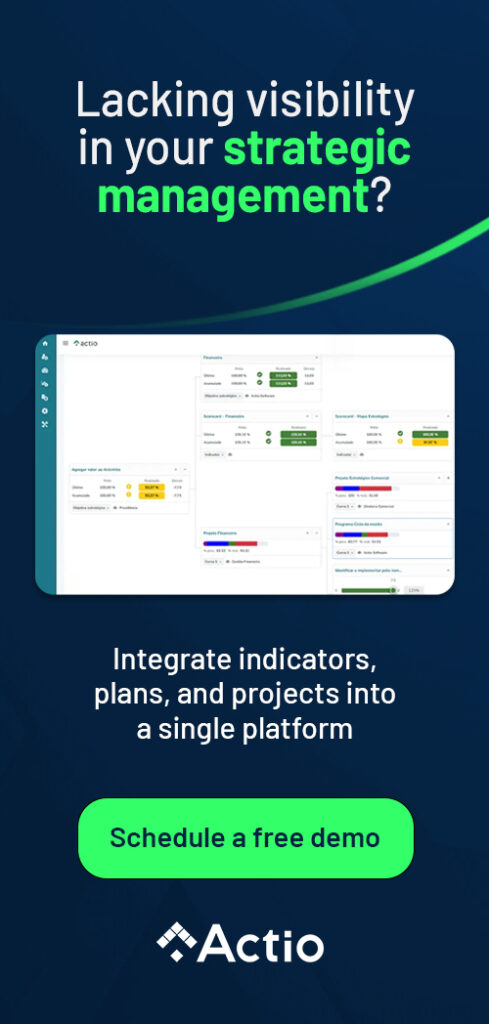
Actio’s Enterprise resource planning became a tool capable of connecting strategic objectives to operational routines.
In most companies, there is a great difficulty in maintaining constant execution. In these cases, strategy is rarely the challenge, but rather its implementation.
In recent years, increasing organizational complexity has revealed a recurring gap: companies operating with multiple systems, but without strategic integration.
In this article, we will explore how a modern system can solve this problem sustainably.
What is an enterprise resource planning (ERP) system and why has it become essential?
A business management system is a platform that integrates different management points, as a strategy, indicators, initiatives, risks, and performance in a single software, enabling aligned vision and disciplined execution.
This type of system acts as a layer of organizational strategy, promoting alignment between distinct areas and clarity in decision-making.
Kaplan and Norton, creators of the BSC, already highlighted that “The execution of the strategy depends on the ability to translate objectives into measurable actions that are continuously monitored.".
With this, the system is no longer just a Database, but operates strategically.
What is the role of an Enterprise Resource Planning (ERP) system?
When well integrated into business management, ERP becomes fundamental for consolidating data, such as financial, accounting, inventory, and purchasing. Its role is ensure operational consistency and the integrity of the records.
However, like any type of system, ERP has clear limits.
The ERP system organizes data, while business management systems execute strategies. This distinction is critical.
Where the ERP does not meet strategic pain points
In the daily operations, there are often challenges that the ERP cannot fulfill, such as:
- Goals not elaborated at all levels;
- Lack of follow-up on strategic initiatives;
- Difficulty connecting indicators to execution;
- Lack of integrated vision between areas.
It is precisely at this point that the integrated business management system has evolved beyond ERP, adding a strategic layer.
How does the system resolve execution failures
According to studies by McKinsey, cerca de 70% das transformações estratégicas de uma empresa falham, e as principais falhas são views on execution and in organizational alignment.
To illustrate, these failures focus on three central points:
Lack of integrated vision
Isolated systems, such as ERP, prevent a holistic view of organizational performance. In other words, each area operates with its own logic, which tends to generate inconsistencies.
For this failure to be eliminated, the adoption of an integrated business management system centralizes and standardizes information, creating what we call a “single source of truth".
2. Lack of disciplined execution
Another critical point is when strategies are defined but not followed up. This means that although there are goals, they are not connected to initiatives.
As former Intel CEO Andy Grove used to say, “Only the ‘crazy’ survive, and that includes relentlessly monitoring execution.”
But for your daily life to be better enjoyed, systems structure follow-up cycles, management routines, and clear accountability, so the focus is on making decisions.
3. Lack of organizational engagement
Finally, another flaw is that the system does not generate perceived value, meaning it stops being used.
A complete business management system It needs to be intuitive., integrated and decision-oriented, and ERPs function only as a record, which makes the system obsolete.
How does an enterprise management system connect strategy, operations, and people
In complex organizations, the gap between what is defined at the strategic level and what actually happens in operations remains one of the main factors of performance loss.
It is precisely at this point that the Enterprise resource planning Assume a structuring role.
The executives' question is legitimate: does this system actually improve strategy, or does it just organize data?
The answer isn't in the system's concept, but in how it's structured. Basically, it's the architecture of a good management system that determines whether it will just be a repository or if it will help in strategy execution.
Connection between strategy and execution
A robust system, created to aid in decision-making, allows for:
- Developing strategic objectives into operational goals;
- Linking Key Performance Indicators (KPIs) to initiatives;
- Continuous performance monitoring.
The main success factors in execution lie in the clarity and tracking of data, as John Doerr says, when popularizing OKRs.
Also read: Strategic planning: know what it is, how to do it, and examples
Integration with operations and data
Furthermore, an enterprise management system doesn't replace the ERP, but it connects to it, which allows for:
- Data updated automatically;
- Reduced manual effort;
- Elimination of rework.
This leaves more time to analyze each decision, as less time will be spent collecting data.
Team Engagement
Finally, another essential point that a good system has is making the strategy visible to the entire organization. This translates into:
- Clarity of priorities;
- Alignment between areas.;
- Individual accountability.
The strategy is only realized when it is internalized by people, and to achieve this, it is essential to have systems that support this logic.
Comprehensive Business Management System: Essential Features
Not all enterprise management systems consistently generate strategic value. To achieve this, they need to go beyond data organization and truly structure the way How does management happen in practice.
This requires a set of capabilities that support integration, governance, adaptation, and visibility.
Among the main criteria are:
- Real integration (not just technical) including strategic connection and integration with existing systems, to avoid work redundancies;
- Structured governance with a clear definition of responsibilities, formal approval workflows, and audit trails;
- Flexibility in the management model: with support for different approaches, adaptability to management logic, and a structure that respects the existing model;
- Real-time visibility: with executive dashboards, automatically updated indicators, and deviation alerts.
In general, a complete business management system ceases to be just a tool and begins to act as a true guide for strategic execution, promoting consistency between what is planned and what is delivered.
ROI of an Enterprise Resource Planning (ERP) system: where is the value
Return on investment analysis is, of course, one of the first concerns in the decision-making process. However, when evaluating an enterprise resource planning system, it becomes impossible to limit ROI to operational efficiency.
In other words, the return is directly linked to the organization's ability to translate strategy into results. With this, the most relevant gains are:
- Increased operational efficiency: significant reduction in time spent on manual tasks and their elimination;
- Reliability and consistency of information: integrated and automatically updated data, reduction of divergence between sources, and increased confidence in analyses;
- Decision-making quality Access to structured information and the ability to quickly identify deviations.;
- Effectiveness in strategic execution: higher rate of goal achievement and constant alignment between departments.
With this, the ROI of an enterprise management system is not limited to cost reduction, but is realized in the ability to sustain growth and ensure consistency in delivering results.
Integration and Adoption: Why an Enterprise Resource Planning System Only Generates Value When it Orchestrates and Engages
One of the most recurring doubts among executives when evaluating an enterprise resource planning (ERP) system is whether it will replace the existing solutions or another layer of complexity will be added to the technological ecosystem.
The answer, when well-structured, is clear: management systems do not replace, but integrate and potentiate.
This means that the system's role is not to replicate functionalities already provided by other platforms, but to act as an orchestration layer, connecting different information sources from a strategic perspective. In practice:
- It does not replace the ERP, which remains the transactional base;
- It does not replace BI tools responsible for advanced analysis;
- It does not replace HR systems, which manage the people dimension.
What he does is structure the relationship between these elements, creating an integrated vision that allows for the alignment of strategy, operation, and execution.
Integration by itself does not guarantee results
A frequently underestimated point is that Technology without adoption generates no value. And in this context, the challenge ceases to be technological and becomes eminently managerial.
To ensure consistent and effective use, certain factors become critical:
- Decision-oriented experience Simple, intuitive interfaces focused on what really matters to the manager.
- Connection to the organization's actual routine: o The system needs to be integrated into management rituals, not alongside them.
- Active leadership sponsorship: Senior management must use the system as a central tool for monitoring and decision-making.
- Value-oriented training More than teaching functionalities, it's necessary to demonstrate how the system improves management and results.
In this context, adoption ceases to be a natural consequence of implementation and becomes a structured component of the management model itself.
Because, in the end, the true differentiator of an enterprise management system is not just in its ability to integrate data, but in its ability to change how the organization executes strategy on a daily basis.
Business management system as a performance lever
The enterprise management system has become a strategic decision.
In a scenario where complexity is growing and decision-making speed is critical, organizations that cannot integrate strategy, operations, and people tend to lose competitiveness.
More than just organizing data, an integrated enterprise management system enables disciplined execution, structured governance and organizational alignment.
If you want to understand how to structure a strategic execution model connected to your organization's reality, it's worth delving into how modern platforms are redefining the concept of business management.
Schedule a conversation with one of our advisors.to understand how Actio's solution can help your business.