
Strategic planning is a complex process involving many factors, which can make it difficult to get a comprehensive view of all the elements involved. However, using a strategy map based on the Balanced Scorecard (BSC) can be an ideal tool to help you with this task.
With this in mind, we brainstormed this article. Read on and learn how to use the Balanced Scorecard's strategy map to identify the right objectives and connect all the pieces of the puzzle!
Enjoy the read!
What is the BS strategy map?C?
For a better understanding, it's important to refresh the concept and purpose of the Balanced Scorecard (BSC).
The BSC was developed by Robert Kaplan and David Norton, renowned professors at Harvard Business School, and since its inception it has revolutionized traditional evaluation systems by focusing above all on the financial perspective.
In creating this important analysis tool, Kaplan and Norton devised four main perspectives:
- Financial: analyzes how strategic decisions affect the company's financial performance.
- Customers: evaluates market performance and customer satisfaction.
- Internal Processes: focuses on the quality and innovation of the processes carried out by the organization.
- Learning and Growth: evaluates the internal satisfaction of employees and investment in their development.
Check out the image below to see how the BSC Strategy Map works:
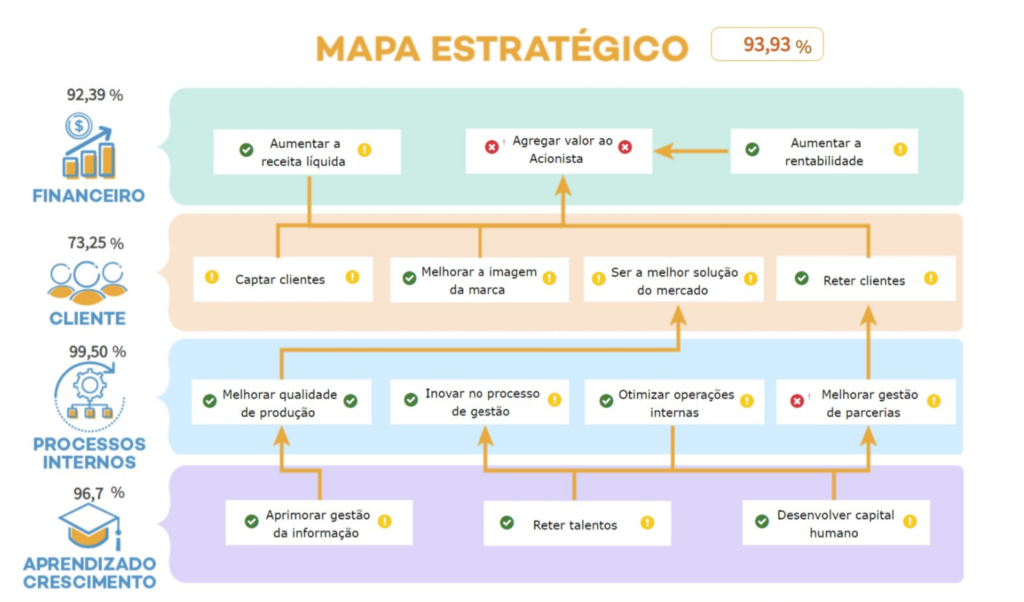
It is worth noting that the main proposal of the BSC is, above all, to assist companies in implementing their strategies, using a strategic map that structures the entire action plan based on the business's mission, vision, values, and strategic objectives. Furthermore, this map provides a visual representation that simplifies the communication of the company's planning to employees.
Also read: How to create an effective strategic plan?
But after all, what is a strategic map for in the BSC?

A strategic map is an essential tool for directing and executing plans clearly and efficiently. To help you understand better, think about the definition of the two words that form the term: “map,” which represents guidance and direction, and “strategy,” which involves planning and decisions to be made. In other words, generally, a strategic map is a visual representation that shows the path to be followed in the development of strategies.
Furthermore, this tool also plays a fundamental role in communication. Since everyone involved needs to be aware of the objectives, strategies, and how they align with the company's mission, vision, and values.
In general, a strategy map can be used for:
- Organize strategies;
- Structuring a company's action plans;
- Visualize objectives and plans clearly;
- Represent the role of each sector in the organizational objectives;
- Direct efforts in a synchronized manner;
- Present the strategic plan and measures to improve processes to everyone.
To create a strategy map, you need to use the four perspectives of the BSC. However, in order to apply them effectively, we advise you to follow a few steps.
Check it out below!
5 Essential Steps to Create an Effective BSC Strategy Map

To develop an effective strategy map, it is necessary to follow five essential steps. These steps are based on a top-down approach, which starts from a macro view to a more specific view.
Here are the steps:
Define the future vision
First, begin by establishing three essential foundations for the company: mission, vision, and values.
The mission statement should clearly describe the company's purpose and how it adds value to customers. The vision statement establishes a long-term goal that motivates employees. The values, in turn, define the characteristics and the way the company presents itself to the market to achieve the vision and fulfill objectives.
Establish strategic themes
Determine the strategic themes that summarize the broad directions the company will follow. These themes represent the company's main strategies, such as internationalization, geographical expansion, customer focus, or operational excellence.
It is recommended to work with 2 to 4 strategic themes to maintain focus and clarity.
Choose the business perspectives
Select the business perspectives that will be adopted. The Balanced Scorecard suggests four main perspectives: financial, customer, internal processes, and learning and development.
These perspectives work for private, for-profit companies, but can be adapted for other types of organizations, considering their specific needs.
Define strategic objectives
Map the strategic objectives that fall under each business perspective. Strategic objectives are drivers that demonstrate the changes the company wishes to achieve, such as logistics optimization, building a skilled team, or improving internal processes.
Additionally, it is important to distribute these strategic objectives across the relevant perspectives.
Flag the cause and effect relationships between the objectives
Finally, identify the cause-and-effect relationships between the strategic objectives. After all, often, achieving one objective is fundamental to reaching others. The BSC emphasizes that objectives associated with the lower perspectives are essential for achieving objectives in the higher perspectives.
By following these five steps, you can create your strategy map. Remember to adapt the model according to the specific activities and needs of your company, whether it's in commerce, services or any other line of business.
Additionally, it's important to use the map as a guide during the journey to execute the planned actions to achieve the indicators established. Remain committed to executing the established strategies and adjust them as necessary along the way.
With determination and focus, you will be on the path to achieving your desired success!
How to ensure the strategic map is executed?
Creating a strategy map is only half the way to success. After all, a brilliant strategy doesn't generate value if there isn't rigorous and constant monitoring. Therefore, it is essential that the map is broken down into concrete action plans for each department of the company.
Understand with the tips below:
- Review meetings (RM) Establish monthly rituals for reviewing the strategic map indicators.;
- Goal alignment Ensure that individual employee goals are connected to the roadmap objectives.;
- Transparency: The map must be accessible to everyone, so that each part of the organization understands its importance in the whole.;
- Flexibility: adjust the route whenever the market or internal results signal the need for change.
On the other hand, the biggest mistake companies make is treating the map as something static. In this regard, management needs to use tools that facilitate real-time visualization of each objective's progress.
Thus, the strategic map ceases to be a bureaucratic document and becomes the compass that guides all day-to-day decisions!
Improve your strategic management tools with a multi-methodological platform
Many companies face difficulties centralizing results due to the excessive use of spreadsheets. Furthermore, the use of different methodologies in each area can cause confusion and a lack of standardization. Therefore, it is the ideal time to consider specialized software such as Actio Strategy Management.
This complete platform Actio It centralizes all your organization's needs in one place, as it allows for both goal development and rigorous performance and results tracking. This way, you can choose from methodologies like BSC, OKR, PDCA, or ESG, adapting the system to your business model.
Therefore, with Actio Strategic Management, it's possible to boost the performance of all teams in pursuit of excellence. After all, the platform uses real data to make decisions much more secure and intelligent. Additionally, our solutions now feature official ChatGPT integration.
This new feature brings an AI-powered virtual consultant to guide your management in identifying causes. This way, we ensure more precise results and complete methodological coherence in all your internal processes. Liked the solution? Then, don't forget to follow Actio on LinkedIn and Facebook to keep up with the news!
Frequently Asked Questions about the Strategic Map in the BSC
Check out some of the most common questions on the topic below:
OBSC is the complete management methodology (indicators and goals), while the Strategic Map is the visual representation that connects the objectives of these perspectives, showing how one effort generates results in another.
The ideal is to maintain between 15 and 25 objectives distributed across the four perspectives. This is because having too many objectives can dilute the team's focus, while too few objectives can leave gaps in the execution of the strategy.
Connections show how success in one area drives another. For example, investing in Training (Learning) improves Efficiency (Processes), which increases Satisfaction (Customers) and generates more Profit (Financial).

