Strategic planning is a complex process that involves several factors, which can make it difficult to obtain a comprehensive view of the elements involved. However, the use of a strategic map based on Balanced Scorecard (BSC) is the ideal tool to transform abstract concepts into a clear and executable visual plan.
In this article, you will learn how to use the BSC strategic map to identify the right objectives, establish cause-and-effect relationships, and connect all the pieces of the organizational puzzle.
Enjoy the read!
What is the BSC strategy map?
To understand the strategic map, it is important to refresh the concept and purpose of Balanced Scorecard (BSC). Developed by Harvard professors Robert Kaplan and David Norton, the BSC revolutionized management by proving that a company's health should not be measured solely by financial indicators, but by a balanced set of perspectives.
Kaplan and Norton structured organizational analysis into four fundamental pillars:
- Financial: analyze how strategic decisions impact financial results, profitability, and return on investment (ROI);
- Customer: evaluate customer satisfaction, retention, the attraction of new audiences, and market positioning;
- Internal processes: focuses on the efficiency, quality, innovation, and productivity of internal operations;
- Learning and Growth: assesses human capital, organizational culture, team training, and technological infrastructure.
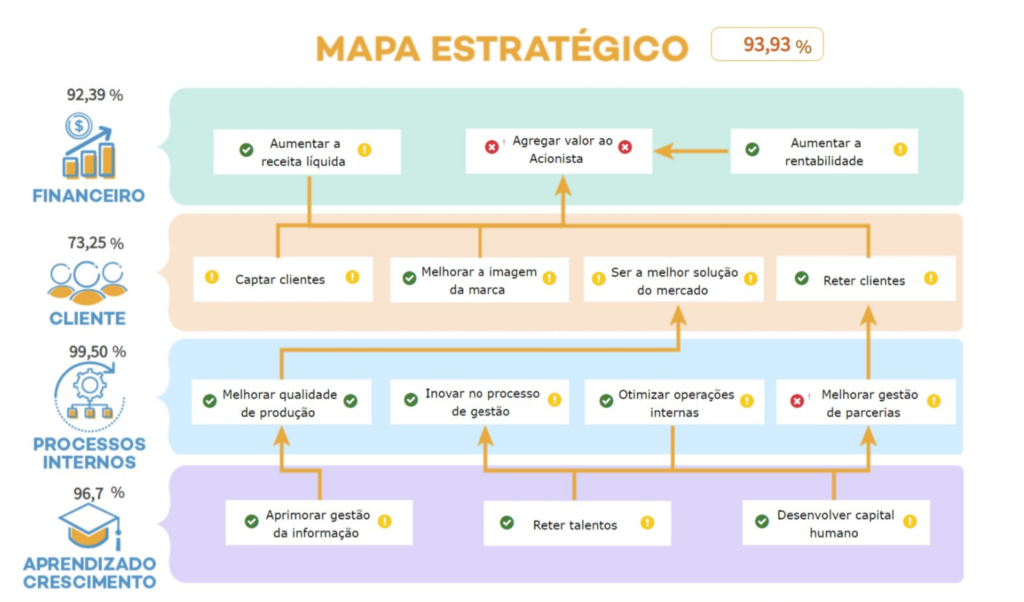
The main proposal of the strategic map is to serve as a BSC graphic representation. Therefore, it translates the business's mission, vision, and values into a simplified visual diagram, allowing all employees to understand the path to success and recognize their role in executing the strategy.
Also read: BSC or OKR
What is the purpose of a strategy map in the BSC?
A strategic map is a corporate compass. The word “map” indicates guidance and direction, while “strategy” refers to the planning of business choices. In practice, it works as an alignment tool to ensure that all areas move in the same direction.
This tool plays key roles in the company's daily routine:
- Organize priorities and eliminate initiatives that do not generate real value;
- Structure the action plans in a logical and integrated way;
- View short-, medium-, and long-term goals on a single page;
- Clearly represent the contribution of each sector to the final result;
- Facilitate internal communication and team engagement in planning.
5 Essential Steps to Create an Effective BSC Strategy Map
To create an effective strategic map, it is necessary to follow an approach top-down (from top to bottom), starting from the corporate vision of the future down to operational details.
Check the 7 essential steps to build your company's strategic map:
1. Define the future vision (Mission, Vision, and Values)
Before charting the path, the company needs to know where it is and where it wants to go. To do this, mission describe the business purpose and how it adds value today and Vision define the ambitious long-term goal.
Finally, the values establish the ethical and behavioral principles that will guide the execution of the strategy.
2. Establish the strategic themes
Strategic themes represent the major business priorities for the cycle. After all, they condense the company's focus areas, such as “Operational Excellence,” “Market Expansion,” “Customer-Centric Innovation,” or “Sustainability and ESG“.
It is recommended to work with 2 to 4 core themes to maintain clarity and avoid the dispersion of resources.
3. Select and structure the four business perspectives
Incorporate the four classic BSC perspectives (Financial, Customer, Internal Processes, and Learning/Growth). Then, organize them visually in a stacked manner, keeping Learning and Growth at the base and the Financial perspective at the top.
For third-sector organizations or public agencies, the Customers/Society perspective can be positioned at the top.
4. Define the strategic objectives for each perspective
Set clear and measurable objectives within each of the four perspectives. These objectives show what must be achieved in each pillar.
For example: “Increase EBITDA margin” (Financial), “Raise NPS” (Customers), “Reduce production cycle time” (Internal Processes) and “Train the team in agile methodologies” (Learning and Growth).
5. Indicate the cause and effect relationships between the objectives:
The great strength of the BSC lies in interconnection. Therefore, use directional arrows to show how the objectives of the lower perspectives support the objectives of the upper ones.
Logical reasoning is: if train the team (Learning), So we will optimize the processes (Internal Processes), which will generate higher customer satisfaction (Customers) and will result in revenue increase (Financial).
6. Associate indicators (KPIs) and targets with each objective
A goal without an indicator is just a wish. Therefore, for each mapped goal, define at least one Key Performance Indicator (KPI) and establish clear goals with defined deadlines.
This metric will make it possible to measure actual progress and identify deviations throughout the execution.
Related: Implementation of KPIs
7. Break down the objectives into action plans (Strategic Initiatives)
Finally, link each objective on the map to practical projects or action plans (using methodologies like 5W2H or OKRs).
Define the direct persons in charge (owners), the necessary budget, and delivery milestones to ensure that the strategic map moves from theory to practice and transforms daily operations.
How to ensure the strategic map is executed?
Drawing the strategic map is half the battle. After all, the biggest bottleneck in organizations lies in execution.
And to prevent the map from becoming a static document forgotten in a drawer, leadership must establish a continuous follow-up routine:
- Flexibility and route revision: Use the gathered data to make timely adjustments to the strategy whenever the market or internal scenarios require it.
- Strategic Analysis Meetings (SAM): conduct monthly rituals with leadership to review map indicators and evaluate the progress of action plans;
- Alignment of individual goals: connect employee performance appraisal and PPR/PLR directly to the strategic map objectives;
- Transparency and continuous communication: disseminate the strategic map on visual boards and internal channels to strengthen the high-performance culture;
Enhance your strategic management with a multi-methodological platform
Many companies struggle to consolidate their strategic maps due to the decentralized use of spreadsheets and manual reports. This lack of standardization creates communication gaps and delays the board's decision-making.
The Solution Actio Strategy Management It transforms this scenario by centralizing the entire strategic planning cycle on a 100% cloud platform. Thus, with Actio’s software, your company can structure the BSC map, break down goals by department, monitor metrics in real time, and integrate complementary methodologies, such as OKR, PDCA, and ESG matrices.
Discover the Actio Strategic Management solution and Discover how to integrate all the pieces of your planning into a single place!
Frequently Asked Questions about the Strategic Map in the BSC
Check out some of the most common questions on the topic below:
OBSC is the complete management methodology (indicators and goals), while the Strategic Map is the visual representation that connects the objectives of these perspectives, showing how one effort generates results in another.
The ideal is to maintain between 15 and 25 objectives distributed across the four perspectives. This is because having too many objectives can dilute the team's focus, while too few objectives can leave gaps in the execution of the strategy.
Connections show how success in one area drives another. For example, investing in Training (Learning) improves Efficiency (Processes), which increases Satisfaction (Customers) and generates more Profit (Financial).