The Risk Management Program (PGR) is the central pillar of occupational health and safety in modern companies. After all, far beyond a mere bureaucratic obligation, it functions as a strategic map to identify, assess, and mitigate environmental and operational risks, thus ensuring the integrity of employees and business continuity.
However, while it is a vital concept for legal compliance, the PGR still generates many doubts among managers and Human Resources professionals. And this lack of familiarity has a clear explanation: the program's consolidation gained full momentum after recent modernizations of the Regulatory Standards, such as NR 01 and NR 18.
Want to understand more about the subject? Come with Actio: we demystify the concept of PGR, its real importance for the company's financial health, and the step-by-step guide to applying it.
And we will give you some tips to achieve excellent results.
What is the Risk Management Program (RMP)?

The Risk Management Program (PGR) is a mandatory administrative tool used by companies to manage occupational safety and health at work. It was established by the modernization of Regulatory Standard No. 01 (NR 01) with the objective of centralizing all accident and occupational disease prevention actions of the organization.
In practice, the PGR is not a static report, but rather a continuous process composed of two fundamental documents:
- Risk Inventory the detailed mapping of all physical, chemical, biological, ergonomic, and accident hazards present in the company;
- Action plan: the schedule with preventive measures, responsible parties, and deadlines for mitigating or eliminating identified risks.
In other words, the program functions as the heart of occupational safety, replacing the old logic of the PPRA (focused only on environmental risks) with a much broader, integrated, and strategic hazard management.
Also read: ChatGPT as an ally in the implementation and update of the PGR
What is the importance of the PGR?
Risk management goes far beyond avoiding labor fines. After all, the implementation of the PGR is fundamental because it transforms safety into a strategic asset, reducing the accident rate and protecting the organization's greatest asset: its people.
Below is how the program directly impacts daily life and business operations:
Reduction of accidents and absences
By mapping threats in detail such as accidents with machinery, injuries from tools, or inhalation of chemical substances, the company ceases to be reactive. This is because identifying these scenarios in advance allows for the creation of specific training and action before the unforeseen occurs, drastically reducing absenteeism.
Data-driven decision making
Through a thorough and categorized assessment, management can intelligently prioritize security investments. Thus, instead of spending resources without criteria, the PGR points out which sectors or functions pose the greatest danger and require immediate attention and improvements.
Effectiveness in the use of PPE and SPI
In industrial or operational scenarios where complete risk elimination is unfeasible, the program determines the correct protection barriers. It defines the surgical use of Personal Protective Equipment (PPE), the installation of Collective Protective Equipment (CPE), and preventive maintenance schedules to neutralize threats.
Related: Risk analysis tools
Legal certainty and compliance
Keeping the PGR updated legally protects the company in cases of inspections by the Ministry of Labor and Employment (MTE). Furthermore, constant monitoring and control prevent labor liabilities and ensure that the organization operates in full compliance with current legislation.
Strengthening Safety Culture
The PGR doesn't work in isolation; it directly involves employees in the prevention process. By establishing new behavioral standards and raising the team's awareness of the risks associated with each task, the program transforms safety into a value shared by everyone.
As a result, employees actively look out for each other, reducing operational failures and creating a much more harmonious and productive work environment.
How to implement a Risk Management Program?
As we've seen, implementing the PGR is a strategic process that goes far beyond filling out reports: it requires practical actions with planning, execution, and monitoring. However, for the program to have legal validity and effectiveness, it must be developed by qualified professionals, such as Occupational Safety Engineers or Technicians.
And if your company doesn't have these specialists in-house, the ideal path is to hire a specialized consultancy in the area. Thus, when well-structured, the PGR fulfills its legal role before inspections and audits, avoiding heavy fines. But, that's not all!
Ultimately, it also functions as a productivity driver: employees who work in a safe environment produce more and better, driving the organization's overall results and sustainable growth.
Keep reading and learn the five essential steps to implement the PGR!
1 – Anticipation and identification of hazards
The first step consists of carrying out a complete scan of all company sectors. In this stage, the work safety team must list all potential sources of danger, from heavy machinery in a factory to inadequate ergonomic arrangements in offices.
Remember: anticipating problems is the key to efficient prevention.
2 – Risk Assessment and Classification
After identifying the hazards, it's time to measure the impact of each one. Next, the risks are evaluated by crossing two main variables: the probability of the event occurring and the severity of the damage it can cause to the worker's health.
This analysis generates a risk matrix, allowing for the categorization and prioritization of the most serious threats.
3 – Risk assessment and inventory development
Based on the collected and classified data, the risk inventory is consolidated. This mandatory document must contain a detailed description of the work environment, the activities performed, the profiles of exposed workers, and the specification of all hazards found.
This is the official occupational health diagnosis of the company.
4 - Construction and execution of the action plan
Based on the inventory, the company designs the Action Plan to eliminate, mitigate, or control risks. In it, each proposed measure, whether it's the installation of collective protection, specific training, or the provision of PPE, must be accompanied by a clear timeline. That is, with defined deadlines, budget, and those responsible for each execution.
5 – Continuous monitoring and cycle review
As we've already discussed, the PGR is a living and dynamic program. Therefore, the final stage consists of continuously monitoring whether the adopted measures are generating the expected effect.
Additionally, legislation requires the program to be reviewed periodically (or whenever there are changes in processes, new technologies, or accidents), ensuring continuous safety improvement.
What happens if the company does not implement the PGR?
Failing to prepare or keeping the PGR outdated exposes the organization to severe administrative, legal, and financial consequences. And since the program is a legal requirement of the NR 01, non-compliance can result in immediate penalties by the Ministry of Labor and Employment (MTE) inspection.
Among the main risks for the company are:
- Administrative fines: financial penalties applied per worker and per infraction, varying according to the degree of risk and the size of the company;
- Interdiction of sectors or machines: in cases of serious and imminent risk that are unmapped and uncontrolled, inspectors may order the suspension of activities;
- Increase in labor liabilities: greater vulnerability in compensation claims arising from work-related accidents or occupational diseases;
- Incompatibility with eSocial: Flaws in occupational health and safety (OHS) information transmitted to the government can block certificates of regular standing and lead to automatic infraction notices.
Enlist the help of risk management software to implement the RMP
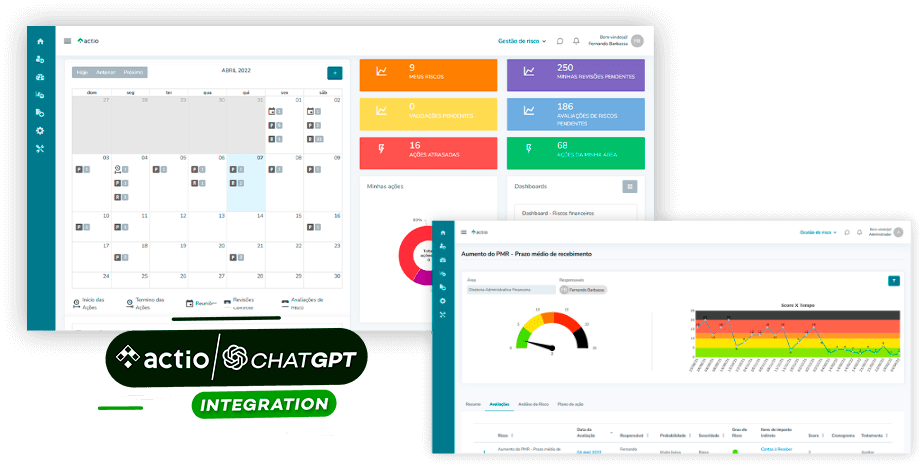
In a scenario where different areas need to work together, it is essential to have an organized approach to the Risk Management Program (PGR). And one way to do this efficiently is by using tools that track safety indicators, facilitating the company's internal operations.
The suggestion is to adopt management software that can consolidate and organize all information. This will provide important resources for the PGR to function well. Thus, with this solid foundation, the company can effectively manage risks to employee health and safety.
That's where the Actio Risk Management, risk management software. Additionally, an added advantage is that the software helps to understand the risks in each activity more precisely. This enables the creation of better plans to reduce these risks and implement controls that work.
Did you like the content? Don't forget to follow Actio on Instagram, LinkedIn and Facebook!
Frequently Asked Questions About PGR
Check out some of the most common questions on the topic below:
Almost all. After all, the PGR is mandatory for all organizations and public bodies that have employees governed by the CLT. The only exceptions are Micro-entrepreneurs (MEI), Microenterprises (ME), and Small Businesses (EPP) with risk levels 1 and 2 that do not declare exposure to physical, chemical, and biological agents in their self-declaration.
The PGR does not have a static expiration date, as it is a continuous process. However, NR 01 determines that the risk assessment must be reviewed every two years. For companies with OHS management system certifications (such as ISO 45001), this mandatory review period is extended to three years.
GRO (Occupational Risk Management) is the company's macro-strategy, meaning the culture and general risk management guidelines required by NR 01. PGR, on the other hand, is the practical embodiment of this management, specifically composed of the mandatory documents: the Risk Inventory and the Action Plan.