


Many entrepreneurs are aware of the difficulty in forming a successful team, where members collaborate to achieve goals. However, creating this team is just as, if not more, difficult than maintaining it: after all, once this achievement is reached, it becomes crucial to keep these professionals motivated, don't you agree?
In an increasingly competitive market, retaining qualified professionals requires more than just good task management; it demands a strategic culture of recognition. In this scenario, bonuses emerge as a driver of loyalty, transforming the company's success into a shared achievement.
In this article, we'll explore 5 practical bonus ideas to help you break out of the ordinary and elevate your team's engagement today. Happy reading!
What is an employee bonus?
Briefly, the performance bonus For employees, it is a form of flexible benefits intended to recognize performance that meets or exceeds established goals.
This tool stands out for its versatility, allowing management to recognize talents individually, highlighting outstanding performances, or collectively. This way, it's possible to reward synergistic effort and the collaboration of an entire team.
What is the purpose of bonuses for results?

Briefly, the central objective of performance-based bonuses is to promote the alignment of interests between the employee and the organization. Thus, by directly connecting financial gain to performance, the company transforms abstract objectives into tangible goals, encouraging an ownership mindset at all levels of operation.
In other words, more than a financial incentive, this strategy aims to:
- Foster high performance motivating the team to overcome limits and constantly seek operational efficiency;
- Recognize the merit: consolidating a culture of improvement, where intense dedication and direct impact on the company's financial success are duly valued;
- Increase retention: functioning as a powerful competitive differentiator for retaining strategic talent, who feel like partners in the business's growth.
In short, bonuses remove management from subjectivity and place it in the realm of measurable results, ensuring that the company's success is also the success of those who build it.
5 effective bonus-for-results strategies

For bonus examples to have the desired impact, they need to be seen as an investment in the company's intellectual capital. After all, the choice of the ideal model should reflect the organization's values and the team's real needs.
Check out 5 effective results-based bonus strategies to transform your recognition culture below:
1 - Award for extraordinary effort
During periods of high demand, the team's delivery often exceeds the regular workday. In these cases, offering benefits focused on well-being is a smart strategy to reward extra effort and prevent physical and mental exhaustion.
Thus, instead of purely transactional benefits, the company can invest in experiences such as paid days off, massage vouchers, or rest packages. This approach humanizes the employment relationship, demonstrating that the organization values employee well-being as much as the results delivered.
2 – Bonus for achieving goals
Another way of rewarding employees is through extra pay or prizes for reaching targets in a given period. However, this differs from commission, which is more regular and defined by sectors, such as sales and marketing.
This practice can be used to encourage employee growth within the company, according to their monthly or annual development, providing an additional approach to motivate the team.
3 – Profit Sharing
The PLR It is one of the most powerful forms of collective bonus. After all, it links a financial reward to the achievement of the organization's global goals.
Thus, by sharing a portion of the profits, the company fosters an ownership mindset, making each employee understand how their individual work directly impacts the financial health and success of the business.
4 – Course and Specialization Registration
For many talented individuals, the opportunity for intellectual growth is as valuable as financial gain. In these cases, rewarding employees by covering the costs of courses, certifications, or participation in industry events is a “win-win” strategy. After all, the employee feels valued in their career plan, while the company gains a more updated and market-ready professional.
This bonus system fosters a culture of continuous learning, raising the team's technical level and ensuring internal competencies evolve at the same pace as the organization's objectives.
5 – Bonus for creativity and innovation
This bonus rewards employees or teams who develop creative solutions to real business challenges. Whether through a new feature, cost savings, or the optimization of an internal process, rewarding intellectual proactivity transforms good ideas into strategic assets.
Ultimately, more than rewarding the final result, this strategy fosters a culture where everyone feels encouraged to question the status quo. Thus, by valuing creative potential, the company increases its competitiveness and accelerates the achievement of complex goals through previously unexplored paths.
Also read: 10 bonus ideas for employees
How to implement bonuses for results?

As we discussed above, for the implementation to be successful and not generate frustration or legal uncertainty, the process must be guided by transparency and objectivity. After all, a poorly structured bonus plan can have the opposite effect, creating a sense of injustice within the team.
Check out the fundamental steps for a strategic implementation:
1. Map the team's profile and motivations
Before defining the prize, it's crucial to understand what truly drives your team. This is because while some professionals value immediate financial incentives, others may be more impacted by flexibility or public recognition.
Aligning bonuses with employees' real expectations drastically increases the perceived value of the reward and ensures that effort is directed with genuine enthusiasm.
2. Ensure the financial sustainability of the plan
Define a clear and feasible budget so that the bonus does not compromise cash flow. The bonus should operate under a “win-win” model, where the distributed amount is financed by the surplus result generated by high performance itself.
This ensures the company's financial health and guarantees the program's long-term sustainability, preventing negative surprises for management.
3. Set goals
For the system to be perceived as fair and efficient, the goals must be specific, measurable, achievable, relevant, and time-bound (SMART methodologyAfter all, subjective or impossible-to-achieve goals are the biggest enemies of motivation, generating frustration and distrust.
Remember: the collaborator needs to see a clear path between their effort and achieving the benefit.
4. Explore strategic partnerships
You can increase the value of your program without necessarily increasing direct costs to the organization by pursuing strategic partnerships. Agreements with educational institutions, gyms, wellness platforms, or leisure services offer exclusive benefits that enrich the employee experience.
This makes the bonus package more attractive and demonstrates 360° care for the professional's life.
Communicate the rules with complete clarity.
The success of any incentive plan depends on transparent communication. Therefore, widely disseminate the rules, eligibility criteria, and calculation formulas to eliminate any noise or ambiguity.
When each team member understands exactly what is expected of them and how they will be evaluated, the organizational climate becomes safer and focused on tangible results.
6. Strictly adhere to the established deadlines
Trust is the central pillar of any performance agreement between a leader and their team. Therefore, meet payment or award delivery deadlines flawlessly.
Delays or mid-process rule changes devalue the effort delivered and can destroy leadership credibility, while punctuality validates the company's respect for the commitment made.
7. Automate management with the use of technology
Manually monitoring complex goals and calculating bonuses in spreadsheets is a slow and error-prone process that leads to demotivation. In these cases, using specialized management software, such as Lift by Actio, allows for centralizing indicators and offers the employee real-time visibility of their progress.
This transparency keeps engagement alive throughout the cycle and ensures absolute accuracy in recognition.
Why invest in result bonuses with the help of software?
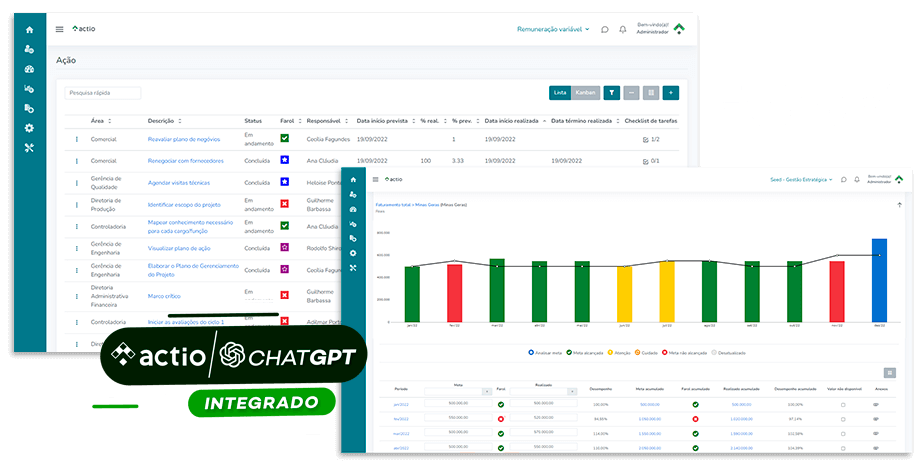
Investing in performance bonuses requires precision and transparency, and this is precisely where technology becomes indispensable. To elevate this process, Actio developed Score, the only variable compensation software approved by Falconi, the largest management consultancy in Brazil. With it, you ensure total clarity in the disclosure of goals and results, allowing each employee to track their performance and rewards in real time.
The tool is highly adaptable and automates complex calculations for commissions, ICP, profit sharing, bonuses, and ILP, eliminating manual errors and simplifying payment management. By centralizing this information, your company moves away from subjectivity and starts making decisions based on concrete data, strengthening team trust and ensuring the financial viability of the incentive plan.
Ready to transform your compensation strategy? Start professionalizing your management now and don't forget to follow Actio at Instagram, LinkedIn and Facebook!
Frequently Asked Questions about Bonuses

Check out some of the most common questions on the topic below:
The main difference is formality. After all, PLR requires an agreement with the union and is mandatory whenever there are profits and goals are met. On the other hand, a bonus is a flexible company benefit, with variable frequency and no need for prior union negotiation.
Bonuses regularly paid to workers are considered salary in nature, like “tips.” In other words, they must be included in the calculation of the thirteenth salary.
However, they do not apply to vacation time or notice periods.
Bonuses are paid independently of salary, and the rewards obtained in this context are clearly differentiated. In other words, without a predetermined limit for the value of these rewards, companies have the autonomy to establish bonus plans according to their needs and goals.