No time to read now? How about listening to the article?
Profit-sharing (PLR) is a benefit still unknown to many people, including employees who are entitled to receive it. However, for qualified and high-performance professionals, PLR can be a significant differentiator when choosing a company to work for.
According to a study by Estadão,% 67% of Brazilians prefer benefits over a higher salary. In this context, profit or results sharing stands out as one of the best ways to distribute benefits, attracting top talent and offering a competitive advantage over competitors.
In this blog, we will explain what PLR is, how it works, and its benefits. Keep reading to understand!
What is PLR, profit and results sharing?

Profit Sharing (PLR) is a type of variable compensation offered by companies as a way to reward employees for good results achieved, granting bonuses based on the company's earnings.
The PLR is based on the Federal Constitution and the Consolidation of Labor Laws (CLT), as established by Law 10.101/2000.
However, not all employees are entitled to this benefit, as its adoption depends on the company's decision. The implementation of profit sharing is optional, and it is up to the company to create a participation program if it wishes to offer this additional remuneration to employees.
It is important to highlight that Profit Sharing (PLR) does not replace an employee's regular salary, as it is a supplementary benefit. Therefore, it is an additional bonus based on the company's profits and results over a specific period.
What is the functionality of PLR?

The main function of Profit and Results Sharing (PLR) is to engage and motivate employees to achieve superior results. Although its adoption is not mandatory for companies, granting this benefit serves as an incentive for employees to strive for better performance.
Various aspects are considered when distributing bonuses to employees, such as productivity and quality metrics, business growth, revenue, feedback on service quality, and company earnings.
Regarding the frequency of PLR payments, it can vary between one or two installments, with the decision on payment frequency being the company's responsibility.
Now that we understand what PLR is and its purpose, it's important to evaluate if this practice is truly advantageous. In the next topic, we will discuss its main advantages.
What are the main advantages of this bonus?
The adoption of Profit Sharing (PLR) by companies brings several important advantages:
Incentive to meet goals Profit-sharing is directly linked to the company's results and profits, motivating employees to meet and even exceed established goals. This increases productivity and strengthens the company's goal-setting program.
Employee Motivation and Engagement Recognition and compensation for work are essential factors for motivating and engaging employees. Profit Sharing offers this recognition, which contributes to greater commitment and better results from employees. Furthermore, engaged employees tend to seek innovative solutions and improve performance.
Increased transparency: Transparency is fundamental to a company's success, both internally and externally. By adopting PLR, the company demonstrates more transparent management, which generates trust and security in its employees. This also strengthens the company's image in the market.
Sense of belonging and dedication PLR helps reinforce employees' perception of their importance in the company's processes, making them feel like an integral part of the organization. This encourages greater commitment to improving the products and services offered.
Turnover reduction With the implementation of profit sharing, employees become more engaged in their activities, which reduces employee turnover. This is beneficial for the company's financial management, as it avoids costs associated with recruiting and training new employees.
Is Profit Sharing mandatory?

Profit Sharing or Results (PLR) It is not mandatory for all companies. This is a form of bonus for workers, and its implementation depends on the existence of an express provision in the Collective Agreement or Labor Convention of the category. If such a provision exists, the company is obligated to establish the PLR program in accordance with what is established in the collective agreement or convention. It is important to note that the mandatory nature of PLR is conditioned on collective bargaining between employees and employers.
Who is entitled to PLR?
To understand who can receive Profit Sharing (PLR), it's important to understand how this remuneration is generated. There are two types of criteria for determining who is entitled to PLR:
1- Based on the company's overall results: In this case, a profit target is set that must be achieved. If the company reaches this goal, employees are entitled to receive a percentage of that profit.
2 – Based on the employee's individual performance: Here, goals are set individually. Those who meet or exceed their goals receive the corresponding profit sharing.
It is important to note that if employees do not achieve the established goals, the company may choose not to pay the profit-sharing bonus. This condition must be specified in the agreement between the company and the employees.
What is the value of PLR?
The value of profit sharing varies depending on each company. The calculation is generally based on productivity, quality, and profitability indicators, as well as goal and results programs.
Regarding the payment of the PLR (Profit Sharing Program), there is no specific date established by law. This is up to the company, but many opt to make the payment at the end of the year, after the established goals are met.
It is important to mention that if the employee receives Profit Sharing (PLR), it is not subject to the collection of labor and social charges.
Looking for variable compensation software? Get to know Actio Bonus Management!
In case of dismissal, is payment still made?
The answer is yes! In case of termination, employees are entitled to receive Profit Sharing (PLR) proportional to the time worked at the company. The company calculates the proportional amount based on the months worked, ensuring that employees are compensated according to their contribution. This measure aims to recognize the results generated by the employee during their period of employment. It is important for companies to fulfill this obligation to ensure respect for workers' rights.
But what is the difference between PLR and PPR?
The fundamental difference between Profit Sharing (PLR) and Results Sharing Program (PPR) lies in the focus of the established goals.
In PPR, the goal is to achieve objective targets defined in the company's planning, which can be related to various aspects beyond profit. In other words, PPR is not necessarily linked to the organization's profit, but rather to the strategic goals to be met.
On the other hand, in PLR, profit is the central goal. The company structures the program to provide employees with a share in the profits obtained.
Therefore, while PPR focuses on objective goals aligned with the company's planning, PLR's main focus is profit sharing. Both programs can be adopted by organizations as forms of recognition and incentive for employees, each with its specificities.
How to offer PLR?

Regardless of the organization's segment or size, it's possible to offer Profit and Results Sharing to employees. However, it's essential to develop a strategic plan to implement the bonus according to specific regulations.
Before offering the PLR, it's important to follow a few steps:
1- Define the goals for the bonus payment: Carefully analyze which goals are relevant for the company's growth and profitability. Choose challenging but achievable goals to keep employees motivated.
2- Establish a responsible commission: Define a commission composed of representatives from the company, employees, and professionals appointed by the union. This commission will be responsible for overseeing the profit-sharing plan (PLR) and ensuring its proper payment.
Clearly communicate the bonus terms: Hold meetings with collaborators and leaders to explain the PLR objectives and clarify all important points. Ensure that you understand which goals you must achieve to receive the benefit.
4. Promote internal dialogue and follow-up: Encourage dialogue between teams and rely on leaders to monitor the progress and productivity of their subordinates. This way, it will be possible to propose improvements and help employees achieve their goals.
Although PLR is not mandatory for companies, Your implementation can improve the organizational climate and contribute to talent retention. Adding PLR to the benefits program can be an excellent way to motivate employees and increase company productivity.
Why invest in PLR with a variable compensation software?
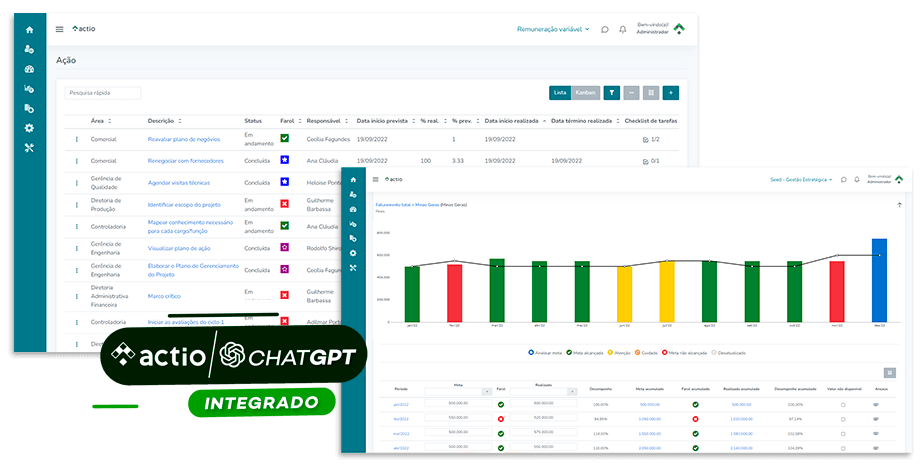
Technology can be an ally in choosing the best variable compensation for your company. Therefore, Actio developed the software Actio Bonus Management, the only variable compensation software approved by Falconi, the largest consultancy in Brazil, and which also seeks to bring transparency to the disclosure of achieved goals and employee bonuses.
With Actio Bonus Management, you will have real-time access to individual results, allowing clear visibility in the variable remuneration process. The software also calculates commissions, ICP, PLR, bonuses, ILP, and much more, adapting to your organization’s specific needs. If facing challenges in this area, consider Actio’s software to simplify the process.
Don't forget to follow Actio on Instagram, Linkedin and Facebook, to stay updated on our solutions and news.