In a McKinsey & Company survey of 54 senior executives at large companies, only one in four stated that the Sales and operations planning of your organization effectively balanced trade-offs between areas.
It’s not a matter of effort: most of these companies have already invested in tools, committees, and planning rituals. The problem is structural.
What usually is lacking is not the desire to integrate sales, operations, and finance, but a formal process that translates the commercial forecast into actual capacity while keeping this conversation anchored in the company's strategic priorities.
It is precisely this gap that sales and operations planning was designed to close, and it is about how to structure it, with discipline and executive-level governance, What is this article about?.
Most managers don't fail for lack of data. They fail because they treat sales forecasting, capacity planning, and budget allocation as three parallel exercises, conducted by different departments, on different calendars, with few real opportunities to challenge assumptions.
The invisible cost of treating Sales and Operations as separate processes
This is the first point that needs to be made clear: the disconnect between demand and capacity It rarely appears as a single line in the results. It translates into stagnant inventory, unplanned overtime, last-minute discounts to clear out excess stock, and sales promises that the operation cannot fulfill on time.
The 2024 McKinsey Global Supply Chain Leaders Survey shows that, despite progress in resilience in recent years, visibility into the deepest links in the supply chain has been declining for the second consecutive year.
When a risk only appears on the radar after the problem has already manifested itself in operations, the cost of correcting it It is always greater than the cost of prevention.
This disconnection also has a technical name and a measurement scale. Gartner has developed a five-stage maturity model to evaluate sales and operations planning processes.
And the recurring observation is that most companies do not progress beyond stages 2 or 3, the at a stage where the process is still reactive, based on spreadsheets and focused on short-term time frames, ranging from one to three months.
It is at this point that S&OP maturity evolves into what the market calls Integrated Business Planning, an additional layer that links operational processes to longer-term financial and strategic decisions.
What Is a Sales and Operations Plan?
A sales and operations plan is a monthly process, led by senior management, that aligns sales forecasts with production capacity, supply, and available cash, resulting in a single, approved business plan.
Unlike a simple forecast forum, it exists to facilitate decision-making, not just to provide visibility.
The difference between strategic planning and this more tactical process tends to confuse less experienced managers.
- The strategic sales planning defines where the company wants to grow in the coming years; markets, portfolio, price positioning.
- Sales and operations planning focuses on the following question: how to translate this ambition into an achievable monthly volume, given what the operation can deliver without compromising quality, lead time, or margin.
A good sales planning process, in isolation, forecasts how much the market should buy; a good S&OP confronts this forecast with the reality of the plant, the supplier, and the cash flow before the commitment reaches the customer.
The Three Components of Sales and Operations That Underpin a Mature Process
A recurring mistake is thinking that the process can be resolved with a well-organized monthly meeting.
In practice, the three sales and operations components that must exist, with clear owners and reliable data, are demand management, supply management, and executive reconciliation, and each fails in a different way when neglected.
Demand management: forecasting as a testable hypothesis
Sales Forecast cannot be treated as a delivered number by the commercial department and I accept it without question.
She needs to combine statistical history, market intelligence, and the sales team's qualified judgment on pipeline and seasonality and, most importantly, she needs to record her own error over time so that accuracy improves from cycle to cycle.
Supply and Capacity Management: Turning Forecasts into Actual Constraints
This is where production, logistics, supplies, and increasingly, cash availability come into play. The central question is not “how much can we sell,” but rather “how much can we deliver with the planned quality and cost, given the revised demand scenario.”.
Skipping this step is what leads to the two most costly extremes of the process: stockouts during periods of high demand and capital tied up in excess production.
Executive Mediation: Where Conflict Becomes a Decision
It is in this third component that the process shifts from being operational to becoming strategic.
Discrepancies between what sales wants to sell, what operations can produce, and what finance can support in terms of cash flow need to be brought before a forum with real authority to make decisions, rather than being resolved informally among department managers.
How higher maturity companies structure Process Governance
Academic research from Harvard Business School on cross-functional alignment in supply chain planning Bring a counterintuitive finding: cross-functional integration was achieved even in companies whose incentive structures did not explicitly reward collaboration.
The determining factor was not the organizational structure, but rather the discipline of the process itself: the cadence of the meetings, the quality of the data brought to them, and the clarity on who decides what.
According to a survey by Project Management Institute Compared with organizations in different sectors, companies with a high degree of agility achieve a project success rate of 76%, compared to 67% for companies with low agility.
A difference that is sustained, in large part, by the existence of formal review and decision-making rituals, and not just tools.
In practice, mature Sales and Operations Planning governance usually follows a monthly cadence with five steps: data and new product review, demand review, supply review, pre-executive reconciliation, and the final executive meeting, in which trade-off decisions are formally approved.
Companies that skip the pre-executive reconciliation step usually turn the executive meeting into a firefighting forum, instead of a strategic decision-making space.
| Gartner Maturity Stage | Dominant trait | Typical horizon |
| 1 — Reactive | No formal process; ad hoc decisions | Weeks |
| 2–3 — Basic to structured | Monthly process, but isolated by area | 1 to 3 months |
| 4 — Integrated | Reconciliation of Demand, Supply, and Finance | 3 to 12 months |
| 5 — IBP / predictive | Aligned with the strategy, including scenarios and simulations | 12 to 24 months |
The Link Between the Sales and Operations Plan and the Execution of Corporate Strategy
A well-designed sales and operations plan addresses the tactical horizon. But it only delivers its full value when connected to the next level: the architecture for implementing the strategy.
Kaplan and Norton describe this principle as closed-loop management (closed-loop management), a system in which strategy formulation, its translation into strategic maps and the Balanced Scorecard, operational execution, and continuous learning are, in fact, connected within a single management workflow.
When this connection does not exist, The symptom is always the same: The operation pursues monthly volume and service targets that no longer reflect the company's current strategic priorities, because the strategic planning cycle and the sales and operations planning cycle are never aligned.
Organizations that solve this problem share a structural characteristic: they link the operational governance of S&OP directly to the metrics and initiatives outlined in their strategy map, rather than maintaining two parallel monitoring systems.
Consider, for example, the case of a consumer goods company that had been operating its S&OP for years, but in isolation—led solely by the supply chain department, without structured involvement from finance or sales in trade-off decisions.
When that company redesigned the process to include regional senior leadership as the decision-makers—sponsoring the meetings and formally taking responsibility for the trade-offs—the business plan is no longer a supply chain document and it became, in fact, the company's plan.
This type of transition is precisely what distinguishes companies where sales and operations planning drives strategy from those that use it solely for inventory control.
From Planning to Execution: The Role of Technology in Supporting the Process
Organizations that maintain this level of integration over time share a common trait: they do not rely on isolated spreadsheets or meetings without a documented record.
They use a unique system in which business goals, operational metrics, the budget, and strategic initiatives are all integrated into the same governance framework, with decision traceability and automatic alerts when a goal deviates from the plan.
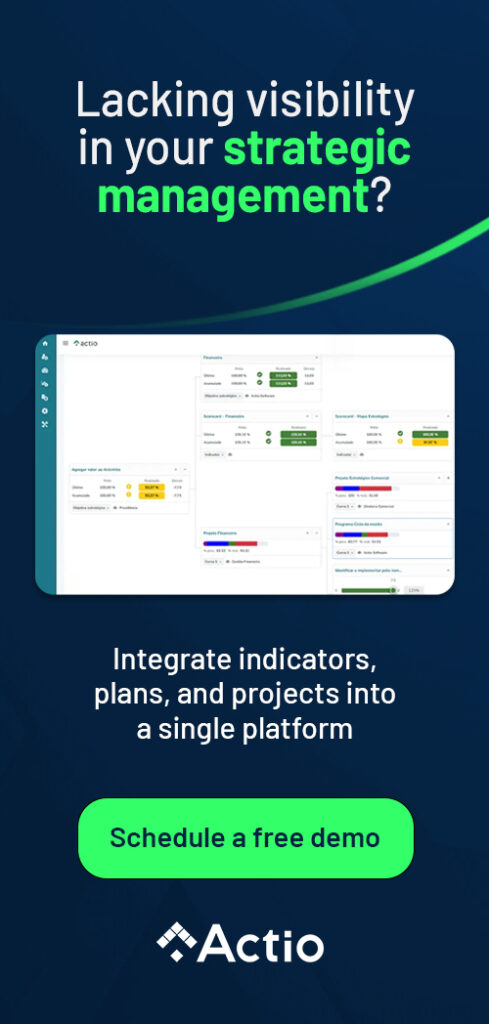
Is that the architecture that Actio's Strategic Management It was built to last.
Instead of treating S&OP, the Balanced Scorecard, OKRs, and budgeting as isolated modules, the platform links strategic planning to execution all in one place: from the strategic map to the action plan for each indicator.
This means that when the S&OP executive reconciliation approves a new sales volume, the system already reflects the impact on the capacity metrics, budget, and area targets that make up the company's strategic map, without requiring anyone to manually reconcile three spreadsheets after the meeting.
This isn't just another KPI dashboard. What really changes for executives is the nature of the conversation during performance review meetings: instead of discussing whether the numbers from each department add up, leadership discusses what to do about the variance that has already been identified, with structured and traceable action plans linked to each unachieved goal.
What is, in practice, the ultimate goal of any well-executed Sales and Operations Planning process.
One business plan, not three versions of it
Companies that mature their sales and operations planning stop having three different truths about the next quarter and start to operate with a single version of the plan, reviewed monthly and connected to the corporate strategy.
This is the gain that no standalone tool delivers on its own: it depends on process, governance, and reconciliation discipline.
The question that remains for the board is no longer “do we have an S&OP process?”, most medium and large companies already have something by that name.
The question is: does this process today connect demand, capacity, and cash flow to the company's strategy, or is it just another monthly meeting that nobody wants to cancel, but nobody knows how to explain what it decides either?
If the answer is still uncertain, it is worth it revisit how your company breaks down strategic planning into execution before trying to fix just the sales process.
To learn how Actio's Strategic Management integrates S&OP, KPIs, and budgeting into a single governance system, schedule a demo with our team by filling out the form below.