Many companies believe they provide feedback, but few do so strategically. After all, there's a gap between pointing out an error and building a path for improvement. Thus, without a strategy, feedback generates resistance instead of progress, becoming noise that harms the organizational climate and the final delivery.
And something most organizations don't know yet is that the key to turning this game around lies in the message structure. Want to know more? Join Actio and explore 10 practical models of positive and corrective feedback designed for leaders seeking to transform communication into a competitive advantage.
Enjoy the read!
What is constructive feedback?

While there are various ways to align expectations, constructive feedback stands out as a specific and strategic form of dialogue. This is because it distances itself from common criticism by replacing judgment with an action plan, focusing less on the error made and more on the strategy to overcome it. In other words, it's the moment when leadership stops merely pointing out flaws and starts suggesting real alternatives for improvement.
And for this dynamic to work, specificity is the golden rule: feedback aligned eliminate ambiguities and create space for growth. Thus, when executed well, this approach consolidates a culture of continuous learning, where operational challenges are converted into opportunities, and each employee's progress fuels the overall success of the operation.
Other feedback formats
Mastering strategic communication requires understanding that feedback is not a “one-size-fits-all” tool. After all, for every scenario, whether it's a quick course correction or a long-term career plan, there's an ideal format that determines the speed and quality of the team's delivery.
And the most effective variations for high-performance management include:
- Positive feedback: It goes beyond casual praise. It acts as strategic reinforcement of behaviors that generate results, ensuring that success is consciously replicated.;
- Corrective feedback: focused on the immediate correction of critical failures or process deviations. It is a direct intervention to prevent operational errors from becoming chronic bottlenecks;
- 360-degree performance review:offers a systemic view by cross-referencing insights from leaders, peers, and subordinates, making it the most powerful tool for identifying behavioral blind spots.;
- Continuous feedback: replace annual reviews with real-time check-ins, supporting the agility needed for dynamic markets and remote teams.
With so many options, choosing the right model depends on the employee's maturity and the urgency of the situation. Thus, while positive feedback sustains engagement, corrective and continuous formats ensure that operations maintain momentum, creating a resilient communication ecosystem.
Also read: Positive and negative feedback
Why is feedback important?
As we discussed, feedback is the main calibration mechanism between leadership's vision and operational execution. And in a highly competitive corporate landscape, it stops being a “routine conversation” and becomes a precision diagnosis. After all, without it, management navigates blindly, relying on vague perceptions instead of concrete data on performance and behavior.
Read more: How to give feedback to your managers correctly?
On the other hand, when applied strategically, feedback acts on three vital fronts for business sustainability:
- Performance optimization: provides the necessary indicators so that the employee understands exactly where their delivery adds value and where there is wasted effort;
- Psychological safety and retention: By replacing uncertainty with transparency, feedback shields the organizational culture from noise and gossip, strengthening mutual trust and reducing turnover;
- Agility in course correction: allows operational failures to be detected and resolved in real time, preventing small errors from escalating into financial or reputational crises.
Thus, constructive feedback ceases to be an isolated event and becomes the driver of a results-oriented culture. In this way, by transforming challenges into practical learning, leadership not only enhances technical skills but also establishes a standard of excellence where productivity is a direct result of strategic clarity and communication.
Also read: Indicator management software
10 examples of how to give constructive feedback to employees

Mastering feedback delivery is what differentiates managers from true strategists. And while the approach requires technique and emotional intelligence, the return on this investment translates into a more resilient, aligned, and productive team. For this, the secret lies not only in the content of the message, but in the structure of its delivery.
To transform your alignment meetings into high-impact tools, we've selected 10 practical examples of how to strategically apply constructive feedback. Check them out:
1– Be specific and objective
When providing feedback, be clear and specific about the behaviors or actions you are addressing. Avoid generalizations and focus on concrete examples.
For example, instead of saying “You need to improve your communication,” be specific: “I would like you to be clearer in your instructions during meetings.”
2 – Focus on the behavior, not the person
It's important to separate the person from the behavior. Therefore, instead of making personal criticisms, focus on observable actions or results.
This helps keep feedback constructive and prevents the other person from feeling attacked or defensive.
3 – Be constructive and positive
Feedback should be an opportunity for growth, not a scolding session. Therefore, whenever possible, highlight positive aspects and offer constructive suggestions for improvement.
For example, “You did a great job on the presentation, and I believe it could be even more impactful if you incorporated more practical examples.”
4 – Use the SBI model: Situation, Behavior, Impact
When giving feedback, follow the SBI model: describe the specific situation, the observed behavior, and the impact it had. This helps to contextualize the feedback and offer clarity on desired outcomes.
For example, “During the team meeting (situation), I noticed that you frequently interrupted your colleagues (behavior), which can make collaboration and idea exchange difficult (impact).”
5 - Make space for reactions and questions
After providing feedback, give the other person an opportunity to respond, ask questions, and share their perspectives. This action demonstrates respect and creates space for open and productive dialogue.
Remember: the most valuable feedback doesn't end with a period, but with a jointly built action plan.
6 - Keep feedback timely and relevant
Feedback is most effective when delivered immediately after the event or situation in question. In other words, avoid accumulating observations or waiting for a performance appraisal Formal.
Be proactive in providing relevant and timely feedback to maximize its impact and relevance.
7 – Offer solutions and resources
As well as identifying areas for improvement, offer suggestions and resources to help the person grow and develop.
This can include training recommendations, reading materials, or mentorship. Additionally, make yourself available to support the learning and growth process.
8 – Be empathetic and respectful
Being empathetic does not mean softening the technical message, but rather acknowledging the context and the employee's effort before addressing the areas for improvement. Therefore, when respect is the basis of the interaction, defensive resistance gives way to receptivity, allowing criticism to be processed as valuable input for growth, rather than as a personal attack.
The goal is to separate the professional from the problem: respect the individual so they have clarity and confidence in facing the operational challenge.
9 – Promote a culture of continuous feedback
Feedback loses its strategic power when treated as an isolated or annual event. This means that for it to truly shape performance, it must be integrated into the organizational culture as a natural alignment practice, reducing anxiety and increasing agility in course correction. Thus, by normalizing this exchange, you eliminate the “fear of conversation” and establish an environment of transparency where continuous improvement is the standard.
Remember: excellence isn't born from grand seasonal interventions, but from the consistency of small daily adjustments.
10 - Thank and acknowledge
Finally, don't forget to express gratitude for the evaluation you've received and acknowledge the other person's efforts to improve.
A simple “thank you for receiving my feedback and being open to improvements” can make all the difference in building positive and productive relationships.
How to structure a post-feedback action plan?
Feedback only achieves its strategic objective when the conversation turns into practical execution. Therefore, without formal follow-up, even the best alignment meeting runs the risk of being forgotten in the operational routine.
And to ensure that the diagnosis translates into real performance evolution, leadership must structure the post-feedback phase into four fundamental stages:
- Formalize the commitments (IDP): record the points discussed and define a clear Individual Development Plan (IDP), establishing what must be maintained, corrected, or developed;
- Define specific deadlines and deliverables: use objective goals to track employee progress, establishing clear dates for results review;
- Provide the necessary tools: ensure the professional has the appropriate support, training, and resources to execute the aligned improvements;
- Establish a follow-up cadence (follow-up): schedule short, periodic meetings to evaluate progress, recognize achievements, and recalibrate the course if new bottlenecks arise.
Meet Actio Individual Performance, performance management software
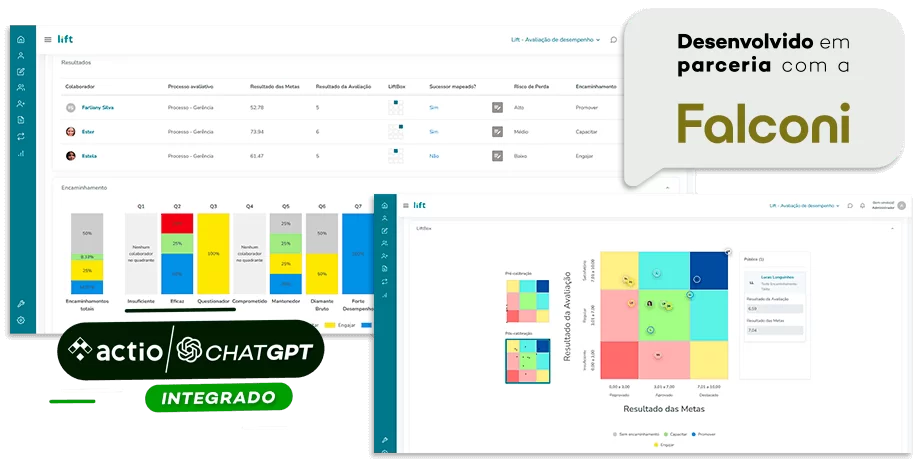
Mastering the art of feedback is just the first step in transforming your company culture. This is because for this practice to be truly scalable and strategic, it is necessary to have technologies that support talent management. It is in this scenario that Individual Performance Action, software developed in partnership with Falconi to revolutionize people management through comprehensive features such as 360-degree reviews, individual development plans (IDPs), succession maps, and fully customizable calibration processes.
Thus, by integrating the principles of constructive feedback into a high-performance tool, you go beyond just pointing out flaws. This is because the focus shifts to managing the real and strategic growth of your team.
Did you like the content? Leave your comment below and don't forget to follow Actio on Instagram., LinkedIn and Facebook to keep up with the best management strategies!
Frequently Asked Questions About Constructive Feedback
Check out some of the most common questions on the topic below:
Negative feedback should be a diagnosis focused on facts and behaviors, never on the person. Therefore, be specific when pointing out the operational deviation, show empathy, and present clear paths for correction.
The best approach is to be direct and use open-ended questions that encourage the customer to detail their experience. Offer accessible channels, such as quick surveys or email, to reduce response effort and increase the volume of insights.
Feedback is the return of information about the performance of an action or process in relation to a goal. In other words, it functions as an organizational compass, and can be positive (reinforcing what was done correctly) or corrective (adjusting what went wrong), always aiming for continuous improvement.