In a company, identifying areas for improvement and correcting flaws is fundamental for each employee to contribute to achieving better results. Among the various evaluation methodologies, 360-degree performance evaluation stands out, seeking different perspectives on an individual being evaluated.
However, like any tool, the 360 assessment has positive and negative points that need to be considered before it is implemented.
With that in mind, in this blog, we will talk more about the advantages and disadvantages of 360-degree feedback. This way, you, the reader, can assess if it can be a good option in your company's strategic management.
Continue reading to make informed decisions!
What is the 360 performance appraisal?

In a few words, the 360-degree feedback it is a strategic methodology that offers a panoramic view of the professional. After all, instead of the traditional “top-down” model, it promotes a feedback circular, integrating feedback from leaders, peers, subordinates, and the employee's own self-assessment.
The differentiator of this approach is its ability to eliminate blind spots, making the diagnosis much more impartial and accurate by crossing different perspectives. Furthermore, some organizations elevate the level of depth by also including feedback from clients and suppliers, ensuring a complete analysis of the employee's real impact on the company's entire value chain.
But after all, what's the difference between 360-degree performance appraisal and 360-degree feedback?
As we saw, 360-degree feedback is a formal process of collecting feedback from various sources to evaluate an individual's performance. To do this, it involves a comprehensive analysis of perspectives such as leaders, colleagues, subordinates, clients, and suppliers.
The 360 feedback, on the other hand, is a specific part of this process, focusing on direct communication to the individual, highlighting strengths and areas for improvement. In other words, while the 360-degree assessment collects information from multiple perspectives, the 360 feedback is the specific communication of that information to the assessed person.
Advantages of 360-degree performance appraisal

Check out the main advantages of this below evaluation model:
1- A holistic view of individual performance
The greatest strength of 360-degree feedback is its ability to offer a complete picture of the professional. This is because by combining the perceptions of leaders, peers, subordinates, and even clients, the company eliminates the subjectivity of a single viewpoint (usually just that of the manager).
This plurality of perspectives reveals blind spots, behaviors, or talents that the collaborator (or their boss) may not notice in their day-to-day work, allowing for a much fairer, more technical diagnosis based on real-life data.
2- Encouraging continuous development
By receiving feedback from diverse sources, employees have the opportunity to identify areas for improvement and promote continuous development. In this way, this action creates a learning culture within the organization, driving individual and collective growth.
3- Strengthening teamwork
Unlike vertical models, 360-degree feedback promotes a culture of open communication. This way, when employees exchange feedback with each other (and not just with their boss), a sense of co-responsibility for the team's success is created.
Furthermore, by understanding how their attitudes impact colleagues on a daily basis, professionals tend to be more collaborative and transparent. This not only improves the organizational climate but transforms feedback into a tool for mutual support, rather than punishment.
Looking for performance management software? Check out Individual Performance Action!
Disadvantages of the 360 performance appraisal

Although it is a powerful tool for human development, 360-degree feedback is not without its challenges. This is because its effectiveness depends directly on the maturity of the organizational culture and the preparedness of the people involved.
In other words, if poorly executed, what should be a growth opportunity can generate communication noise and insecurity. Below, check out the main points of attention so that the implementation does not compromise your company's climate:
1- Possible interferences in the evaluation
One of the biggest challenges of 360-degree evaluations is ensuring the impartiality of evaluators. After all, by involving a wide network of contacts, the process becomes vulnerable to cognitive biases, such as the halo effect (when a positive trait overshadows flaws) or the weight of personal affinities.
If the company culture is not mature enough, feedback can be distorted by friendships or, conversely, by interpersonal conflicts.
2- Complexity of implementation
Unlike a direct evaluation, the 360° model requires a robust infrastructure to be viable. The complexity lies not only in the data volume, as each employee receives multiple feedbacks, but also in the need for technological resources that ensure the confidentiality and organization of information.
So that the process doesn't become bureaucratic or confusing, the company must invest in a rigorous schedule and, most importantly, in the training of evaluators. Without clear communication about the steps and objectives, engagement drops and the tool loses its strategic purpose.
3- Resistance to change
The transition to a 360° model often generates discomfort, especially in more rigid or hierarchical organizational cultures. The fear of exposure or potential retaliation can lead to resistance to change, causing employees to offer superficial or overly flattering feedback to avoid conflict.
Overcoming this barrier requires more than just new forms; it requires building an environment of psychological safety. Therefore, without a genuine change in how the company views mistakes and learning, the transparency proposed by 360° evaluations can be seen as a threat, not a development tool.
How to successfully implement a 360 performance appraisal?
Now that you know the advantages and disadvantages of the 360 appraisal, it's clear that in order to avoid mistakes in the process, you need to implement the methodology correctly.
Check out the best strategies below for effectively implementing 360-degree feedback in your company:
1- Strategic Planning
No HR tool works without a clear direction. Therefore, before running the forms, it is essential to define the purpose of the evaluation. Will the focus be on individual development, identifying successors, or providing a basis for promotions?
This detailed strategic planning involves mapping participants (who evaluates whom), choosing the competencies to be measured, and, most importantly, aligning evaluation criteria with the company culture. Without this solid foundation, the collected data loses its strategic meaning and becomes just numbers without context.
2- Transparent communication
The success of 360-degree feedback depends directly on employee trust in the process. For this reason, it is essential to openly communicate the “why” and the “what for” of the methodology.
When the rules are transparent, including how anonymity will be guaranteed and how data will be used, the fear of exposure gives way to collaboration. Furthermore, well-structured communication transforms the team's perception, making everyone see the evaluation as a real opportunity for growth and self-knowledge.
3- Adequate training
The success of a 360-degree evaluation doesn't just depend on the form, but on the quality of the information that goes into it. Therefore, offering structured training for evaluators and those being evaluated is essential. The focus should be on teaching the basics of constructive feedback: how to separate facts from perceptions and how to suggest improvements without causing defensiveness.
Thus, when the team understands the mechanics of the process and learns to write feedback based on real behaviors, the tool ceases to be a “judgment” and becomes a powerful input for the IDP (Individual Development Plan). Without this training, the risk of generic or misinterpreted messages compromises the entire strategic investment.
4- Careful analysis of the results
The true value of 360° feedback lies not in its collection, but in the intelligent interpretation of the data. Careful analysis allows for the identification of behavioral patterns and performance trends that were previously hidden. In other words, more than just scores, the results should be translated into clear diagnoses of team health and organizational competencies.
From this reading, the company gains a foundation for assertive decisions, such as adjustments in training programs, promotions, and, most importantly, support for leadership.
The future of management with Actio Individual Performance
The performance appraisal 360 is a valuable tool for companies seeking a comprehensive understanding of their employees' potential. By adopting this model, organizations invest in constant growth and evolution, creating a culture that values both personal and collective development.
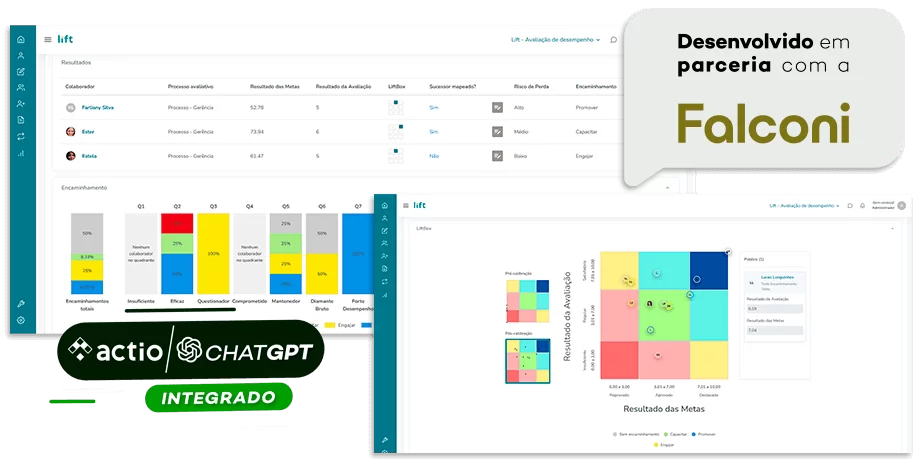
To effectively implement this strategy, the Actio and Falconi joined forces to create the Individual Performance Action, a software that is revolutionizing people management. The tool is highly adaptable to the needs of your organization and offers essential resources for the daily work of HR:
- Feedback and Ratings Calculation: Complete management of leaders, peers, subordinates, and self-assessments;
- Individual development Creation and monitoring of Individual Development Plans (IDPs);
- Management intelligence Succession mapping and calibration resources.
Ready to level up your performance management? Don't forget to follow Actio on Instagram, Linkedin and Facebook to follow more content like this!
Frequently Asked Questions about 360-Degree Performance Reviews
Check out some of the most common questions on the topic below:

Performance appraisal is crucial in organizations for a number of reasons, since it enables progress and the achievement of individual and organizational goals to be identified.
In addition, the methodology helps to develop skills and competencies, contributes to decision-making regarding promotions, training and rewards, and promotes effective communication between managers and employees.
Human resources management plays a key role in conducting performance appraisals.
As such, this sector is responsible for establishing policies and procedures for the appraisal process, training managers and employees on best practices, ensuring impartiality and consistency in appraisals, and using the results to make strategic decisions regarding staff development.
There is no single best performance appraisal model, as this depends on the specific characteristics and needs of each organization.
However, some of the most common models include evaluation by objectives, 360-degree evaluation, evaluation by competencies and the graphic scale. Therefore, the choice of model must take into account the organizational culture, the objectives of the evaluation and the nature of the functions performed by the employees.