
Discovering something is wrong in your company only when profits fall is like trying to put out a fire that has already consumed half the building. And the market doesn't forgive reactive management: today, success depends on anticipating bottlenecks and understanding what's happening day-to-day, before losses hit the bottom line. That's why performance evaluation has ceased to be a bureaucratic HR task and has become a strategic radar.
In practice, this tool functions as a live diagnosis of your team. To do this, it replaces “I think” with concrete data, revealing who is overworked, who has leadership potential, and where the flaws lie. Therefore, when you truly understand each employee's performance, you can create career plans that genuinely motivate and retain talent, transforming the work environment into a high-performance engine.
But it's not enough to just “grade” employees: the secret is in choosing the methodology that best fits your business culture. And whether through a 360° feedback or a self-assessment, the right model is one that generates dialogue and continuous improvement.
Want to know how to put this strategy into practice? Let's explore how to apply performance evaluation and which models will take your management to the next level!
What is a performance review?

The idea of measuring performance was born in the early 20th century with Frederick Taylor, but at that time the focus was purely mechanical: extracting maximum productivity. And it was only from the 1950s onwards, with the advancement of People Management, that performance appraisal evolved. After all, it ceased to be a mere task inspection and became a strategic process focused on human development and alignment of expectations.
Today, this practice consists of a structured procedure to analyze how employee contributions connect to company goals and culture. Therefore, far beyond “giving a grade,” modern appraisal functions as a diagnosis of technical and behavioral skills.
It is through this analysis that HR identifies talent and corrects flaws, ensuring that each professional's growth actually drives collective results.
What are the goals of performance appraisal?
The main purpose of performance appraisal is to transform employee potential into real results through three pillars: development, improvement, and innovation. Thus, when these objectives move from theory to practice, they become clear goals that guide the professional and ensure the company does not stagnate.
And for these goals to work, they are divided into strategic fronts:
- Innovation focused on creating new solutions and methods that increase productivity and keep the company relevant in the market;
- Development: the gaze turns to talent development, honing skills so that it reaches its maximum potential;
- Improvement essential for adjusting routes when results fall below expectations, allowing HR to monitor progress and quickly correct failures.
But that's not all! This is because for these goals not to remain just on paper, each objective needs to be designed under the SMART methodology.
This ensures that they are:
- Specific and measurable detailed and quantifiable;
- Attainable and relevant: challenging, but realistic, and aligned with business objectives;
- Temporary with clear deadlines for them to happen.
This structure eliminates ambiguity and ensures that both the leader and the subordinate are aligned, promoting a culture of transparency and high performance.
The 10 main types of performance appraisal

Now that you understand the strategic importance of this tool, the next step is to choose the ideal model for your organizational culture. But remember: there is no one-size-fits-all solution; each methodology offers a different perspective on talent and productivity.
Here are the most effective methods to diagnose your team's performance and boost your results:
1 – 360-degree evaluation
The 360-degree feedback involves various stakeholders, including leaders, colleagues, subordinates, clients, and suppliers.
Furthermore, this balanced approach reduces personal biases and provides a comprehensive view of an employee's performance.
2 - Self-assessment
In this model, the employee themselves analyzes their deliverables and behaviors based on company criteria. For this reason, it is a powerful tool for stimulating self-awareness and responsibility for one's own career.
Furthermore, by actively participating in the process, the employee brings their perspective to the table, which enriches the final feedback and makes the development plan much more assertive and collaborative.
3 – Critical Incident Evaluation
This method focuses on recording extreme behaviors, documenting situations where an employee performed exceptionally well or poorly. Thus, instead of generic ratings, the focus is on real facts and specific events.
This approach requires continuous leadership follow-up, but it offers valuable insights for evidence-based feedback. This way, it facilitates the correction of shortcomings and the recognition of successes.
4 – Evaluation by immediate supervisor
The evaluation carried out by the immediate supervisor is a traditional method, where the direct manager assesses the employee's performance. Therefore, it is particularly effective because the evaluator has close involvement with the employee's daily activities.
This helps to ensure regular evaluation criteria and facilitates communication between the evaluator and the evaluated.
5 – Competency-based evaluation
This model goes beyond deliveries and focuses on “how” work is done. In it, the leader analyzes the balance between the hard skills (technical knowledge) and the soft skills (behavior and attitude) required for each role.
Here, therefore, the great advantage is personalization. By identifying exactly which skills the employee is lacking, HR can create custom training, transforming weaknesses into competitive advantages.
Also read: Positive and negative feedback
6 – Management by Objectives
In this method, the focus shifts from the process to the result. The leader and the led collaborate to define the goals that must be achieved within a specific period.
The differentiator here is commitment: as the employee actively participates in creating their own goals, they feel more ownership of the process. For this reason, it's the ideal model for companies seeking high performance and clarity in deliverables.
7 – Team Performance Evaluation
Unlike the individual focus, this method puts the collective under the microscope. After all, the goal is to understand how the team functions as a single organism, analyzing how collaboration, communication, and division of tasks impact group efficiency.
By identifying the strengths and weaknesses of the group, the company can eliminate internal noise and strengthen synergy among members. It is the ideal choice for transforming workgroups into high-performance teams.
8 – Direct or 90-degree evaluation
This is one of the most objective models, where the power of analysis is concentrated in the immediate manager. And by following the team's daily routine and challenges, the leader has the necessary ownership to accurately identify the strengths and weaknesses of each subordinate.
The big advantage here is agility. After all, since the evaluator knows the daily routines and technical deliveries well, the feedback is usually direct and focused on immediate improvements in operations.
9 – Joint or 180-degree evaluation
In this model, the process ceases to be a “sentence” handed down by the boss and becomes a dialogue. In it, manager and employee sit down together to analyze performance, discussing successes and establishing next steps collaboratively.
This approach is excellent for promoting transparency and mutual trust. However, for it to work, it requires maturity: both sides need to be open to frank exchanges and communication without barriers.
10 – Employee Satisfaction
This review inverts the traditional perspective: instead of looking solely at delivery, it analyzes organizational climate and team well-being. Thus, through questionnaires and feedback, the company identifies how the work environment and interpersonal relationships influence individual performance.
It is an essential tool for detecting weaknesses before they become serious problems, such as high turnover. This way, by ensuring the team is satisfied and engaged, productivity grows naturally and sustainably.
Which performance appraisal model should I choose?
To choose the ideal model, you should first look at your company's DNA and your team's current stage. In other words, if the goal is speed and technical accuracy within a more traditional structure, the 90-Day Review effectively resolves the situation. However, if the intention is to build a culture of autonomy and innovation, models like Objective-Based Reviews or the 180-Degree Review are more powerful, as they place the employee as the protagonist of their own growth.
The secret, therefore, is not to look for a magic formula, but rather for the tool that best “communicates” with your strategy.
Remember: the secret to success lies in the balance between the clarity of SMART goals and the sensitivity of satisfaction surveys. And this combination creates a complete diagnosis that, in addition to measuring results, safeguards the organizational climate and transforms talent into high performance!
How to Implement Performance Reviews in Your Company in 5 Steps
As we've seen, implementing an evaluation cycle doesn't have to be a bureaucratic challenge, but rather a strategic growth journey. However, for the process to generate real results and engagement, it's necessary to follow a roadmap that ensures clarity, fairness, and a focus on development.
Check out the 5 essential steps to get your performance appraisal from paper and transform it into a high-performance tool for your business:
1 – Defining clear objectives
The first step to a successful implementation is to establish clear objectives that are in total alignment with the organization's culture and strategic goals. After all, by defining what is expected to be measured, the company creates a direction that guides team behavior and ensures everyone knows exactly what results need to be achieved.
More than just a control metric, these objectives should serve as the engine for each member's professional growth. Thus, based on what has been defined, it is possible to structure personalized Individual Development Plans (IDPs), transforming the evaluation into a practical tool.
2 – Process Planning
The process planning defines the pace and depth of the analysis, and must always respect the organization's internal time and culture. It is at this moment that the frequency of rounds and which approach will be used are decided, ensuring that the evaluation cycle is not just an isolated event, but a continuous practice integrated into the daily routine.
At this stage, it is crucial to define who will be involved, which may include managers, colleagues, and even clients for a broader perspective.
3 – Identifying Competencies
For the evaluation to be fair, it is essential to map the technical and behavioral competencies of each position. Involving managers and employees in this process ensures that the criteria reflect the real daily challenges and the needs of each area.
Although certain skills are universal, they must be adapted to the organization's values and culture. This is because it is this alignment that creates a standard of excellence that guides development and serves as a benchmark for measuring the success of each talent within the company.
4 – Analysis and Development Strategies
With the data in hand, the focus should be on strategic monitoring. Here, the use of visual tools and analysis platforms facilitates the interpretation of information, allowing managers to identify performance patterns and operational bottlenecks.
Based on this diagnosis, the next step is to structure the Individual Development Plan (IDP), establishing training programs and continuous improvement goals. Remember: it is essential to track this progress over time, comparing successive cycles to measure the real evolution of each employee and the success of the strategies.
5 – Awareness and Engagement
Finally, so that performance reviews are not seen as a burden, it is vital to communicate their strategic importance for everyone's growth. To this end, organize meetings, send communications, and use explanatory content, such as videos, to make it clear that the process is an opportunity for development, not punishment.
Remember: transparency is what sustains engagement. Therefore, also provide open channels for employees to ask questions and send suggestions.
When the team understands the rules of the game and realizes that their voice is heard, adherence becomes natural!
Most common errors in performance evaluation (and how to avoid them)
Implementing a performance evaluation without proper planning and follow-up can compromise the process's credibility, affect the organizational climate, and lead to team disengagement. To ensure that this tool fulfills its strategic and development role, check out the most common mistakes companies make and how to avoid them:
- Recency effect (or recent memory): Occurs when the evaluator only considers the most recent events, whether successes or failures, ignoring the entire history of the employee during the evaluated cycle. To avoid this bias, leadership must maintain continuous monitoring and document relevant episodes throughout the year;
- Focus exclusively on weak points: Turning the feedback meeting into a list of criticisms or accusations disengages the professional and creates a defensive culture. The dialogue needs to be balanced and constructive, recognizing the successes and value delivery while providing clear direction and support for the development of the identified gaps;
- Lack of clarity in the evaluation criteria: When indicators are subjective, generic, or out of alignment with the routine of the job, the employee does not understand the reason for their score. To prevent this failure, establish transparent, measurable goals aligned with the technical and behavioral competencies required for each function;
- Absence of follow-up after the evaluation: To perform the diagnosis, but not to create one Individual Development Plan (PDI) or failing to follow the established goals turns the cycle into a mere bureaucratic obligation. Evaluation only generates real impact on operations when accompanied by practical plans of action and periodic alignment meetings;
- Manual and decentralized management in spreadsheets: Monitoring team performance in isolated files leads to data loss, discrepancies in criteria, and workload overload for the Human Resources team. Automation with dedicated software simplifies feedback collection, standardizes metrics, and provides reliable real-time reports.
Elevate your business with performance management software
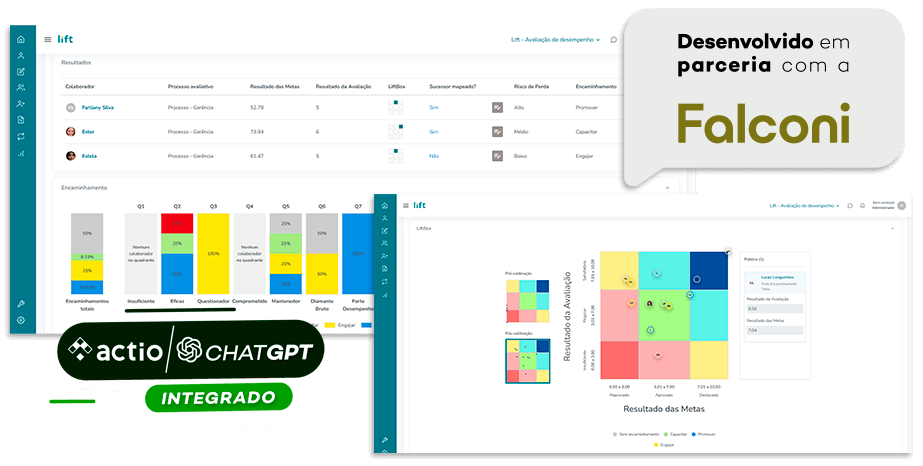
In a world where managing people is increasingly consolidating itself as a strategic area in the life of companies, Performance Management takes on an essential role in supporting the affirmation and growth of the field.
With this in mind Actio in partnership with the Falconi, developed the Individual Performance Action, a software that arrives to assist in Performance Management. The tool also calculates feedback, evaluations: leader, peers, self-assessment and subordinate, IDP, calibration, succession map, and much more, adapting to the specific needs of the organization. For this reason, if you are facing challenges in these areas, consider Actio's software to simplify the process.
Did you like the content? Be sure to follow Actio on Instagram., LinkedIn and Facebook, to stay updated on our solutions and news!
Frequently asked questions about performance appraisals
Check out some of the most common questions on the topic below:
There isn't a single rule, but the market has been moving from an annual model to shorter cycles, such as semi-annual or quarterly. The most important thing is that the frequency allows for real monitoring of the employee's development, ensuring that feedback isn't too late for corrections.
Feedback is a continuous practice of guidance that should happen daily. Performance appraisal, on the other hand, is a structured process with a set date and formal criteria, which analyzes a specific period to inform strategic decisions, such as promotions or training plans (IDP).
The secret lies in the IDP (Individual Development Plan). Thus, after analyzing the data, leaders and their teams should define practical actions, such as courses, mentoring, or new responsibilities, with determined deadlines.
Without an action plan, evaluation risks becoming just a document filed away in a drawer.