The biggest bottleneck for most companies lies not in the lack of plans, but in the inability to execute them. Therefore, it's very common to see leadership design brilliant annual goals that end up forgotten in a slide, simply because the day-to-day operations have no idea how their work connects to those macro objectives.
To correct this lack of synchronization, large organizations turn to Management by Guidelines (MBG), a methodology known as Hoshin Kanri and popularized in Brazil by Professor Vicente Falconi. But what is this method, and how can it be applied?
Keep reading this article to fully understand how GPD works, what its steps are, and how you can use this framework!
What, in the end, is Management by Objectives?
To understand GPD, it's necessary to understand that a directive only exists when it combines two inseparable elements: a goal and um action plan. And the method is based on the principle that setting a goal without outlining its execution process is just a wish, not management.
This means, in practice, the GPD functions as a deployment gear that connects strategy to daily operations through:
- Annual guidelines: the main priorities and challenges defined by the presidency and the board for the fiscal year;
- Unfolded goals: the mathematical and logical division of these large goals among area directors, managers, and supervisors;
- Action Plans (Method): Detailed mapping of the causes preventing the achievement of results and the definition of corrective actions in routine.
What is the objective of Management by Objectives?
The central objective of Management by Objectives is to ensure Strategy executability. In other words, in practical terms, the method serves to close the gap between what management plans and what operations execute, transforming global goals into individual responsibilities and smaller goals.
However, for this development to move from concept to routine, the GPD uses an ecosystem of established management tools:
- Cycle PDCA (Plan-Do-Check-Act): the GPD engine, used for planning goals, executing actions, checking deviations, and acting correctively;
- 5W2H Matrix: practical action plans that clearly define what will be done, why, by whom, where, when, how, and how much it will cost;
- Performance Indicators and Dashboards centralized metrics for real-time monitoring of the evolution of each department's results;
- SWOT analysis used in the embryonic phase of the process to map the strengths, weaknesses, opportunities, and threats that will underpin the choice of the year's guidelines.
Advantages of Management by Objectives

The benefits of Management by Guidelines go far beyond the simple organization of goals. After all, the real impact of the methodology is felt in the company's operational maturity, which begins to work based on predictability, data, and absolute focus on efficiency.
Thus, by creating a culture where every error is treated as a process deviation to be corrected, the organization gains consistent advantages:
- Operational stability and error shielding The GPD brings stability because it replaces “firefighting” with a structured and systematic approach to problem-solving. Thus, through check-in routines, the company learns to identify the root cause of failures, creating patterns that prevent the repetition of the same errors.;
- Maximum efficiency and waste elimination Efficiency in GPD happens organically and mathematically. As the method requires each action to be justified by a clear goal, investments without return and resource waste are drastically mitigated.;
- End rework through standardization: With the use of the PDCA cycle and clear action plans, teams know exactly what to do and how to do it. This eliminates guesswork in daily task execution, drastically reducing rework rates.;
- Cultural alignment and fair meritocracy: Because the goals are clearly broken down and the indicators are transparent, each employee perfectly understands what their deliverable is and how it impacts the whole.
Also read: Project management indicators
The two Management by Guidelines systems
In order to facilitate the implementation of the method at the different management levels, the GPD introduces two management systems:
1- Cross-functional management
The primary focus of this system is to anticipate the company's future. To achieve this, it maintains a direct connection with senior management, taking responsibility for the deployment of corporate guidelines and their distribution among the various departments.
In addition, cross-functional management aims to strategically align the organization's actions to meet long-term objectives.
2 - Functional Management
Aimed at continuous improvement and the maintenance of organizational routines, functional management is directly linked to the administration and quality control of the company's daily activities.
Thus, its emphasis is on operational efficiency, seeking to constantly improve routine processes and ensure consistency in day-to-day operations.
These two complementary GPD systems work together to provide a comprehensive approach.
How to implement Management by Objectives in 3 steps?
The application of GPD should not be seen as a one-time event, but rather as a cyclical and living governance process. After all, the methodology functions as a gear that transforms ambitious business goals into predictable and transparent routines for everyone involved.
And to bring this structure to life without complications, the implementation can be summarized in three major macro steps.
1. Strategic goal deploymentTop-Down)
The first step consists of slicing the large annual objectives defined by the leadership ecosystem. Thus, the presidency establishes the macro guidelines and, from there, each directorate, management, and supervision receives a mathematical “slice” of this challenge.
The objective here is to ensure vertical alignment: when all operational levels meet their specific goals, the company's overall goal is achieved as a consequence.
2. Development of action plans with a focus on the method
A goal without an action plan is just a wish. Therefore, in the second step, each manager and their respective team should meet to design the “how.”.
Using tools like the 5W2H matrix, the team maps the causes of current problems and establishes clear initiatives, deadlines, and responsibilities. It is in this phase that the strategy gains traction and transforms into practical day-to-day operational tasks.
3. Continuous Review Rituals and PDCA Application
The GPD only survives with discipline and daily monitoring. Therefore, the third step requires the creation of a strict routine of periodic reviews to analyze facts, data, and results.
This is where the PDCA cyclePlan-Do-Check-Act) works transparently: teams check deviations between the planned and the actual and take corrective action immediately. This culture of constant checking ensures continuous improvement and prevents problems from being forgotten.
Related: Work results
Meet Actio Strategic Management, strategic management software
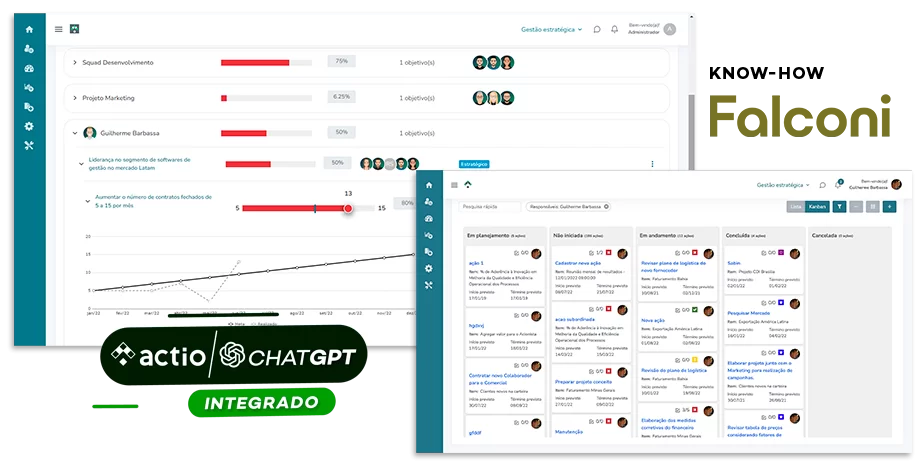
As we have seen, Management by Guidelines (MBG) is a management methodology that provides a variety of benefits for organizations that choose to adopt it. Furthermore, by establishing clear goals aligned with strategic objectives, MBG plays a fundamental role in improving business performance.
Using the right technology for your management processes is essential to be effective. And that is where the Actio Strategic Managementsoftware to manage MBO in your company; with it, you ensure total control of all information, goals, and actions.
It is worth noting that Actio is part of the Falconi Group, a benchmark for business excellence. In other words, with a renowned multi-methodology solution on a single platform, you ensure total integration between the various areas of your organization.
Don't forget to follow Actio on Instagram, LinkedIn and Facebook!
Frequently Asked Questions about Management by Objectives
Check out some of the most common questions on the topic below:
Although both focus on goal alignment, GPD (Hoshin Kanri) has a more vertical (top-down) structure, focused on cascading goals from the presidency down to operations based on rigid, long-term processes (typically annual cycles). OKRs, on the other hand, are more agile and flexible, combining vertical and horizontal goals in short, quarterly cycles, and are very common in innovative environments.
PDCA is the engine that powers the GPD. In the GPD, guidelines and goals are established in the Planning (P) phase; action plans are executed daily (D); results are measured and compared with goals in the Checking (C) phase; and corrective actions are taken (A) whenever a deviation or problem is identified.
Yes. Although it became famous in large corporations and industries, the foundation of GPD works for businesses of any size.
In SMEs, the process is usually even faster, requiring fewer levels of rollout.