Retaining talent in today's market requires much more than a fixed amount at the end of the month. And while salary is the foundation, what truly unlocks engagement and motivation is how the company recognizes each employee's effort. After all, a high-performing team doesn't happen by chance: it's shaped by a smart reward strategy.
Modern compensation functions like an ecosystem. It blends benefits, incentives, and flexibility to meet the expectations of different professional profiles. And when a company understands this dynamic, it stops merely “paying bills” and starts building a value proposition. But do you know which compensation models truly make sense for your business model?
In this article, we'll dive into the main options on the market and show you how to apply them to generate lasting results and an unbeatable organizational climate. Grab your pen and paper (or notepad) and happy reading!
So, what is remuneration?

Often confused with salary, compensation is actually a much broader concept. After all, it represents the sum of all amounts an employee receives in return for their work. This includes base salary, but goes beyond it, incorporating variables such as commissions, overtime, bonuses (night shift, hazard, or unhealthy conditions), and other stipulated benefits.
In other words, in practical terms, compensation is the professional's “total package” of earnings. It is important to highlight that the structure of this payment can vary significantly depending on the hiring model. Therefore, some professionals are paid by production or task, while others follow the standard monthly workload.
Regardless of the format, clarity in the employment contract is the greatest guarantee for both parties. Thus, when all bonuses are well documented, the relationship between company and employee becomes much more transparent and secure.
What is the difference between salary and compensation?

Although used interchangeably in everyday conversation, salary and remuneration have very different roles in payroll. Salary is that fixed and predictable portion, agreed upon in a contract and paid regularly (usually every month). That is, it is the basis of everything, but it doesn't tell the whole story on its own.
Remuneration, on the other hand, is the complete picture. It represents the sum of the base salary plus everything the employee receives in exchange for their effort. Therefore, commissions, overtime, hazard pay, bonuses, and even the 3- Profit-sharing. In other words: salary is a part; compensation is the whole.
And mastering this difference is not just an HR issue, but one of transparency. After all, when the company and the employee understand these concepts, the relationship becomes more secure, avoiding misunderstandings about rights, obligations, and the real value of the benefits package offered.
Also read: Errors when implementing bonuses for employees
What are the components of compensation types?
As we saw, compensation is not a single block of money, but rather a set of layers that, when added together, form the real value that the professional delivers and receives. That is, it functions as an ecosystem of earnings: while some components are guaranteed by law, others are used by the company as strategic tools.
And understanding what makes up this structure is essential to seeing the full value of the work proposal. Check it out:
- Base salary: is the fixed value agreed upon between the employer and the employee, which corresponds to the basic remuneration for work performed;
- Overtime additional compensation paid to an employee when they work beyond the established regular working hours, in compliance with labor legislation;
- Thirteenth salary also known as “Christmas bonus,” it corresponds to an extra payment equivalent to a base salary;
- Vacation paid leave granted to an employee after one year of work, plus one-third of the base salary;
- Commissions Additional value granted to an employee based on their sales or achieved targets, common in positions involving sales and commission;
- Profit sharing: benefit that allows employees to receive a portion of the profits earned by the company in a given period;
- Add-ons are additional amounts paid to the employee, such as night shift differential (for those who work at night), hazard pay (for risky activities), and unhealthy work pay (for work with exposure to health hazards);
- Paid weekly rest It is the value referring to the worker's weekly day off, guaranteed by law, and which must be paid.
However, that's not all. It's important to note that there may be other benefits, such as meal vouchers, transportation vouchers, health insurance, among others, which can vary from company to company.
Main types of compensation
There isn't a single formula for rewarding talent. Therefore, the choice of the ideal model depends directly on the company culture, the sector of operation, and the objectives to be achieved. During the hiring process, understanding these variations is what allows HR to put together a proposal that is both attractive to the candidate and sustainable for the business.
To help you identify which strategy best suits your reality, we've listed the six most commonly used types of compensation in today's market below:
1 – Variable compensation
This model is a great driver for teams working with goals, such as sales and expansion teams. This is because it combines the security of a fixed salary with the incentive of variable earnings, which fluctuate according to individual or collective performance. And, for this reason, when well-structured, this strategy creates an environment of meritocracy, where direct effort translates into immediate financial reward.
For the company, the big advantage of Bonus it's cost predictability in relation to revenue: you pay more when the result appears. For the employee, on the other hand, it acts as a constant challenge that prevents stagnation.
2 – Skills-based compensation
Unlike traditional models, the focus here is not just on what the employee does, but how they do it. Therefore, here, the company evaluates the set of knowledge, attitudes, and deliverables that the professional offers to the business.
This format encourages continuous self-development, as the employee realizes that their professional growth directly reflects in their earnings. Thus, by adopting this model, the organization can better map its internal talents and ensure that the right people are in the most strategic positions, being compensated for their real value delivery.
3 - Functional compensation
This is the classic job and salary plan, where pay is determined by the position held within the organizational hierarchy. It's a model that brings a lot of transparency and legal certainty, as it establishes clear salary ranges for each level of responsibility. Therefore, it serves as the backbone for many solid companies, allowing for more rigid and predictable cost management.
Furthermore, the great strength of functional compensation becomes apparent when it is accompanied by a well-designed career plan. After all, when an employee sees exactly what they need to do to move up and increase their income, they tend to remain loyal to the organization for longer.
4 – Skills-based pay
In this model, what counts are the tools the professional brings in their baggage, such as technical certifications, language proficiency, or academic specializations. Therefore, it is common in technical sectors where specific qualifications can save processes or accelerate projects. The differentiator is that the employee can be rewarded for extra knowledge, even if they continue to perform the same role as their colleagues.
This creates a direct incentive for continuing education. And for the company, the benefit is having a team that is increasingly specialized and up-to-date with best market practices.
5 – Indirect Salary
Indirect salary is the set of benefits that complement nominal income, focusing on the employee's quality of life and well-being. And, here, items such as top-tier health plans, flexible vouchers, and educational assistance often weigh more heavily than cash.
For companies, indirect salary is a powerful employer branding tool. After all, besides offering tax advantages in some cases, these benefits demonstrate care and empathy with the employee's journey.
Related: Employee bonuses
6 – Commissions and bonuses
Although they walk together, these two elements fulfill distinct functions in engagement. This is because commissions are already foreseen percentage payments, generally tied to sales volume or contract closings. Awards, on the other hand, are punctual and extraordinary bonuses, granted when performance exceeds all expectations or when a critical project is delivered with excellence.
This combination keeps the team focused on the day-to-day, but always with an eye on the opportunity to achieve something extraordinary.
7 – Profit and Results Sharing (PLR)
The PLR it is one of the most effective strategies for aligning employee interests with shareholder objectives. After all, by sharing a portion of the net profit or the achievement of global goals, the company transforms the employee into a business partner. Thus, this model stimulates a systemic vision: the employee begins to care not only about their own role but about the financial health of the entire organization.
However, that's not all: in addition to motivational impact, PLR offers tax advantages for both the company and the employee, as it does not have a direct salary nature. It's a win-win model: in prosperous years, everyone celebrates the fruits; in challenging years, the team unites to recover profitability.
How to choose the right type of compensation for your company?

Defining a payment strategy is not purely an administrative task: it's a decision that shapes the company's culture. And to avoid making the wrong choice, the ideal approach is to follow a roadmap that balances the business's financial health with the team's expectations.
Read more: How to have a strategic compensation program?
Check out the essential steps to make this decision:
- Analyze the measurement of results: Before adopting variable models, ensure the company can measure performance fairly. Remember: if there are no clear metrics, incentives can turn into frustration.;
- Review the job and salary plan: Ensure that the new model does not create salary gaps between people performing the same function. Internal balance is key to avoiding conflicts and labor lawsuits.;
- Think about your Employer Branding: How do you want to be seen in the market? Consider your answer, and remember that compensation is a pillar of your reputation. A modern and attractive system helps attract talent that your competitors cannot reach.;
- Seek the “win-win” scenario: The perfect system is one in which the company grows and the employee feels that growth in their pocket. In this way, when the team realizes they are partners in success, productivity reaches another level.;
- Calculate the financial impact: No strategy survives without viability. Therefore, before implementing, project short-term and long-term costs to ensure the new structure is sustainable, even during periods of market fluctuation.
Why invest in the different types of compensation with the help of software?
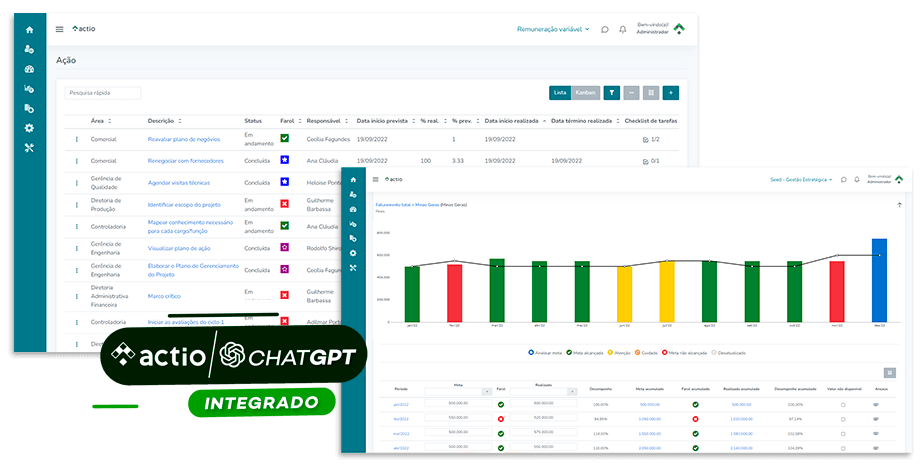
Here, we always say that technology can be an ally in choosing the compensation that best suits your company. That's why Actio developed the Actio Variable Compensation software, the only compensation software approved by Falconi, the largest consultancy in Brazil.
With Actio Bonus Management, you will have real-time access to individual results, allowing for clear visibility into the variable compensation process. Additionally, the software also calculates commissions, ICP, PLR, bonuses, ILP, and more, adapting to your organization's specific needs.
Are you facing challenges in this area? Consider Actio software to simplify the process. Also, take advantage and be sure to follow Actio on LinkedIn and Facebook, to stay updated on our solutions and news!
Frequently Asked Questions about Compensation Types
Check out some of the most common questions on the topic below:
According to the consulting firm TalentCorp, 85% of professionals view benefits as a deciding factor when accepting a job offer. As such, offering an attractive and flexible benefits package increases engagement, reduces turnover, and reinforces the company’s commitment to the team’s growth and well-being.
The contract must detail the base salary and all foreseen benefits, such as commissions and bonuses. This transparency prevents labor liabilities and ensures legal security for both the company and the employee.
The choice should be based on market research, the company's budget, and the level of responsibility of the position.