No time to read now? How about listening to the article?
Have you ever felt your team could deliver more but lacks that extra “fuel”? The secret might lie in variable compensation. This is because, more than just a bonus, this strategy is one of the most powerful tools for aligning company objectives with employee effort.
Ultimately, when good performance directly impacts one's wallet, engagement ceases to be a goal and becomes a reality. Furthermore, this model creates a culture of meritocracy, where the talents that generate the most value are duly rewarded, while the company maintains financial health by tying personnel costs to actual results.
If you want to attract talent, reduce turnover, and get your team to truly “wear the jersey,” keep reading. We'll show you how to implement this model successfully and what the best practices are to avoid common mistakes!
But, after all, what is variable compensation?
Unlike fixed salary and traditional benefits, the Bonus It is a strategy where the amounts paid fluctuate according to predefined criteria. The big differentiator is that these payments can be monthly, quarterly, or annual, creating a continuous cycle of stimulus and reward.
But, contrary to what many think, it's not just about “paying extra.” In practice, this modality directly links financial gain to delivered results. In other words, it's the real application of performance-based appreciation: the more the employee contributes to the company's success, the greater their return.
What are the advantages of variable compensation?

Adopting variable pay allows the company to share success with those who help build it. A real-world example is NC Group, which achieved significant evolution in results and team engagement by using the Actio Variable Remuneration software.
And besides driving business growth, this strategy offers clear competitive advantages:
- Cultural strengthening: An environment focused on results is created, improving organizational climate and brand reputation.
- Recognition and valorization the collaborator feels like a fundamental part of the results, increasing the sense of ownership.;
- Increased productivity The financial incentive tied to performance motivates the team to constantly exceed goals.;
- Talent attraction and retention: High-performance professionals seek meritocratic environments, which strengthens the employer brand.;
- Turnover Reduction Engaged and well-rewarded employees are more likely to stay with the company.;
The most common types of variable compensation
Now that you understand the concept and benefits of this strategy, the question remains: which model best fits your company's reality?
The answer is that there isn't a single format. After all, the choice depends on your objectives, whether it's to increase sales, retain executives, or distribute profits fairly. Therefore, to help you decide, we've listed the most commonly used examples in the market below and how each one works in practice:
Bonus
The bonus is an additional amount granted to the employee in recognition of meeting goals, whether individual or collective. This bonus may be based on multiples of the salary and calculated according to the performance achieved.
Additionally, bonuses can be distributed annually, semi-annually, quarterly, or even monthly, depending on the company's compensation policies.
Also read: Bonus strategies
Commission
The sales commission is one of the most common forms of variable compensation in the market. After all, it functions as a bonus for salespeople, encouraging them to continuously increase sales volume.
In this case, the employee receives an amount proportional to the total sales made in a given period, usually monthly. In many businesses, a minimum sales value must be reached to receive the commission.
Profit Sharing (PLR)
The PLR It is a strategic program where the company decides to share a portion of its profit with the team. Although regulated by Law 10.101/2000, its implementation is optional and depends on a prior agreement between the organization, a committee of employees, and the category's union.
The great benefit of this model is transparency. Thus, when profitability goals are met, employees are rewarded proportionally. As a result, a “win-win” environment is created where the business's success directly reflects in the pockets of those who helped build it.
Financial awards
Financial bonuses are direct incentives for teams or employees who meet and exceed specific goals within a given period. Generally awarded after a careful evaluation of results, these bonuses transform extraordinary effort into tangible recognition, celebrating the organization's victories.
Furthermore, unlike profit sharing, bonuses can be customized according to the company's structure, being distributed individually or collectively. This flexibility allows managers to reward outstanding performances punctually, keeping the team focused and motivated to achieve ever-higher levels of excellence.
Skill-based bonus
This form of variable remuneration consists of a bonus offered to employees based on their skills and qualifications. For example, it is possible to grant a bonus to someone with a postgraduate degree and add the amounts according to the employees' level of education.
This incentive is interesting for retaining employees within the company, promoting talent retention, and encouraging the continuous development of their skills.
What does the law say about variable remuneration?
Variable remuneration is regulated in Brazil and is provided for in paragraph XI of art. 7 of the Federal Constitution. However, there are specific rules for the regulation of Profit and Results Sharing (PLR) established by Law nº 10.101/2000.
This law establishes criteria that must be followed by companies, such as:
- Proportionality to results the payment of Bonus it must be done proportionally to the results achieved by the employees and the company;
- No salary replacement or integration: The PLR cannot replace or supplement employees' salaries. It is an additional bonus based on performance and results.;
- Negotiation between company and employees: Profit Sharing Agreements (PSAs) must be negotiated between the company and employees, through their legal representatives, such as unions or employee committees.;
- Annual Goals and Results Program: An annual program of goals and results must be established, defining the criteria for the distribution of variable remuneration.
Step-by-step guide to implementing variable compensation

Contrary to popular belief, eliminating variable compensation requires more than just willingness; it demands planning and method. After all, a poorly structured program can lead to confusion regarding goals and even labor risks. Therefore, the success of this strategy lies in creating clear rules where employees know what they need to deliver and what they will receive in return.
Are you ready to professionalize your company's incentive management? The path begins with structuring indicators and choosing the right tools. Check out the essential step-by-step guide for a flawless implementation below:
1 – Select the ideal model
The first step is to identify which type of variable compensation (profit sharing, bonuses, commissions) best suits your company's culture and objectives. Careful analysis ensures that the chosen model not only rewards the employee but also drives the results the organization truly needs to achieve.
2 – Establish clear goals and indicators
Define what needs to be delivered and how it will be measured. Goals can be quantitative (such as sales volume) or qualitative (such as customer satisfaction), as long as they are SMART goals: Specific, Measurable, Achievable, Relevant, and Time-bound.
Remember: the balance between challenge and reality is what keeps motivation high.
3 – Communicate with complete transparency
Clarity is the soul of variable compensation. Therefore, explain in detail to the team how the system works, what the rules of the game are, and how the calculations will be done.
Thus, when the employee understands the process and sees practical examples, they feel confident to focus on execution, eliminating noise or doubts.
4 – Monitor real-time performance
Don't wait until the end of the year to discuss results. Implement a continuous monitoring system with reports and feedback meetings so everyone knows exactly where they stand and what's missing to achieve the award.
Offering support and monitoring tools helps correct routes before the deadline expires.
5 – Evaluate and refine the program
A good variable compensation system is never static. Therefore, regularly monitor the effectiveness of management and the impact on team engagement. If the indicators are too easy or impossible to achieve, make adjustments.
Continuous evolution ensures the system remains fair, sustainable, and performance-focused.
Why invest in variable compensation with Actio Bonus Management?
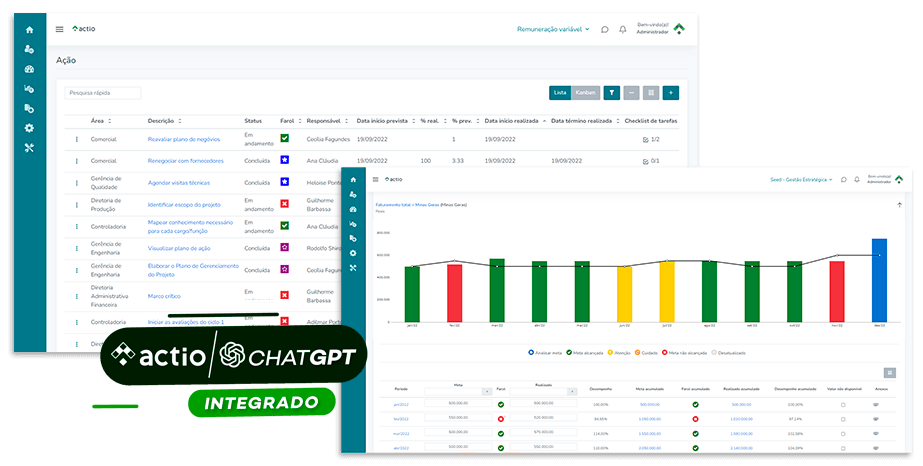
Technology can be a great ally when choosing the best variable compensation option for your company. Therefore, the Actio developed a unique software called Actio Bonus Management, which aims to ensure greater transparency in the disclosure of work goals achieved and the extra bonus each employee will receive.
With it, it’s possible to have real-time access to individual results by area and by collaborator, providing greater visibility and clarity in the process. Furthermore, the software offers different methodologies, such as Goals Card, Action Tracking, Indicators and KPIs, Bonus per Employee and Area, among others. This allows you to choose the methodology that best suits your organization's specific needs.
So, if you are facing difficulties in applying any type of variable compensation, be sure to consider hiring Actio's software.
Don't forget to follow Actio on Instagram, LinkedIn and Facebook.
Frequently Asked Questions About Variable Pay
Check out some of the most common questions on the topic below:
It depends on the model. If it's configured as a regular commission or bonus, it's considered part of the salary and incurs charges. However, profit sharing, when it follows Law 10.101/00, does not have the nature of salary and is exempt from labor and social security charges for the company.
Although there are awards in “kind” (trips, vouchers), classic variable remuneration is financial. If the objective is to use the PLR tax exemptions, payment must be made in cash and follow the procedures of Law 10.101/00.
The secret is to balance individual goals with collective goals. That way, when part of the gain depends on the success of the sector or the company as a whole, you encourage collaboration and ensure everyone is working in the same direction, avoiding a “every man for himself” mentality.