No time to read now? How about listening to the article?
Did you know that engaged employees can increase a company's productivity to surprising levels? The challenge, however, is how to maintain this incentive constantly. And the Profit Sharing Program (PPR) emerges as an opportunity by offering a tangible reward for achieving collective goals.
But for the program to be a success and not a legal problem, its inner workings must be understood. That is why, from legal regulations to calculation formulas, we have prepared this blog to answer the most frequent questions from managers and HR departments.
Continue reading and learn how to implement PPR safely and efficiently!
What is the Profit Sharing Program (PPR)?
In summary, the Profit Sharing Program (PPR) It is a strategic tool designed to integrate the interests of the company and its employees, with a total focus on productivity. In other words, unlike common bonuses, PPR functions as a performance gear. Thus, the team's variable compensation is directly tied to the achievement of clear and measurable goals.
Furthermore, a crucial point that sets it apart from other models is that the PPR focuses on performance, not necessarily profit. This means that if the team overcomes the established technical and operational challenges, the bonus should be paid regardless of the company's final financial health. This logic brings greater security to the employee, who realizes that their reward depends exclusively on the delivery of their work, and not on variables outside their control.
In other words, for those in operations, the PPR is much more advantageous because the bonus depends on the work delivered, not on fluctuations. Unlike profit sharing, where external factors can zero out the payment even if the team is killing themselves working.
For the company, this ensures that the investment in compensation returns in the form of productivity and processes that actually work. Ultimately, it's a practical agreement: the team delivers the agreed-upon results and ensures the extra gain transparently.
Key Benefits of a Profit Sharing Program for a Company
Implementing a Profit Sharing Program (PPR) goes far beyond offering a financial bonus; it's about creating a culture of genuine commitment. When a company sets clear goals and directly links them to the earnings of those who achieve them, it transforms the employee's perspective on the business. In other words, it shifts from merely “clocking in” to “delivering results,” as everyone understands that the organization's growth directly reflects in their personal gains.
In this way, the PPR acts as a powerful productivity engine, eliminating bottlenecks and reducing waste that often go unnoticed in daily operations. By aligning management's objectives with operational tasks, the company gains agility and transparency, creating an environment where errors are minimized and effort is directed towards what truly brings returns.
Check out the main advantages below that make this methodology indispensable for those seeking excellence:
1 – Employees' biggest motivation
The PPR creates a real incentive for employees, as it offers a clear opportunity to increase monthly earnings through the achievement of well-defined goals. In this sense, when the employee realizes that their effort directly translates into money in their pocket, their relationship with work changes. What was just a daily obligation becomes a rewarding challenge.
Furthermore, this extra motivation directly reflects on the quality of deliverables and the agility of operations. After all, knowing that the company's success is connected to their personal benefit, employees tend to act more proactively, identifying flaws and seeking solutions that help achieve collective goals.
Also read: Operational routine
2 – Increased productivity
With the PPR, employees gain a direct financial incentive to raise the standard of deliveries and optimize work time. This incentive leads each member to seek more efficient ways to perform their tasks, focusing on what truly generates value for the business. Thus, when individual and collective effort is directed towards achieving concrete goals, operations flow much more smoothly, reducing waste and errors that previously went unnoticed.
This way, productivity ceases to be a demand from management and becomes a shared interest for the entire team.
3 – Greater commitment
OPPR promotes a sense of responsibility and ownership that is difficult to achieve with fixed salary models. And by understanding that their performance directly impacts their compensation, the employee stops being passive and becomes committed to the health of the operation. After all, they understand that each well-executed task is another step towards the common goal.
In addition, this program makes teams feel like an integral part of the company's success. Thus, when results are shared, the barrier between “what belongs to the company” and “what belongs to the employee” diminishes, creating a true partnership.
4 – Better relationship between employer and employees
The OPRR creates a more collaborative and trusting environment between the company and those on the front lines of operations. This is because by establishing clear, transparent, and, above all, achievable goals, the organization shows that it plays fair with the employee.
This transparency in the agreement strengthens mutual trust and reduces communication noise. After all, the employee gains a better understanding of the business challenges and feels valued for being a key player in the solution. Ultimately, this union creates a solid foundation for the company culture, ensuring the team remains focused and motivated in the long term, knowing they are in a place that truly recognizes and shares the rewards of good work.
5 - Scope of defined goals and objectives
Finally, the PPR directs employee efforts towards meeting the company's strategic goals and objectives. By aligning employee interests with those of the organization, goals are more likely to be achieved, driving business growth and success.
It is important to emphasize that the success of the PPR depends on careful and well-planned implementation, ensuring a proper balance between increased company revenue and employee compensation.
Also read: Everything you need to know about PLR/PPR
What are the rules of the Profit Sharing Program (PPR)?
The Profit Sharing Program is regulated by Law No. 10.101/2000, which requires that the rules be established through a written agreement between the company and its employees. To this end, this document must be prepared by a joint committee, with representatives from both sides, supported by unions or collective bargaining agreements.
Furthermore, the legislation defines that rewards must follow clear criteria, such as productivity goals, quality, or previously agreed deadlines. Another fundamental point is that the PPR does not have a salary nature, functioning as an indemnification fund exempt from labor charges (such as FGTS and INSS). However, it is worth remembering that, although exempt from these taxes, the amount received must be duly declared by the employee on their Income Tax return.
How to apply the Profit Participation Program (PPR) in your company?
To apply the PPR Successfully, it's not enough to just announce a bonus. After all, you need to design a strategy that makes sense for your business reality and is transparent to operations.
Want to know more? Check out the fundamental steps to get your project off the ground safely and efficiently:
1 – Create a dedicated team
Form a committee with representatives from the company and employees to lead the implementation. This team will be responsible for outlining the program's guidelines, setting realistic goals, and transparently monitoring the results.
With this shared management, the process gains more confidence and ensures that the project meets everyone's interests.
2 – Union Registration
Report and register the adoption of the Profit Sharing Program in the union corresponding to your company's category. This helps ensure transparency and the involvement of employees and the union in the process.
3 - Set realistic goals
Establishing clear and achievable indicators is what separates a motivating program from a frustrating one. For this to happen, goals need to be aligned with the company's strategy but must, above all, be measurable and consistent with the reality of operations.
Furthermore, ensure these goals are communicated transparently, making sure each collaborator understands exactly what needs to be done.
4 – Track the results
It is essential to regularly monitor the results achieved in relation to the management established. This can be done through periodic reports, meetings, or performance reviews.
Remember: tracking results allows you to identify areas of success, as well as opportunities for improvement.
5 – Communicate and celebrate progress
Finally, don't wait until the end of the year to talk about the PPR. Keep communication channels open so everyone knows exactly how much is left to reach the goals.
So, when a goal is met, celebrate the outcome with the team. This reinforces confidence in the program, keeps the operation going strong, and makes it clear that the company's success is, in fact, a victory for everyone.
How is the Profit Sharing Program (PPR) calculation made?

The law does not provide clear guidelines on how to calculate the PPR. However, companies generally offer bonuses based on the employee's salary. Additionally, the employer must take into account the profit projection after meeting goals to determine the bonus amount.
To make it easier for you to understand, check out some examples of how PPR can be applied to your company:
- Example 1: if the company increases its revenue by 20%, each employee will receive an amount equivalent to 10%of the net profit as a PPR;
- Example 2: If the company increases its revenue by 10%, the PPR will be 5%of the net profit for the employees.
Why invest in a Performance and Rewards (PPR) program with variable compensation software?
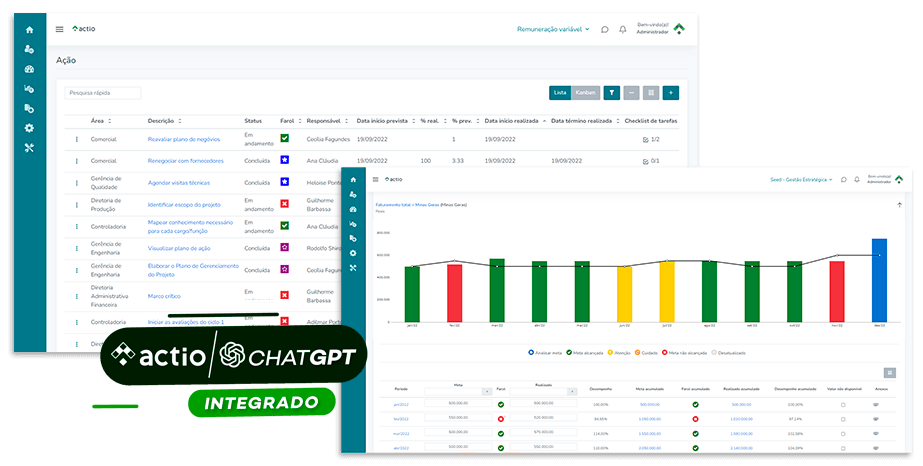
Technology can be a great ally when choosing the best variable compensation option for your company. Therefore, the Actio developed a unique software, called Actio Variable Remuneration, which aims to ensure greater transparency in the disclosure of achieved work goals and the extra bonus each employee will receive.
With Actio Bonus Management, it is possible to have real-time access to individual results by area and by employee, which provides greater visibility and clarity in the variable compensation process. Furthermore, the software offers different methodologies, such as Goal Card, Action Tracking, Indicators and KPIs, Bonus per Employee and Area, among others. This allows you to choose the methodology that best suits your organization's specific needs.
So, if you are facing difficulties in applying any type of variable compensation, be sure to consider hiring Actio's software.
Don't forget to follow Actio on Instagram, LinkedIn and Facebook.
Frequently Asked Questions about Profit Sharing Program (PSP)
Check out some of the most common questions on the topic below:
All employees registered via CLT (including temporary or probationary ones) can receive the PPR, provided the company decides to implement the program, as participation is optional for the employer.
Additionally, in cases of resignation or dismissal without just cause, payment must be proportional to the months worked in the cycle. Please note: public servants are not entitled to the benefit, which is restricted to the private sector.
Regulated by Law No. 10.101/2000, the Profit Sharing Plan (PPR) requires a written agreement between the company and employees, mediated by a joint committee or union. Rewards must follow objective criteria, such as productivity, quality, or deadline targets.
Furthermore, due to its compensatory nature, the amount is not considered part of the salary, remaining exempt from charges like INSS and FGTS, although it must be declared for Income Tax purposes.
In general, bonus payments are usually made up to twice a year, with a minimum interval of three months (or one quarter) between payments.
However, private companies and unions independently determine the month for benefit payments, as well as the method of payment. This can include the option to pay the amount in a single installment or divide it into two payments.