Bonus and gratification may seem like synonyms, but the differences between them are fundamental. And in everyday corporate life, confusing these terms can lead to payroll errors.
However, that's not all: after all, understanding these rules also brings legal certainty and improves talent retention. Furthermore, the correct choice between rewarding or bonifying directly impacts the company's expenses. In other words, it's a matter of financial strategy and professional appreciation.
With that in mind, in this guide, we will demystify these terms and show you how to apply them in your organization's practices. Understand the definitions and discover how each one works in a business context.
Enjoy the read!
What is a bonus?
In a nutshell, a bonus is an extra financial reward for an employee. This is because it functions as an incentive that goes beyond the monthly salary, and its aim is to recognize those who deliver something extra on a daily basis.
Furthermore, the bonus is generally tied to exceptional performance. After all, it rewards the achievement of ambitious goals or strategic accomplishments for the organization. It's a clear way of saying that the company values above-average effort.
Thus, when implementing bonuses, leadership stimulates remarkable results. And this recognition, in turn, strengthens engagement and a high-performance culture.
What are examples of bonuses?
As we've seen, bonuses are generally one-time events intended to celebrate special achievements. Some bonus suggestions include:
- Days off: offer days off as a reward for excellent work;
- Profit sharing: share a percentage of company profits with employees;
- Incentive trips: Provide travel as a way to motivate and recognize employee effort.;
- Gift cards: offer vouchers for employees to choose products or services of their choice;
- Digital gift cards: provide gift vouchers electronically, offering convenience to beneficiaries;
- Holiday gifts: giving gifts to employees on special occasions, showing appreciation and recognition;
- Event tickets: grant tickets for cultural, sporting, or entertainment events;
- Christmas hampers: distribute special baskets during the Christmas period as a form of gratitude.
However, remember that it’s essential to strategic planning these initiatives carefully to ensure that they do not negatively impact the company's finances.
What is a gratuity?
The Gratification, in turn, is an extra payment provided for by law or collective agreements. That is, unlike bonuses, it occurs in specific situations and at certain dates. It is a right that provides predictability for both the company and the employee.
This amount is usually linked to seasonal events, such as the end-of-year celebrations. It can also compensate for extraordinary activities, such as working overtime. In other words, it is compensation for special working conditions.
A crucial point is that the bonus is usually predefined. For this reason, it does not depend on individual performance or the achievement of targets.
What are examples of a gratification?
As we saw above, bonuses are more formalized. After all, they are excellent ways of recognizing an employee's constant dedication and partnership with the business. Learn about the main types:
- Length of service bonus: Celebrating a professional's birthday at the company is a classic way to show appreciation. In this way, the employer defines the ideal period for this recognition, reinforcing mutual commitment.;
- Profit sharing: When an employee directly impacts financial results, the company can share part of that gain. It's an effective strategy for aligning the team's interests with the company's objectives.
- Performance bonus: Focused on individual competencies, this incentive rewards the development of new skills. It is therefore an excellent incentive for employees to seek knowledge and take on more responsibility.
But what is the difference between a bonus and a gratuity?
In a nutshell, the main difference between bonus The difference between bonuses and bonuses lies in the nature of the award. After all, while a bonus is a strategic choice by the company to reward merit, a bonus is usually an obligation or an agreement for specific conditions. Understanding this distinction avoids confusion in people management.
In addition, bonuses celebrate personal achievements and the attainment of challenging goals. Gratuities, on the other hand, function as additional compensation, often linked to situations beyond the employee's direct control.
Regardless of the choice, both are different tools for different moments in a professional's journey. And mastering these concepts allows you to create much more effective incentive policies. After all, by applying each benefit at the right time, your company strengthens the culture of recognition and motivates the team with transparency.
Remember: it's the ideal balance between legal certainty and high performance.

How important are bonuses in the workplace?
In general, bonuses and incentives are fundamental pillars of a strong organizational culture. After all, when a company invests in these rewards, it signals that it values human capital above bureaucracy.
This, in turn, transforms the internal climate and generates practical and strategic benefits for the business, such as:
- Engagement on the rise: Bonuses act as fuel for productivity. After all, they encourage the team to overcome challenges and continuously strive for exceptional results.;
- Retaining talent: The bonus shows that the company cares about its employees during special moments. This care strengthens the emotional bond and drastically reduces turnover.;
- Positive climate: financial recognition creates a healthy meritocratic environment. Thus, where there is real appreciation, there is motivation to grow along with the organization;
- Competitive edge: companies with clear bonus packages attract the best professionals on the market. And this recognition is the tie-breaker for talent to choose your brand;
- Cost reduction: replacing an employee is expensive. Keeping people engaged through these incentives protects internal knowledge and saves resources on new selection processes.
Well-structured bonus and reward systems boost team morale. This is because more than payroll figures, these practices build a relationship of trust and partnership.
This is, it's the right investment for those looking to turn employees into brand ambassadors and ensure the team plays focused!
How to implement a bonus or incentive system in an organization?
Implementing a bonus and compensation system requires strategy and rigorous planning. After all, when executed well, this process transforms team motivation and drives business results. The secret, therefore, lies in aligning rewards with the organization's actual objectives.
Want to know how? Here are the essential steps to guide implementation in your company. Find out how to structure a reward model that is sustainable and highly effective:
1 - Set objectives and goals
The first step is to define what the company hopes to achieve with this system. After all, without a guide, rewards lose their strategic meaning. Thus, you need to know whether the focus is on increasing sales, reducing costs or improving the organizational climate.
Next, with the objectives set, determine the management that employees must meet in order to receive the awards. Be specific about the frequency of awards and the eligibility criteria. These well-designed rules avoid frustration and keep the team focused on what matters.
Remember: a target only works if it is measurable and realistic. This is because when employees understand exactly what they need to deliver, the bonus system becomes fuel for high performance.
2 - Get to know your employees
Understand who the people driving your business are. To do this, use performance reviews and satisfaction surveys to discover what truly motivates your team. Close conversations help identify the real needs and preferences of each department.
Remember that knowing your collaborators allows you to personalize rewards. Not everyone is motivated solely by money, and sometimes, time off or a specialized course can generate more value. In other words, personalization is the key to genuine engagement.
When the benefit makes sense for the professional's reality, they feel truly valued. It's the care for the individual that turns a bonus into a talent retention tool!
3 – Create a detailed plan
Develop a comprehensive plan that links the company's goals to the award criteria. To do this, precisely define the frequency of rewards and who will be eligible in each cycle. Clarity in the rules is what sustains the trust of the entire team.
In addition, include rigorous financial planning to ensure the viability of the program. After all, the bonus system must be sustainable in the long term, without compromising the organization's cash flow.
A well-structured plan is what transforms intentions into real results. This is because it serves as the official guide for managers and collaborators, eliminating doubts and noise. With finances and rules aligned, the success of the implementation is guaranteed.
4 – Promote transparency
Avoid conflicts and mistrust by being transparent at all stages. To do this, clearly communicate the program's objectives, criteria and rules to all employees. When the rules are known, the team plays more safely.
In addition, create open channels for questions about the system. A rewards program without mystery is much more respected because clarity turns a payment promise into a high-performance engine.
5 – Document everything
Finally, keep detailed records of all gratuity and bonus program stages.
Organizing data facilitates future audits and reviews. And with everything recorded, you avoid payroll errors and internal conflicts. This is the solid foundation for a professional and sustainable rewards system.
Why invest in bonuses or gratuities with the help of software?
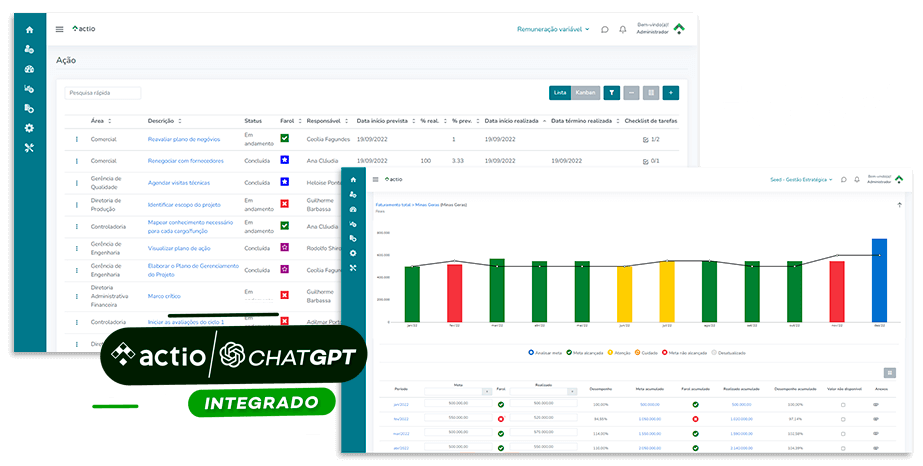
Technology can help you choose the benefit that best suits your company. Therefore, Actio developed the Actio Variable Remuneration software, the only remuneration software approved by Falconi, Brazil's largest consulting firm, and which also seeks to bring transparency to the disclosure of targets achieved and employee bonuses.
With Actio Variable Compensation, you will have real-time access to individual results, allowing clear visibility in the variable remuneration process. The software also calculates commissions, ICP, PLR, bonuses, ILP, and much more, adapting to your organization’s specific needs. If facing challenges in this area, consider Actio’s software to simplify the process.
Although possible, this usually depends on company policies and the circumstances justifying each form of compensation.
When it comes to the Consolidation of Labor Laws (CLT), both gratuities and bonuses are considered an integral part of the worker's salary, equivalent to “tips.”.
Yes. Even in cases where the prize or bonus is exempt from INSS and FGTS (according to the CLT), the amount received by the employee is subject to withholding income tax (IRRF), following the official progressive tax table of the Federal Revenue Service for labor income.