
Why do some companies overcome crises while others stagnate? The answer almost always lies in the strength of their goal management. For this reason, defining clear objectives goes beyond motivating people: it's about aligning every individual effort with the macro purpose of the business.
However, it's not enough to just list wishes on a spreadsheet. After all, true effectiveness lies in the applied methodology. And robust goal management transforms intentions into concrete action plans, allowing managers to identify bottlenecks in real-time and recalibrate the course before results are compromised.
Interested in learning more? In this guide, we'll demystify goal management and show you how to use performance indicators to ensure your company is always growing. Follow along!
What is goal management?
In a few words, in Latin, the origin of the word ‘management’ refers to the idea of leading, of setting in motion. In business practice, this means much more than just handling papers or processes: it is the art of making resources, your time, your financial capital, and your greatest asset, people, work in harmony to deliver real results.
This is where the goal management It ceases to be a bureaucracy and becomes the engine of the business. This is because it is the link that transforms strategic planning into execution, ensuring that every bit of energy spent by the company is moving in the right direction. But make no mistake: effective goals are not born ready-made. They need a solid ecosystem, where planning, execution, and monitoring go hand in hand, without interruptions!
What is the importance of goal management?
We are on the verge of the fifth industrial revolution, and in this scenario, competitiveness is no longer an option; it's the rule of the game. For this reason, staying ahead of the competition requires more than just presence; it demands absolute clarity about the next steps in each area of the company.
And when goal management ceases to be tight control and becomes a compass, the impact is immediate: organizational performance soars, and employees find clear purpose in their contributions. After all, tangible and well-defined goals don't just measure results; they transform pressure into motivation and daily challenges into shared achievements.
The main benefits of goal management for businesses
It's not uncommon to find companies where the strategy resides with the board of directors, but the operations stumble in the dark. And this misalignment happens when employees can't see how their individual efforts connect to the overall success of the business.
Thus, without this bridge, productivity is lost in bureaucratic tasks and motivation disappears. It is precisely to eliminate this ‘blind spot’ that goal management becomes indispensable. Check out the benefits that this clarity brings to your organization:
1 – Sustainable profit margin growth
When an employee understands where the company is headed and realizes their growth aligns with that vision, the game changes. After all, work gains meaning and execution becomes much more precise.
This alignment creates a natural engagement. And in an environment where goals are clear and achievable, productivity stops being a demand and becomes an organic result, driving profit margins sustainably. Ultimately, a sense of belonging and shared responsibility are what keep the team focused on turning objectives into reality.
2 – Agility in strategy execution
When the organization's goals and those of its employees speak the same language, execution gains another speed. After all, this alignment is what allows leaders to allocate resources precisely, without waste, focusing capital where it truly generates returns.
For the manager, the advantage is clear: clarity about goals simplifies delegation and project tracking. This way, no one wastes time on accessory tasks or activities that don't move the needle.
3 – Turnover Reduction
Nothing retains good talent more than clarity of purpose. Thus, when the employee truly sees how their daily effort translates into the company's achievements, work ceases to be a task and becomes a collective construction.
Furthermore, this level of engagement creates a real connection between the person and the business, which directly impacts turnover reduction. After all, teams that know where they are going and feel they are part of the results have far fewer reasons to seek other opportunities.
In summary: effective goal management is also the best strategy for retaining those who truly commit.

How to manage corporate goals in 5 steps?
Turning a strategy into reality requires more than good intentions: it requires a repeatable method. Therefore, if goal management is the engine of your business, the following steps are the gears that ensure that engine doesn't seize up along the way.
There's no magic formula, but there is a logical path to align expectations, optimize resources, and ultimately celebrate results that appear on the financial statements. Below, we've structured the 5 essential pillars for you to implement goal management that not only demands numbers but builds the future of companies.
Let's go?
1 – Use a goal-setting framework
Every successful goal starts with a smart structure. But don't try to reinvent the wheel: use established methodologies like the SMART framework (Specific, Measurable, Achievable, Relevant, and Time-bound) or OKRs (Objectives and Key Results) or the Balanced Scorecard.
These structures act as a reality filter for your business. After all, they ensure that each objective is ambitious enough to take the team out of their comfort zone, but realistic enough not to cause frustration. Thus, with the right method, what was once just an abstract idea gains clarity, focus, and, most importantly, an actionable plan.
2 – Collaboration with Other Business Leaders
No goal management is done alone behind a desk. For this reason, the second step is to integrate other leaders in the organization into the process of designing these objectives.
This way, when you bring different perspectives to the table, the goal shifts from a limited view of a single sector to reflecting the complexity and opportunity of the entire company. This collaboration not only enriches the strategy but also creates a sense of shared commitment. After all, goals debated and validated together are much easier to execute than orders that arrive ready-made and without context.
3 – Start with the big picture
Before diving into spreadsheets and indicators, take a step back and look at the horizon. Goals that don't align with the company's purpose are just empty numbers. Therefore, start by defining your ‘north star’: where does the organization want to be in three to five years?
With this long-term vision established, the next step is reverse engineering. Take this larger goal and slice it into smaller, quarterly deliverables. This way, by transforming a big challenge into smaller, tangible goals, you remove the weight of uncertainty from the team and create a clear roadmap.
Remember: nobody climbs a ladder in a single bound; it's steady progress that ensures reaching the top.
4 – Utilize goal management software
Goals that live only in spreadsheets forgotten or text documents tend to die at the first hurdle. Therefore, for the strategy to come to life, you need a digital ‘headquarters,’ such as specialized software.
The big differentiator here is integration. After all, when the software talks to the team's daily tasks, the goal stops being a quarterly event and becomes the focus of every morning.
5 – Evaluate and adjust regularly
Remember: hitting the nail on the head with a goal doesn't mean it should be set in stone. This is because the market changes, unforeseen events arise, and your management needs to be resilient. In this context, regularly assessing progress and having the courage to adjust course is what distinguishes agile companies from those that fall by the wayside.
In other words, more than control, these periodic reviews are valuable moments for continuous learning. After all, they allow the team to understand what worked, what needs improvement, and where the strategy needs a fresh start. And by adopting this cycle of constant improvement, you not only achieve goals: you build an organization ready to win in any scenario.
The Path to Excellence in Goal Management
Although goal management is a powerful approach, it's important to remember that its implementation requires commitment, planning, and the involvement of the entire organization to achieve significant results.
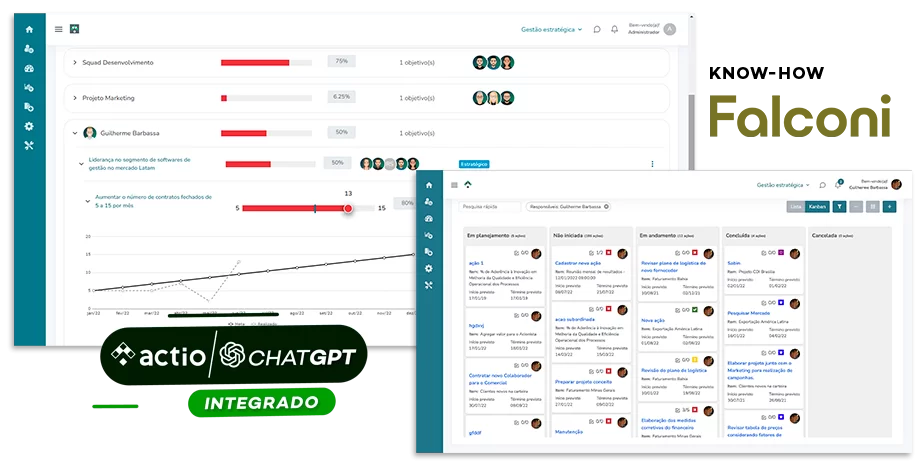
However, it’s not just that; using the right technology for your management processes is crucial to being effective. Get to know Actio Strategic Management, software to manage goal management in your company; with it you guarantee total control of all information, goals, and actions.
It is worth mentioning that Actio is part of the Falconi Group, a reference in business excellence.
OKR, which stands for Objectives and Key Results, is a system designed to set and track goals, along with the key performance indicators associated with those objectives.
Think of the goal as your final destination (e.g., “to be the market leader”). The objective, on the other hand, is the quantified, time-bound path (e.g., “increase market share by 15% by December”). That is, the goal is the direction, and the objective is the step.
Don't see it as a failure, but as data. Analyze what stalled the process: was it a lack of resources, an unrealistic deadline, or a market shift? The important thing is to adjust course quickly and apply the learning to the next cycle. Remember: management is continuous adjustment!

