
Since its creation, the Balanced Scorecard (BSC) methodology has been essential for the advancement of organizations worldwide, proving to be an invaluable ally in business management.
But after all, do you know what the purpose of the BSC is? Does it only serve to provide a clear view of the company's needs to achieve its goals and measure the results of ongoing work?
The truth is that the Balanced Scorecard methodology goes beyond that. When applied effectively, it drives significant improvements in results, as it empowers leaders to implement action plans aligned with their preferences and the particularities of the global business context. With this in mind, we created this blog so you can understand more clearly how BSC works and its benefits. Happy reading!
What Is Balanced Scorecard? Benefits and Examples

The Balanced Scorecard, which means "Balanced Performance Indicators" in Portuguese, is an essential methodology in strategic business management. Furthermore, the tool aids in evaluating progress towards long-term goals by transforming strategy into objectives, indicators, targets, and strategic initiatives.
The differential of this approach lies in its emphasis on measuring results, going beyond the traditional use of financial indicators. In this case, performance indicators play a crucial role, as they represent numbers, percentages, or ratios that measure specific aspects of performance and allow for comparison with previously established goals.
In the context of the Balanced Scorecard (BSC), performance indicators function as instruments for evaluating progress toward goals. However, it is important to understand the difference between objectives and targets. Objectives are clear descriptions of what is intended to be achieved, while targets are self-imposed challenges, defined in terms of deadlines, quantity, or quality, with the purpose of achieving the established objectives.
In addition to all the benefits mentioned above, the Balanced Scorecard also represents a long-term strategic approach, supported by a system for organizational management, communication, and performance measurement. In this way, its implementation allows for the creation of a comprehensive vision of the company's objectives, reaching all levels of the organization and providing a solid foundation for strategic decision-making.
The objective of the BSC is to translate a company's strategy into a set of objectives and key performance indicators that are linked and measureables.

The BSC methodology's main objective is to align a company's operational activities with its strategic planning. This is achieved by representing the organization's strategy and mission through measures and objectives that are translated into indicators. Thus, these indicators facilitate the evaluation of results and provide employees with information on positive and negative aspects, which helps to involve them in the pursuit of long-term goals.
To achieve this result, it is necessary to follow specific actions that reflect the BSC objectives:
Translate and clarify the strategy
The organization's objectives can only be fully achieved when understood in terms of the strategic mission. This requires all managers to work with indicators and goals related to each department, ensuring a common understanding among employees, managers, and business operations.
Establish, plan goals, and align strategic initiatives
Setting goals is a responsibility of managers, who also need to plan processes, develop financial planning, and determine the expected pace of company growth. Therefore, it is essential that these plans are realistic, taking into account organizational capacity and performance expectations.
Improve strategic learning and feedback
The review and feedback process analyzes the performance of the company's strategy and established goals. In this way, it contributes to optimizing employees' knowledge and skills, making it easier to monitor and control the business from four perspectives: customers; financial; learning and growth; and internal processes.
Associate and communicate strategic measures and objectives
It is the responsibility of managers to communicate strategies, linking overall objectives with the specific needs of each company sector. This way, it ensures that all levels of the organization understand the long-term strategies established and that the objectives of each sector and individual are aligned.
Looking for strategic management software? Meet Actio Strategy Management!
But how does the Balanced Scorecard actually work?

The Balanced Scorecard (BSC) is an approach based on four essential components to help organizations define, monitor, and achieve their strategic objectives. These components are:
ObjectivesThey are the specific goals and achievements that the organization wishes to attain in each of the four strategic perspectives of the BSC: Financial; Customer; Internal Processes; and Learning and Growth. For example, a goal in the Marketing perspective might be to increase market share.
IndicatorsThey are quantifiable measures that reflect the organization's performance in relation to its objectives. Furthermore, they help evaluate whether the strategy is being successful or not.
ManagementThey represent the desired performance levels for each indicator. Therefore, establishing clear and measurable goals is fundamental for tracking progress toward strategic objectives.
Strategic Initiatives or ProjectsThese are the planned actions and interventions that the organization must execute to achieve the established performance goals. That is, these initiatives can encompass a wide range of activities, from marketing campaigns to the implementation of customer relationship management (CRM) systems.
OBSC allows strategies to be detailed down to an operational level, providing clarity on the necessary steps to achieve strategic objectives. For example, if the strategic objective is to increase market share, this can break down into sales indicators, lead generation, online traffic, among others, with specific goals for each indicator. However, strategic initiatives may include content production, digital marketing campaigns, sales team training, and CRM system implementation.
The 4 perspectives of the Balanced Scorecard are:* Financial * Customer * Internal Processes * Learning and Growth

The Balanced Scorecard (BSC) uses four distinct perspectives to address essential areas of strategic implementation, promoting integration between them to achieve organizational objectives.
Financial PerspectiveFrom this perspective, the impacts of strategic decisions on long-term financial goals are evaluated. In other words, it is crucial to establish financial objectives and connect them to an action plan that covers financial aspects, customers, internal processes, and human resources. Furthermore, financial indicators such as profitability, revenue, and value increase play an important role in verifying if the company is on the right track.
2. Customer PerspectiveHere, both the company's market share and customer satisfaction are considered. Therefore, it is fundamental to identify stakeholders and define the results to be evaluated, such as loyalty, satisfaction, profitability, acquisition, and market share. Furthermore, this perspective encompasses aspects related to products or services; customer interaction; and the company's image and reputation, taking into account the customers' view.
3. Internal Processes PerspectiveFrom this perspective, the focus is on improving the quality of internal processes, encompassing innovation, operations, and after-sales service. Thus, this translates into indicators such as productivity, costs, technology adoption, and development time. In this way, the constant pursuit of process excellence is fundamental, involving the implementation of improvements and the correction of errors or failures.
4- Learning and growth perspectiveThis perspective assesses employee satisfaction and covers intangible assets such as engagement, empowerment, and team satisfaction. Additionally, it's important to measure employee turnover and the impact of training programs. It also includes infrastructure objectives and measures needed to achieve effective results with the team.
What technological resources are necessary to implement the Balanced Scorecard?
The Balanced Scorecard is a valuable tool for organizations that wish to measure and manage their performance comprehensively and in alignment with their strategy. In other words, by considering the four perspectives and establishing clear indicators, goals, and initiatives, companies can improve their performance, foster continuous learning, and effectively achieve their strategic objectives. Although the BSC is a powerful approach, it is important to remember that its implementation requires commitment, planning, and involvement from the entire organization to achieve significant results.
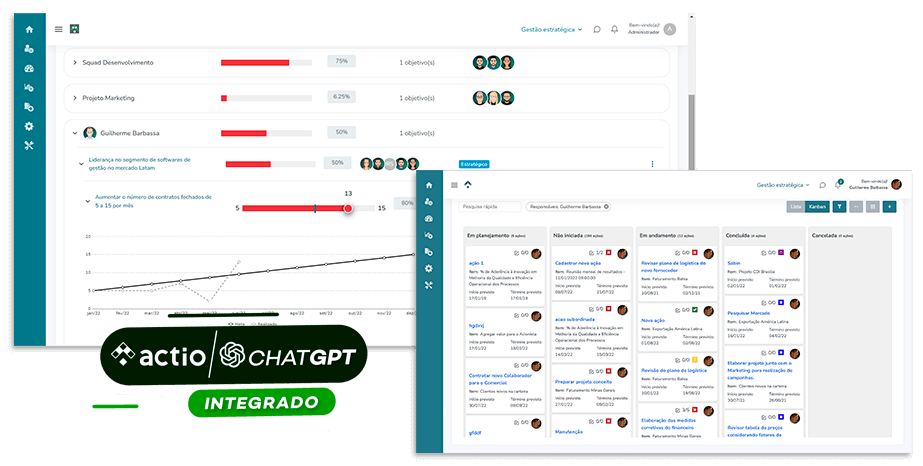
However, it’s not just that; using the right technology for your management processes is crucial to being effective. Get to know Actio Strategy Management, Actio's software for managing the BSC in your company. With it, you ensure complete control of all information, goals, and actions. A multi-methodology solution on a single platform that allows full integration between the various areas of your organization.
Like the content? Don’t forget to follow Actio on Instagram, Linkedin and Facebook.

