
Operational risk management to reduce incidents, losses, and disruptions
Manage risks related to processes, people, and systems to reduce incidents and losses and preserve the continuity of critical operations.

Connecting management and results in companies around the world






✦ Challenge
There is a lack of commitment in your organization's risk management?
Symptoms that your organization's risk management is not yet an efficient process:
Risk management only happens if there is direct action from the corporate area.
The operational areas lack clarity on the risks under their responsibility.
Risks are identified only in periodic cycles or after events.
The controls are described, but their execution and effectiveness are poorly monitored.
Managers and operations teams are not very involved in the evaluations.
The risk department does not have up-to-date visibility into operational exposure.
✦ Solution
Risk management with participation, context, and visibility
The solution of Operational Risk Management Actio allows managers, risk owners and those responsible for controls to participate in the assessment, treatment and monitoring of the contexts in which risks occur.
At the same time, it offers the corporate area a consolidated view of operational exposure, controls, and actions needed to reduce incidents, losses, and disruptions.
Distributed management
Involve managers, risk owners, and control owners in the activities under their responsibility.
Consolidated data
Unite risks, processes, activities, people, systems, and controls in a single environment.
Updated view
Provide the corporate area with reliable data on risks, controls, incidents, and necessary actions.
✦ Implementation steps
From process structure to exposure monitoring
Organize operational risk management in just six steps, keeping the people responsible for the risks and controls in the loop:
01Map critical processes and activities
01
Map critical processes and activities
- Structure the organization's processes, subprocesses, and activities.
- Identify systems, people, suppliers, and resources involved.
- Define responsible parties and assess process criticality.
- Relate applicable documents, policies, and procedures.
02Identify operational risks
02
Identify operational risks
- Register risks related to failures in processes, people, systems, and external events.
- Identify causes, events, and possible consequences.
- Relate risks to processes and impacted areas.
- Define owners and responsible parties for follow-up.
03Evaluate and prioritize risks
03
Evaluate and prioritize risks
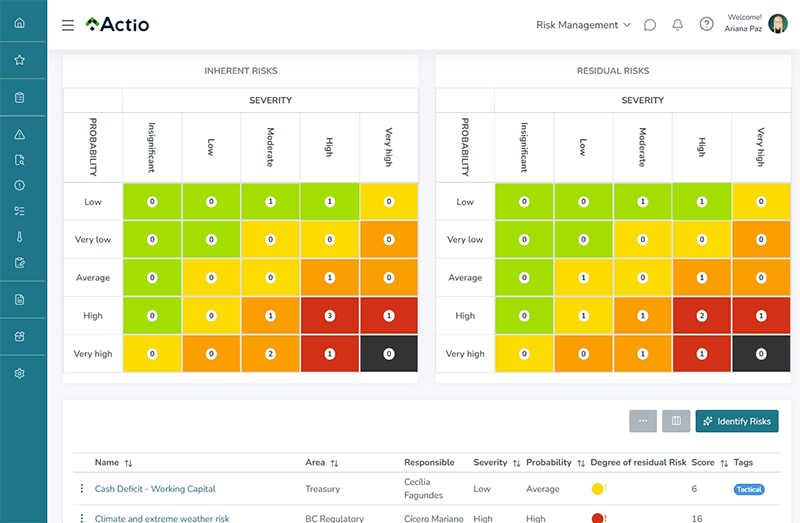
- Assess probability, impact, and exposure level.
- Compare the inherent and residual risks.
- Identify the most critical processes and activities.
- Prioritize risks that require treatment or reinforcement of controls.
04Map and execute controls
04
Map and execute controls
- Register preventive, detective, and corrective controls.
- Define responsibilities, frequencies, and expected evidence.
- Relate each control to the risks and causes it seeks to mitigate.
- Monitor the execution of periodic reviews.
05Evaluate the effectiveness of the controls
05
Evaluate the effectiveness of the controls
- Perform the control self-assessment through the Control Self Assessment.
- Evaluate the design and test the operating effectiveness of the controls.
- Record evidence, deficiencies, and recommendations.
- Create actions to correct missing or ineffective controls.
06Monitor incidents, losses, and exposure
06
Monitor incidents, losses, and exposure
- Record operational incidents and losses.
- Analyze causes, impacts, and recurrences.
- Reevaluate risks and controls based on the events that occurred.
- Track indicators, trends, and action plans.
- Consolidate information for managers, committees, and executive leadership.
Who is this solution for?
The solution connects the different roles involved in the identification, treatment, execution of controls, and supervision of operational risks.
Operational Risk Manager
Structure the methodology and consolidate the organization's operational presentation.
Risk owner
Assess, treat, and monitor the risks under your responsibility.
In charge of control
Execute the controls and record evidence of their completion.
Internal Controls Professional
Evaluate the design and effectiveness of the adopted controls.
Executive leadership
Monitors risks that can cause losses, interruptions, or significant impacts on the operation.
✦ Features
Resources for structure, execute, and monitor operational risk management
Centralize the necessary elements to relate risks to operations, track controls, and transform assessments, events, and decisions into monitorable actions.

Risks and Controls

Processes

Key Risk Indicators (KRI)

Risk Matrix
Auditing

Documents

Action plan

Custom dashboards

Power BI
Control Self-Assessment

Control Test
Continuous Feedback
Executive presentations

Meetings
✦ Schedule your demo
Take risk management to where risks happen
Discover Actio's Operational Risk Management in a personalized demonstration.
✦ Frequently Asked Questions
Get your questions answered about operational risk management
Objective answers to the main questions of those who need to bring risk management to operational areas.
What are operational risks?
Operational risks are events related to failures in processes, people, systems, or external factors that can generate losses, incidents, or interruptions in the organization's activities. Their management involves continuously identifying, assessing, treating, and monitoring these risks.
How does the platform help reduce operational risks?
The platform connects risks, processes, activities, owners, systems, and controls in a single environment. This way, operational areas can participate in assessments, monitor controls, log incidents, and execute action plans, while the corporate area maintains a consolidated view of operational exposure.
Is it possible to monitor the execution and effectiveness of the controls?
Yes. The platform allows registering controls, defining owners, frequencies, and expected evidence, as well as performing self-assessments, control testing, and deficiency logging. With this, the organization can track not only whether the control was executed, but also whether it is functioning properly.
Can the platform be adapted to the company's risk methodology?
The solution can support different process structures, evaluation criteria, risk matrices, indicators, controls, and monitoring workflows. The configuration scope must consider the methodology, governance, and specific needs of each organization.
How does the platform's hiring process work?
The hiring is defined according to the context, needs, and scope of the organization. To understand which features and configurations are most suitable, the company can request a consultation with an expert and receive a personalized proposal.