Many companies set goals, but few manage to track and execute these objectives consistently. Did you know that only 60 out of 300 small businesses keep a formal record of their goals, resulting in some goals being achieved, while others remain inactive? It is in this scenario that the goal card gains importance.
It functions as a simple yet extremely effective tool for organizing, visualizing, and tracking goals. Instead of loose or unclear objectives, the card transforms everything into something structured, visible, and actionable.
In practice, this helps managers and teams stay focused on what truly matters, whether in the short, medium, or long term. Happy reading!
What is the goal card?
The goal card is a structured way to organize objectives clearly and visually. Unlike a simple list, it allows you to track progress, understand priorities, and maintain direction over time.
It can be used at both the individual and organizational level, connecting personal goals, team goals, and strategic company objectives. The big differentiator is clarity. When goals are well-defined and visible, it becomes much easier to make decisions and avoid dispersion.
Why is the goals card important for the business

The adoption of a goal card directly impacts how a company executes its strategy. It not only organizes objectives but also creates a system for tracking and accountability.
Improved goal tracking
One of the main benefits is the ability to track progress more accurately. When goals are organized on a card, it becomes easier to break down large objectives into smaller steps. This allows you to visualize progress along the way, rather than just waiting for the final outcome.
For example, instead of just defining “increase sales,” the card can detail monthly goals, indicators, and specific actions. This makes the process much more controllable.
Increased motivation and engagement
Another important impact is on team motivation. When people know exactly what they need to achieve and can visualize their progress, the level of engagement tends to increase. This happens because the goal stops being abstract and becomes concrete.
Furthermore, when the goals card is linked to recognition or variable compensation systems, it becomes a strong performance driver.
Stimulate continuous growth
The constant use of the goals card creates a culture of continuous improvement. The team begins to review results frequently, identify deviations, and adjust courses quickly. This cycle of monitoring and correction contributes to both individual development and the growth of the company as a whole.
Target card templates
There are different ways to structure a goal card, and the choice depends on the company's needs.
Traditional model
In this format, goals are organized by timeframe, generally divided into short-term, medium-term, and long-term. This approach is useful for companies that need to balance immediate results with broader strategic objectives.
Model by areas or themes
Here, goals are separated by categories, such as sales, marketing, operations, or people development. This model facilitates organization when different areas have distinct responsibilities.
Time-oriented model
In this case, the goals are distributed over a schedule with well-defined deadlines. This structure helps create a sense of priority and urgency, preventing delays and the accumulation of tasks.
How to create an efficient goals card
Creating a goal card goes beyond just writing down objectives. It needs to be structured in a way that it actually works in day-to-day life.
Start with clear goals
The first step is to define exactly what you want to achieve. Generic goals like “improve results” don't work. It's necessary to specify what will be done, in what timeframe, and with what expected outcome.
For example, “increase sales by 20% in the next three months” is a clear and measurable goal.
Connect goals with indicators
Every goal needs an indicator that allows progress to be tracked. Without it, there's no way to know if the company is moving forward or not. Indicators turn objectives into something measurable and manageable.
Define stakeholders
Every goal needs a direct owner. When this doesn't happen, execution is compromised because there's no clarity on who should act. The goal card helps make this responsibility explicit.
Set realistic deadlines
Setting deadlines is essential for maintaining the pace of execution.
Very short deadlines can create excessive pressure, while overly long deadlines can lead to procrastination. Balance is key.
Constantly review and update
The goal card is not a static document. It should be reviewed frequently to track progress, adjust strategies, and correct deviations. Companies that do this constant monitoring tend to have more consistent results.
Read more: Business Goal Management: Execution for Results
How to use the target card in variable remuneration?

The goals card is also a key piece when we talk about variable compensation.
In this context, it functions as a clear agreement between the company and the employee, defining what needs to be delivered for financial recognition.
Definition of weights and priorities
Not all goals have the same impact. Therefore, it's important to assign different weights to each objective, according to its relevance to the business.
Scoring system
Each goal can have a score associated with its fulfillment. At the end of the period, the sum of these scores determines the employee's performance and, consequently, the bonus amount.
Frequent follow-up
Ideally, goals should be monitored monthly. This allows for quick identification of deviations and adjustment of the action plan before the final result is compromised.
Transparency in the process
For the model to work, it's essential that all criteria are clear. The collaborator needs to understand exactly what is expected and how their performance will be evaluated. This increases confidence in the process and improves engagement.
Why use technology in goal management
Manually managing goals may work at first, but it quickly becomes limited as the company grows. Decentralized spreadsheets make tracking difficult, increase the risk of errors, and reduce visibility of results.
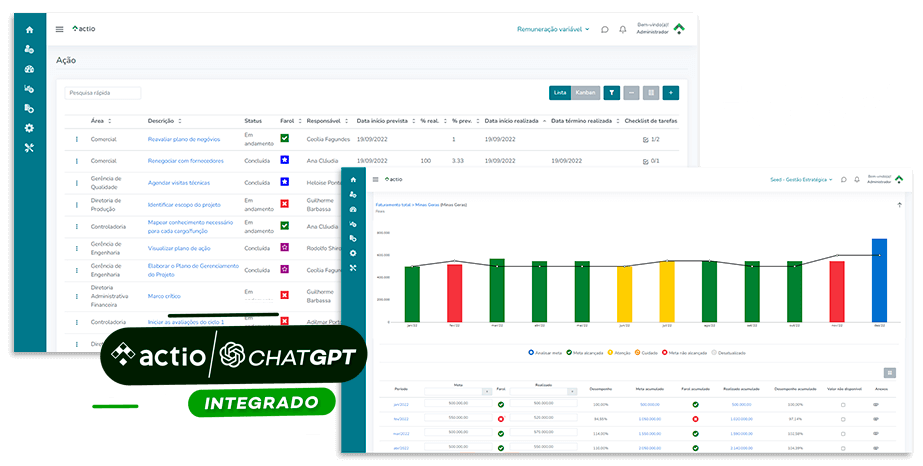
With the support of software, it is possible to centralize all goals, track indicators in real time, and automate variable compensation calculations. If you want to structure this process more efficiently, it is worth checking out Actio Variable Compensation.
With it, your company can track goals, calculate bonuses, commissions, PolishR and other variable compensation models in an integrated and reliable way.
Why invest in a goal card with the help of software?
When implemented correctly, the Goals Charter becomes a powerful tool for boosting team performance, directing focus and aligning efforts with the results that really matter to the business. However, technology can be an ally in choosing the remuneration that best suits your company.
What's more, with the Actio Variable CompensationYou will have real-time access to individual results, allowing clear visibility into the variable remuneration process.
In addition, the software also calculates commissions, ICP, PLR, bonuses, ILP, and more, adapting to your organization's specific needs. In other words, if you're facing challenges in this area, consider Actio's software to simplify the process.
It is a tool that organizes and tracks goals clearly, connecting objectives, indicators, and responsible parties.
It is necessary to set clear objectives, establish indicators, assign responsibilities, set deadlines, and regularly monitor results.
Objectives are broader and more strategic, while goals are specific, measurable, and have a defined deadline.