
Planning is the foundation of any organization that seeks effective results and sustainable growth. However, it is common for the terms “strategic,” “tactical,” and “operational” to be confused, even though they represent completely distinct levels, time horizons, and management processes.
Understanding these differences is what separates companies that merely execute tasks from those that dominate the market. After all, each level of planning has a specific role in the business's machinery, connecting the executive team's vision to the day-to-day reality.
Want to understand more about the particularities of these three spheres and how to integrate them to achieve high-performance management? Continue reading to turn your planning into practical results!
What is strategic planning?
In a nutshell, the strategic planning it is the foundation that supports the entire structure of an organization. After all, it establishes the company's long-term vision and outlines the macro guidelines necessary for the business's overall objectives to be achieved.
In other words, more than just defining mission, vision, and values, this process involves a deep reading of the internal and external environments through analytical diagnostics.
In practice, strategic planning serves to align the company's direction and create adaptive flexibility in the face of market transformations. However, it is worth noting that an efficient strategic plan requires systematic governance reviews to remain anchored in real data.
Main characteristics of strategic planning
Strategic decisions impact the direction of the entire corporation. Below, we highlight their fundamental characteristics:
- Comprehensive and systemic view: it involves a global perspective on the organization, articulating the market, competitive position, financial capacity, and business longevity;
- Executive responsibility: the formulation, validation, and leadership of planning are the responsibility of senior management, the board, and key executives (C-level);
- Long-term: it covers broad time horizons (generally 3 to 10 years), establishing the macro guidelines that will guide the other levels of the company.
Also read: Effective strategic planning
What is tactical planning?
Actio’s tactical planning He is responsible for creating the conditions necessary for the strategic plan’s guidelines to move beyond the drawing board. In other words, he serves as an indispensable bridge, translating the long-term corporate vision into goals, projects, and action plans broken down by sector.
Unlike the overall strategy, the tactical plan operates on an intermediate and focused scale, breaking down guidelines for specific areas (such as Marketing, Sales, HR, Finance, and Operations). It is at this stage that sector-specific risks are identified and resources are allocated with precision.
The time horizon for tactical planning is focused on the medium term (generally 1 to 3 years). Thus, because this timeframe is shorter and more predictable, it allows managers to quickly adjust actions and processes to keep the company on track toward its overall goals.
Main characteristics of tactical planning
Being the gear that connects the top to the base, the tactical level presents essential particulars for governance:
- Sectoral specificity and focus: The goals and initiatives are tailored to specific business units or departments;
- Middle leadership responsibility: Area managers, functional directors, and coordinators are responsible for developing and monitoring these plans;
- Medium term: operates on an intermediate time horizon, adjusting projects and budget allocation to support strategic objectives.
And what is operational planning?
Finally, the operational planning It serves as the direct point of contact with day-to-day operations. As such, it translates tactical goals into routines, standardized procedures, and concrete work schedules for the teams.
And while the previous levels focus on direction and structure, the operational plan focuses on the short term (daily, weekly, monthly, or quarterly intervals). The primary focus here is on efficiency, eliminating bottlenecks, and strict adherence to delivery standards.
Operational success is the engine that enables the realization of the entire strategic ecosystem. Thus, when daily work is well executed, tactical goals are met and, consequently, the company's macro vision materializes.
Main characteristics of operational planning
Ensuring that the routine happens with excellence, the operational level is characterized by:
- Front-line responsibilities: led by supervisors, operational coordinators, and project managers, and carried out by the entire frontline team;
- Short-term: encompasses short-term, dynamic timeframes (ranging from weeks to a few months), focusing on immediate deliverables and routine oversight;
- High level of detail: describes in detail the procedures and the individuals responsible (5W2H), checklists, deadlines, and the resources needed for each task.
What are the main differences between strategic, tactical, and operational planning?
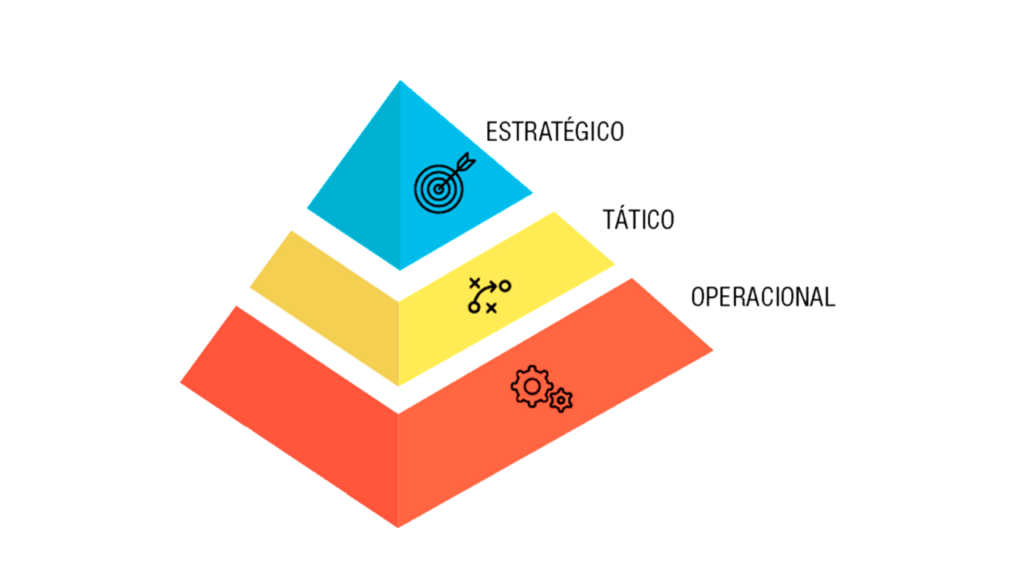
To understand the practical distinctions between the three levels, it is useful to analyze the core questions each one answers, the hierarchy involved, and its response time.
Below, we summarize the points of divergence and complementarity between each planning sphere:
- Time frame: The strategic focuses on the long term (3 to 10 years); the tactical concentrates on the medium term (1 to 3 years); the operational acts in the short term (days, weeks, or months);
- Scope of activity: The strategic level views the organization as a whole within the market; the tactical level focuses on the internal environment of each department; and the operational level focuses on workflows and individual tasks;
- Hierarchical level: Strategic planning is guided by the C-level and shareholders; the tactical level is managed by division directors and managers; the operational level is led by supervisors and implementation teams;
- Core management question: the strategic answers to “What to do and where to go?”; the tactical responder to “How to structure and make it viable?”; operations responds to “When, by whom, and how to execute?”.
What is the relationship between strategic, tactical, and operational planning?
A fundamental point in high-performance management is that these three levels do not function in isolation. This is because they form a living ecosystem and depend on continuous alignment for the organization to grow sustainably.
And the connection between them follows a logical flow of unfolding and feedback: strategy defines the overall direction; tactical fragments this direction into functional plans; and operational executes the daily routine. If there is communication noise at any of these stages, a disconnection occurs between management's discourse and the teams' practice.
And to keep this machinery finely tuned, it is essential to have an integrated governance model and technological tools that unify the visualization of end-to-end metrics.
How can you develop effective strategic, tactical, and operational plans?
Developing a robust plan requires a methodical approach, consistency, and discipline in integrating the various stages. Thus, each level must be designed with its unique characteristics in mind, while maintaining a direct link to the overarching guidelines.
Below, we present the essential practices for successfully structuring each layer of your planning:
Strategic planning
The strategic phase demands cold data analysis, foresight, and clear market positioning. And to build it with precision:
- Perform in-depth diagnoses: Use the SWOT matrix and environmental analysis to understand strengths, weaknesses, threats, and opportunities;
- Define broad guidelines and SMART goals: set clear, measurable institutional goals that are aligned with the company's purpose;
- Identify the major market drivers: Consider changes in consumer behavior, technology, and economic conditions to prevent the strategy from becoming obsolete.
Tactical Planning
At the tactical level, the key word is feasibility. It translates the board's wishes into concrete projects for the various divisions:
- Break down global objectives into sector-specific goals: Use frameworks such as BSC or OKRs to align corporate priorities with the various departments;
- Allocate resources wisely: define budgets (OPEX/CAPEX) and size the operational capacity of the teams to avoid overload;
- Map and mitigate functional risks: analyze potential process bottlenecks and plan preventive actions in each department.
Operational Planning
At the operational level, the focus is on standardization, pace, and absolute clarity in execution:
- Develop operational action plans: apply the 5W2H methodology to define tasks, deadlines, costs, and direct responsible parties;
- Standardize procedures (SOP): ensure that daily routines adhere to predictable and scalable quality standards;
- Create follow-up and check-in rituals: Use visual tools (such as Kanban) and quick alignment meetings to correct deviations as soon as they occur.
Discover Actio Strategy Management, strategic management software from the Falconi group
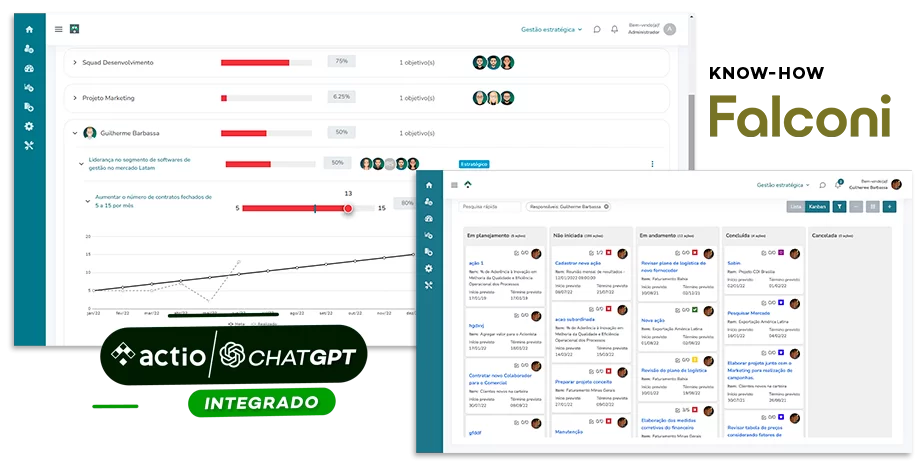
As we have seen, managing and integrating strategic, tactical, and operational planning requires method and real-time tracking. And trying to control all these levels, goals, and action plans through manual spreadsheets results in data loss, lack of governance, and misalignment among teams.
Actio’s Actio Strategic Management, management software developed by Actio in partnership with Falconi, was created specifically to address this challenge. The platform centralizes the three levels of planning in a single environment, allowing corporate goals to be broken down into tactical and operational action plans with complete transparency and automation.
With Actio Strategic Management, your company gains precision in decision-making, reduces communication noise, and ensures that every employee understands their real contribution to the business's success. Contact Actio's specialists and discover how Actio Strategic Management can revolutionize your company's management!
Frequently asked questions about strategic, tactical, and operational planning
Check out some of the most common questions on the topic below:
Skipping the tactical level creates a severe misalignment between management and operations. Thus, the company ends up with very abstract strategic goals that the frontline doesn't know how to execute on a daily basis.
This generates resource waste, task overload without priority, and operational paralysis.
Actio’s 5W2H It is used to unambiguously map how routine operational tasks will be executed. It establishes: What will be done (What), Why (Why), Where (Where), When (When), Who by (Who), How (How) and How much it will cost (How much), eliminating ambiguities and defining a single person responsible per action.
Yes. Although in SMEs the same professionals may accumulate both strategic and tactical roles, maintaining the conceptual separation of routines is indispensable. The manager must set aside time to define the company's direction (strategic), organize resource allocation (tactical), and monitor the execution of deliverables (operational).

