Contrary to popular belief, strategic planning is no longer about predicting the future, but about being prepared for it. And in a market that changes at the speed of a click, a robust plan is what separates companies that merely react to crises from those that set the pace for the industry.
That's why, whether you're a scaling startup or an established corporation, knowing how to structure this route is the first step to turning ambitious goals into real results. Want to know how? Come with Actio: in this post, we'll show you how to get planning off the ground and turn it into a practical competitive advantage.
Check it out!
What is effective strategic planning?

First of all, it's important to say that the strategic planning it is much more than a formal document. After all, it is a dynamic and continuous process that defines an organization's identity and future. Therefore, its central focus is to establish long-term goals and, above all, to map out the smartest path to achieve them.
And for it to work in practice, planning requires a deep dive into two main fronts:
- Scenario analysis: and it is necessary to look inward (strengths and weaknesses) and outward (market opportunities and threats);
- Resource management which involves deciding where to invest time, talent, and capital to maximize returns.
In other words, it functions as a strategic compass. In a constantly changing market, having this well-structured plan allows the company not only to react to unforeseen events but also to anticipate trends and adjust its sails with agility. It is the tool that transforms leadership's vision into concrete action plans, ensuring that all levels are aligned in the same direction.
Why is effective strategic planning the heartbeat of modern management?
Developing a strategic plan goes far beyond setting goals on paper. This is because it provides clarity and confidence for decision-making at all levels of the company. Thus, without it, management is adrift, reacting to crises instead of anticipating solutions.
Check out three pillars that show the vital importance of this process:
1. Clear view of the scene
Strategic planning forces managers and entrepreneurs to step away from day-to-day operations to see the big picture. This is because it allows for a realistic diagnosis of internal strengths and weaknesses, crossing them with market opportunities and threats.
This strategic awareness is what empowers leadership to define safe directions for growth and the conquest of new territories.
Also read: SWOT Analysis
2. Agility and proactive posture
Companies that plan are not caught by surprise. After all, by anticipating scenarios, executives can react much more agilely to changes, abandoning a defensive stance to adopt a proactive attitude.
This means having the necessary structure to adjust the route as the market demands, without losing sight of the ultimate goal.
3. Resilience and competitive advantage
In the end, planning not only serves to guide the company towards its goals: it makes it adaptable.
And in a volatile market, being able to face challenges with a plan B up your sleeve is what builds the resilience needed to survive and thrive. This is ultimately what transforms risk management into a strategic advantage. Developing a strategic plan goes far beyond setting goals on paper. This is because it provides clarity and confidence for decision-making at all levels of the company. Therefore, without it, management is adrift, reacting to crises instead of anticipating solutions.
How to create an effective strategic plan in 5 steps?

Knowing that strategic planning is important is the first step, but the real differentiator lies in execution. This is because a well-constructed plan is not a static work of art, but a practical tool that guides the team every day.
Therefore, to get ideas out of your head and turn them into a real growth roadmap, you need a clear method. Check out the 5 essential steps below for building a strategic plan that truly delivers results:
1 – In-depth analysis of the current situation
Before starting any planning, it is necessary to fully understand the context in which the company is situated. The SWOT analysis stands out as a valuable tool in this process, as it allows for a clear identification of internal strengths, weaknesses, external opportunities, and threats that the company faces.
In other words, this assessment offers valuable insights to guide future strategic decisions.
2 – Establishment of clear and measurable goals
With a solid understanding of the current situation, it's time to set clear, measurable goals to guide your company's growth.
Here, it's important that these goals are Specific, Measurable, Achievable, Relevant, and Time-bound (SMART). This way, by setting short-, medium-, and long-term objectives, the company gains a clear and tangible direction for its activities.
3 – Development of strategies
Once the goals are established, the next step is to develop strategies and actions aligned with these objectives. For example, if the goal is to increase the customer base, strategies may include product improvement, geographic expansion, or investment in digital marketing.
However, remember that specific actions must be detailed, indicating clear responsibilities and deadlines.
Related: Shared Goal Management: Aligning Teams
4 – Implementation with monitoring
Executing the plan requires close monitoring of progress against the established goals. After all, defining relevant key performance indicators (KPIs) allows for regular evaluation of the success of the adopted strategies.
Additionally, it is essential to closely monitor results and make adjustments as needed to ensure the company stays on track.
5 - Periodic Review
Finally, keep in mind that the business environment is dynamic and subject to constant change. Therefore, it is crucial to periodically review strategic planning and adapt it to new circumstances. Remember that remaining flexible and open to adjustments is fundamental to ensuring the plan's relevance and effectiveness over time.
Furthermore, it's important to leverage technological opportunities, such as strategic management software, to collect and analyze data that can inform more robust strategic decisions. Thus, by taking these detailed steps, your company will be well-equipped to face market challenges and achieve long-term success!
Introducing Tune by Actio, a strategic management software
As we've seen, building an effective strategic plan is the foundation of modern business management. By following the fundamental steps, from defining clear objectives to diligent monitoring, your organization positions itself to win in an increasingly competitive market. However, long-term success depends on transforming these intentions into monitored actions and measurable results.
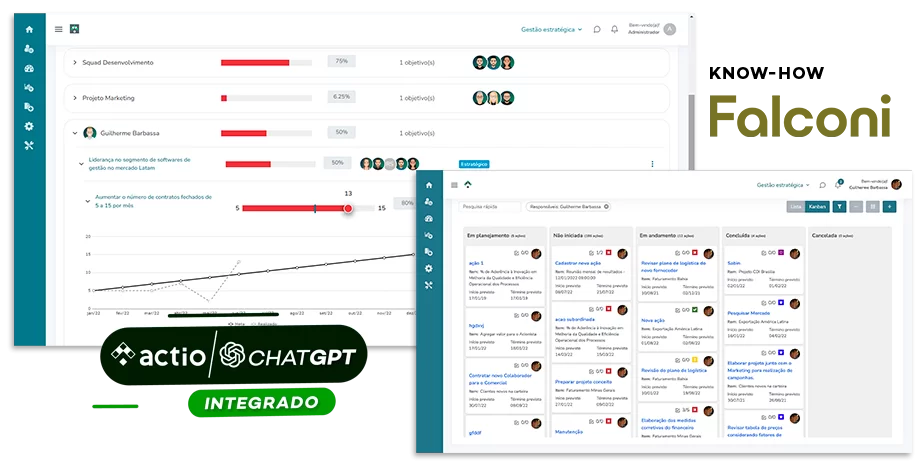
And for this implementation to be truly effective, team involvement is essential, but technology is what ensures the sustainability of the process. This is where the Tune by Actio becomes your greatest ally. After all, as the official strategic management software of Falconi Group, Tune offers complete control over goals, insights, and action plans in one place.
Betting on a solution that combines Falconi's expertise with Actio's innovation is the way to move from theory to flawless execution. In this way, with the right tools, planning ceases to be a bureaucratic challenge and becomes the engine of your business growth.
Did you like the content? Leave your comment below and don't forget to follow Actio on Instagram., LinkedIn and Facebook to follow more tips on management and strategy!
Frequently Asked Questions About Effective Strategic Planning
Check out some of the most common questions on the topic below:
As we saw, strategic planning defines the company's long-term objectives and general strategies, based on internal and external analyses. Tactical planning, on the other hand, translates these objectives into specific medium-term actions, coordinating different areas and with the participation of middle managers.
Finally, operational planning focuses on executing daily activities to achieve short-term goals. It is generally led by supervisors and line managers, focusing on the immediate allocation of resources and solving operational problems.
Strategic planning is part of an organization's strategic management process, which also includes monitoring results and restarting the decision-making cycle. Within this context, the SWOT tool is commonly used.
Although the focus is long-term (generally 3 to 5 years), review should be constant. Ideally, hold monthly or quarterly follow-up meetings to assess performance and bi-annual meetings for deeper tactical adjustments. This ensures the plan does not become obsolete in the face of sudden market changes.