
Managing risks is not just about avoiding crises: it's about ensuring that your company has firm ground on which to grow. That's why, in today's scenario, corporate risk management has gone from being a ‘security’ sector to becoming the driving force behind strategic decision-making.
But is every management structure worth the investment? After all, although it brings predictability and efficiency, implementing these processes also imposes operational challenges and costs that not every organization is ready to absorb.
With this in mind, in this article we're going to analyze the main advantages and disadvantages of risk management, as well as giving you practical examples so that you can assess the real impact on your business.
Read on to find out!
What is Risk Management?
In short, we can say that risk management is a structured process for identifying, evaluating and monitoring uncertainties in an organization. Its main objective is to minimize threats and maximize opportunities that could affect business success.
In other words, risk management is a proactive approach to dealing with uncertainties, allowing anticipation of challenges and adequate preparation to face them effectively.
Risk management therefore acts as a real preventative shield for the business. Imagine, for example, a company that depends on a single raw material supplier.
By identifying this bottleneck, the manager approves new partners in advance. This way, in the event of a logistical failure, production does not suffer critical interruptions.
Risk management example
Before you learn about the advantages and disadvantages of carrying out the risk management inherent, it is important to understand how this practice is used in various sectors.
Below, we will present some examples of areas where risk management plays a fundamental role, check them out:
1- Workplace Safety
Risk management is essential in the workplace to protect employees and ensure that operations are safe.
Examples include identifying and mitigating risks related to accidents, exposure to hazardous substances, and implementing workplace safety measures.
2- Environmental
In the environmental context, risk management aims to minimize the negative impacts of operations on ecosystems. This involves assessing and reducing environmental risks such as air and water pollution, deforestation, and soil degradation.
3- Hospital
In healthcare institutions, risk management plays a crucial role in ensuring patient safety and preventing medical errors.
Furthermore, health risk management, in compliance with Anvisa guidelines, is essential to maintain the integrity and effectiveness of health services, making the sector more reliable and safe.
Examples include identifying and controlling risks related to surgical procedures, prescription of medications, and patient data management.
Looking for risk management software? Meet Actio Risk Management!
4- Project
Risk management plays a crucial role in projects, where uncertainties can impact the schedule and budget. This affects not only the organization, but also the stakeholders.
Examples include identifying risks that can delay a task, such as changes in customer requirements, lack of resources, or technical issues.
5- Financial Investment
Finally, the last example of risk management is in the financial world. In this case, the management of inherent risks is essential to protect investments and assets.
Examples of risks here include stock market volatility, currency fluctuations, and credit risks.
5 advantages of risk management
As we have seen, corporate risk management is not just a bureaucratic process, but a strategy that can bring countless benefits to your business. Here are five advantages of risk management that you need to know:
1- Informed Decision-Making:
Managing inherent risks gives companies a clearer view of the threats and opportunities they face. This allows leaders to make more informed decisions, minimizing risks and maximizing returns.
Remember that understanding the risks involved in each decision is fundamental for sustainable growth.
2- Loss Reduction:
One of the main objectives of risk management is to minimize financial losses. This is because by proactively identifying and mitigating risks, companies can avoid disastrous situations and protect their financial assets.
This is particularly important in times of economic uncertainty.
3- Compliance with Regulations
Many industries are highly regulated, and non-compliance with standards can result in severe penalties. Corporate risk management helps companies ensure compliance with all relevant regulations, thereby reducing exposure to fines and sanctions.
4- Continuous Improvements:
Inherent risk management is not just about avoiding problems; it is also a means of driving continuous improvement. Thus, by identifying risk areas, companies can implement improvements in processes, systems, and practices, becoming more efficient and competitive.
5- Building Trust
Risk management demonstrates a company's commitment to responsibility and sustainability. This not only builds the trust of investors and customers, but also strengthens the organization's reputation.
After all, trust is a valuable asset in business.
Also read: Strategic management trends
5 Disadvantages of Risk Management
Risk management is an essential practice for companies wishing to protect their interests and guarantee the continuity of their operations. However, although it is a valuable tool, risk management is not without its drawbacks. Check them out below:
1-Complexity of Risk Management:
As we've already mentioned, risk management is a complex process that involves identifying, evaluating and mitigating risks in all areas of a company. That's great, right? However, we need to consider that this complexity can overwhelm managers and require significant resources.
Additionally, a lack of proper understanding of risks can lead to misguided decisions.
2- Personnel Requirements:
To effectively manage risks, qualified and trained personnel are necessary. Hiring and training risk management specialists can be expensive and time-consuming.
In addition, a lack of qualified personnel can compromise the effectiveness of the process.
3- Time Consumption:
Risk management is not a quick process. After all, identifying, assessing and mitigating risks takes time, which can be a disadvantage in a dynamic business environment.
In addition, delays in making decisions can result in lost opportunities or increased risks.
4- Impact on Business Decisions:
Risk management can also significantly influence business decisions. This is because companies can sometimes become overly cautious, avoiding opportunities that could be beneficial.
5- Response to Incidents:
Companies may face unforeseen incidents even with an effective risk management system. Responding to these incidents can be challenging and disruptive, affecting normal business operations.

How to mitigate the disadvantages of risk management?
Although challenges exist, it is perfectly possible to mitigate all the disadvantages mentioned through a strategic and structured approach. After all, complexity decreases when the company establishes clear processes and uses the right tools for each step.
To reduce time consumption and the operational burden, the key is to invest in flow automation. In this way, you replace manual data collection with systems that generate alerts and reports in real time.
In addition, the issue of qualified personnel can be resolved by focusing on organizational culture. Therefore, by training internal teams, risk management ceases to be an “isolated department” and becomes a shared responsibility.
In this sense, the use of integrated technologies, such as Actio Risk Management, facilitates the visualization of the risk matrix. This allows managers to focus on strategic analysis instead of wasting time with the bureaucratic organization of data.
Finally, the balance between caution and agility arises when processes are dynamic. Thus, your company gains operational security without hindering decision-making or losing market opportunities!
Meet Actio Risk Management, risk management software
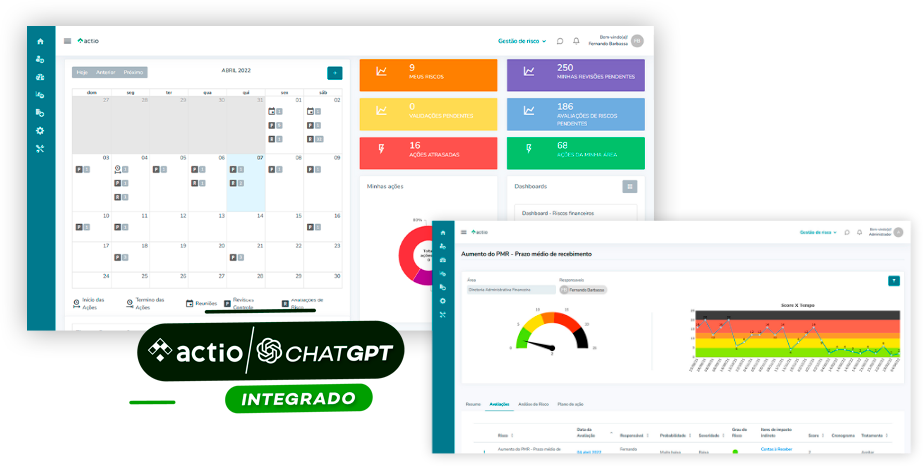
As we've seen throughout the article, risk management is vital for business survival. Therefore, Actio, in partnership with Falconi, developed Actio Risk Management!
This software is designed to meet the specific needs of your organization. That's because with it, you can centralize all communication and make it easier to monitor strategic actions.
But that is not all, since the tool allows you to create robust risk matrices and efficient mitigation plans. Furthermore, major names like the Hospital Alemão Oswaldo Cruz already use Actio Risk Management successfully!
Don't miss the chance to increase your business's competitive edge with intelligence. Did you like the content? Then follow Actio on LinkedIn and Facebook for more updates!
Inherent risk is the exposure to dangers or uncertainties that an organization naturally faces without considering mitigation measures or corrective actions.
It reflects the level of risk to which a company or project is inherently exposed, regardless of implemented risk management strategies.
Any company, regardless of size or industry, can benefit from corporate risk management. Risk management is essential to protect assets and drive growth, from small family businesses to large corporations.
The first step is to carry out a diagnosis of internal processes in order to map vulnerabilities. In addition, it is essential to define who will be responsible and to choose a methodology, such as the ISO 31000, to guide mitigation strategies.
Some common challenges in risk management include the accurate identification of risks. Additionally, allocating resources for risk mitigation and adapting to changes in the business environment are also some of the challenges encountered.