
Do you know what performance-based bonuses are? Keeping employees engaged and motivated to achieve goals is a constant challenge in organizations.
Therefore, many choose to adopt different forms of compensation, such as performance-based bonuses. This approach aims to stimulate teams to generate better performances.
This blog will explore the main aspects of performance-based bonuses and how to apply them to boost your team’s performance. Keep reading to understand more!
What is a performance-based bonus?

Performance-based bonuses are typical in many organizations, where employees receive financial incentives or other rewards based on their performance and results.
Additionally, this strategy aims to recognize hard work and positive results and encourage excellence and ongoing commitment.
Unlike the fixed monthly remuneration that represents the salary, performance-based bonuses are an additional reward for employees (monetary or non-monetary), which organizations use as an addition to the fixed salary.
In other words, its main objective is to incentivize the employee by rewarding them for achieving a particular goal.
What are the types of bonuses?
Organizations can offer several forms of bonuses to reward performance and motivate employees. Check out the following:
Performance bonuses: This type of bonus is granted to employees based on their performance and productivity. Additionally, it’s a way to recognize and reward those who excel in their responsibilities.
Seasonal bonuses: During specific periods, such as the holiday season, companies offer seasonal bonuses to express gratitude to employees and encourage them to maintain good work.
Sales commissions: As part of the company’s profits, sales commissions are offered to employees who meet or exceed established goals, providing an additional incentive to achieve sales objectives.
Team goal bonuses: Besides recognizing individual performance, team goal bonuses encourage collaboration and teamwork to achieve shared objectives.
Fixed bonuses: As a form of recognition for specific achievements or essential events, set bonuses are added to employees’ salaries, demonstrating appreciation for their exceptional work.
These various forms of bonuses incentivize employees and promote a more motivating and productive work environment.
Looking for performance review software? Meet Actio Individual Performance!
But after all, who is entitled to performance-based bonuses?
The beneficiaries of performance-based bonuses include all employees who meet established goals, individually and collectively, as defined by the standards set by the company.
Additionally, this reward system includes employees who demonstrate satisfactory performance according to the criteria established in the bonus regulations.
Benefits of performance-based bonuses

Over the years, organizations from different sectors have adopted this approach due to its numerous benefits, as we will see below.
1- Enhanced motivation and engagement
Bonuses for results act as a significant stimulus for employees, pushing them to reach and exceed the targets set by the company.
In this way, the prospect of additional earnings promotes a sense of purpose and commitment, raising the level of employee engagement and dedication to their responsibilities.
2- Directed focus on results
By directly linking remuneration to the results obtained, performance bonuses effectively direct employees' attention to organizational goals and objectives.
In addition, this practice contributes to the creation of a corporate culture based on achieving concrete results and striving for collective success.
3- Reduction of turnover
High turnover rates represent the loss of valuable talent, which requires the company to invest in constant training processes for new employees.
However, this not only generates additional costs; it also takes up precious time that could be directed to more productive activities.
In other words, offering an attractive bonus for results not only motivates current employees; it also makes the company more attractive to talented professionals who seek recognition and reward for their exceptional performance.
How do we implement an effective performance-based bonus system??
Implementing an effective performance-based bonus system requires carefully considering various essential steps and criteria to ensure its effectiveness and acceptance among employees.
To do this, it is crucial to follow a series of well-defined steps:
1- Understand the team’s profile
First and foremost, it's crucial to understand employees' preferences and motivations. This allows us to offer incentives that truly motivate them.
In this way, carrying out surveys and individual conversations helps to understand what employees value as a reward.
2- Establish clear and achievable goals
The success of performance bonuses depends on setting clear, specific and measurable targets.
In other words, the goals must represent achievable challenges, aligned with the organization's strategic objectives; so that everyone understands what needs to be achieved.
3- Establish an adequate budget
It is essential to establish a clear and realistic budget for the bonus program.
This ensures that there are sufficient resources to reward exceptional employee performance.
4- Explore strategic partnerships
Seeking partnerships with other companies or suppliers can expand reward options and add value to the bonus program.
5- Promote efficient communication
Making sure that all employees clearly understand the criteria and procedures of the bonus program is essential.
In this way, open and transparent communication contributes significantly to the success of the system.
6- Ensure timeliness in rewarding
Strictly adhering to bonus payment deadlines is fundamental. Delays can lead to frustrations and undermine employee confidence in the incentive program.
7- Monitor the bonus program
Finally, after a period of implementation, it is essential to carry out periodic evaluations of the bonus program.
Thus, having predefined dates to analyze whether the plan is working as expected or requires adjustments is of the utmost importance.
This practice makes it possible to identify opportunities for improvement and ensure the ongoing effectiveness of the bonus-for-results system.
By following these steps and considering the mentioned criteria, organizations can implement a performance-based bonus system that motivates employees, promotes engagement, and contributes to the company’s overall success.
Meet Actio Individual Performance, performance management software
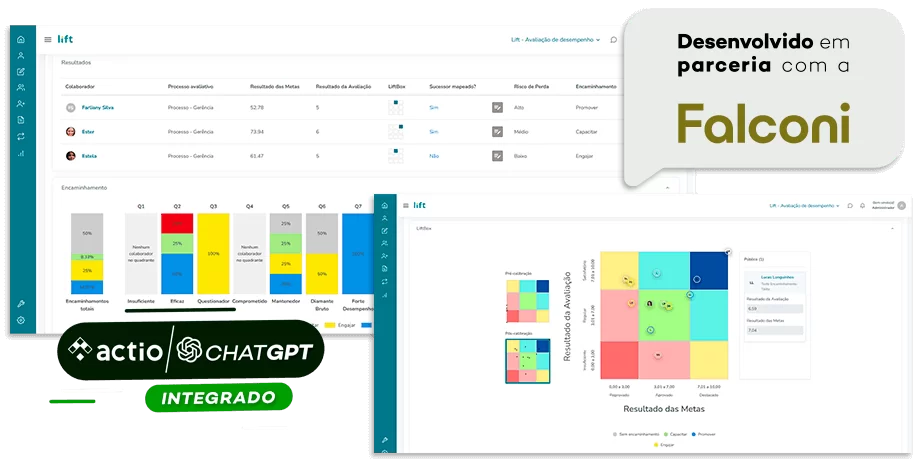
The Actio and Falconi joined forces to create the Individual Performance Action, software designed to revolutionize people management.
This tool offers a wide range of features, including feedback calculation; leader assessments; pairs; self-assessments and followers; development of individual plans (PDI); calibration; creation of succession maps and much more.
Moreover, Individual Performance Action is highly adaptable and can be customized to meet your organization's specific needs.
Frequently Asked Questions
1- What is the definition of a bonus?
A bonus refers to an additional advantage or benefit granted to someone, usually in recognition of exceptional performance; a specific achievement or as a form of incentive.
In the financial context, a bonus can also refer to the free distribution of additional shares to a company's shareholders.
2- How to calculate a performance-based bonus?
To calculate a performance-based bonus, it is usually necessary to determine the performance criteria established by the company or organization.
Once these criteria have been defined, the calculation of the bonus can vary. It usually involves the application of a formula that takes into account individual or collective performance in relation to established objectives.
In addition, the criteria can include sales targets, profitability, customer satisfaction, among others.
3- What is a stock bonus?
A stock bonus is a common practice in some companies, where the company issues additional shares to existing shareholders at no extra cost.
Additionally, this free issuance of shares is a way to reward investors. It can be done for various reasons, such as capitalizing reserves, increasing stock liquidity, or as an incentive strategy.
Conclusion
Results-based bonuses are a powerful tool for boosting your team's performance and productivity.
By setting clear goals, defining transparent evaluation criteria and offering personalized incentives; you can create a work environment that promotes excellence and continued success.
Don’t forget to follow Actio on Instagram, Linkedin and Facebook.
Did you like the content? Tell me in the comments.