No time to read now? How about listening to the article?
Have you ever wondered how some of the world's biggest companies, such as Google and iFood, manage to attract the best talent and maintain a highly motivated and productive team? The answer lies in the implementation of employee bonuses!
Just imagine: a highly engaged team, where every employee feels motivated to achieve the best possible performance, knowing that this could result in a significant increase in their remuneration. This approach is the key to valuing your professionals and, at the same time, boosting your company's results
But do you really know how employee bonuses work in practice? What are its advantages and how can you apply this model in your own company? Don't worry, we'll tell you in this blog!
What is an employee bonus anyway?

Employee bonuses are a way of rewarding the performance of employees and encouraging them to exceed targets set within a given period. What's more, it's a category of flexible benefits that can be granted either individually, to highlight outstanding employees, or collectively, to reward entire teams.
This variable compensation strategy offers various reward possibilities and can be implemented in different ways, such as:
- Monetary values: Provide financial compensation to the employee, recognizing their efforts and results.
- Travel and accommodation guaranteed: A rewarding experience that allows employees to enjoy special moments.
- Food hampers, gift vouchers or various products: It offers employees freedom of choice, making the benefit personalized and attractive.
- Registration for courses and training: It invests in employees' professional development, strengthening their skills and knowledge.
- Right to additional time off: It provides a well-deserved rest to recharge after a period of high performance.
What is the difference between bonuses and PLR?

Bonuses and profit sharing (PLR) are two different forms of reward designed to encourage employee productivity and commitment.
The main difference between them lies in the implementation process. While employee bonuses are an internal company initiative that does not require prior negotiation, profit sharing must be negotiated between the company, its employees, and union representatives before being formalized in a collective agreement.
Another important aspect is the frequency of the award. The PLR must be paid annually whenever the company records profits and good results, as agreed in advance. On the other hand, bonuses can be paid at specific times determined by the company and are not necessarily linked to a fixed periodicity.
However, it is essential to note that bonuses for employees must be established with clear performance criteria. If it occurs too frequently, without well-defined metrics, or becomes a constant practice, similar to salary, it can be considered an integral part of remuneration and, consequently, will be subject to labor charges.
What are the advantages of bonuses for employees?

Recent research has revealed that financial stress is the biggest concern faced by Brazilians, and its impacts go beyond personal life and are directly reflected in companies. Employees' financial stress can lead to problems such as a lack of motivation, a drop in productivity, an increase in absenteeism and turnover rates, and the loss of talent to other companies.
In this context, benefits that promote employees' financial health and peace of mind, such as performance bonuses, bring a series of advantages to the company. Check out some of these advantages below:
- Motivation and Productivity: Bonuses for results encourage employees to strive for excellence in their activities, boosting team motivation and productivity.
- talent retention Valued employees tend to stay with the company longer, reducing turnover and the costs associated with training and terminations.
- Attracting talent: Offering performance bonuses attracts top professionals in the market, making the company more competitive in its talent acquisition.
- Strengthening the Bond with the Company Bonuses strengthen the bond between employees and the company, creating a sense of belonging and engagement with the organizational objectives.
- Positive Work Environment Valuing employees' efforts promotes a healthier, more collaborative and inspiring working environment.
- Professional Development: The bonus can be used to invest in courses and training. Additionally, the gratification fosters the professional development of employees.
- Better people management: With motivated and engaged employees, the Human Resources sector finds it easier to manage human capital, optimizing the company's performance.
Looking for variable compensation software? Meet Actio Variable Compensation!
Step-by-step guide to applying employee bonuses in your company

1- Simplify the bonus process
An effective bonus program is clear and direct, avoiding misinterpretation. Use short sentences that describe the targets for earning the bonus. For example, a bonus of R$500 for selling 10 laptops. Make a clear distinction between individual and collective targets.
2- Increase and recognize productivity
Recognize the efforts of employees who contribute with greater productivity, whether through more working hours or generating new business. Furthermore, recognition strengthens the company-employee relationship and encourages dedication and loyalty.
Base the bonus on revenue growth
Consider offering bonuses when sales revenue exceeds previous results. Goals should be realistic and achievable, avoiding the loss of employees' prestige and trust in management.
4- Encourage and reward active participation
Value the most participatory and proactive employees, those who solve problems without constantly depending on their superiors. Share the benefits generated by their actions through a bonus program.
Provide regular feedback.
Maintain a consistent practice of providing feedback to employees. In addition, individual performance appraisals help employees understand their contributions and align themselves with the company's expectations.
6 - Pay on time
Never delay the payment of bonuses, as this can undermine employee confidence in the company. The company must remain committed to rewarding good employee performance, as well as expecting positive results from them.
When implementing an employee bonus program, your company values and motivates the team, increasing productivity and building a more efficient and positive organizational culture. Always remember to keep the process simple, objective, and in constant dialogue with employees.
Why invest in employee bonuses with variable compensation software?
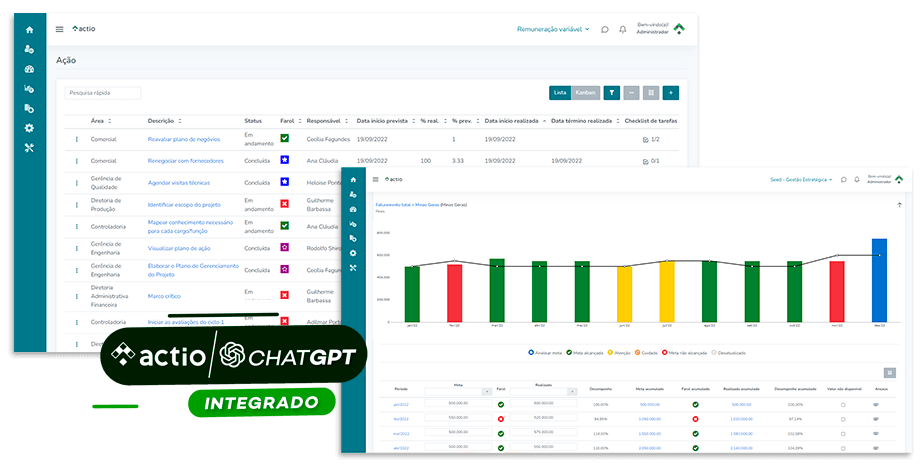
Technology can be an ally in choosing the bonus that best suits your company. That's why Actio developed the software Actio Bonus Management, the only variable compensation software approved by Falconi, the largest consultancy in Brazil, and which also seeks to bring transparency to the disclosure of achieved goals and employee bonuses.
With Actio Bonus Management, you will have real-time access to individual results, allowing clear visibility in the variable remuneration process. The software also calculates commissions, ICP, PLR, bonuses, ILP, and much more, adapting to your organization’s specific needs. If facing challenges in this area, consider Actio’s software to simplify the process.
Don't forget to follow Actio on Instagram, Linkedin and Facebook, to stay updated on our solutions and news.