Strategic planning is the roadmap for any organization. But the real challenge isn't in drawing it up; it's in ensuring it moves from paper to reality and generates tangible results. Therefore, if you're looking for a methodology that connects your company's vision to day-to-day execution, the Balanced Scorecard (BSC) is the ultimate solution.
After all, much more than a set of indicators, BSC is a management model that allows us to understand the current scenario, align expectations, and translate complex goals into practical actions. And by balancing indicators with customer, process, and learning perspectives, your company stops focusing solely on the past and starts building the future.
Want to know more? In this comprehensive guide, we'll dive into the world of the Balanced Scorecard. You'll discover how this tool can transform business performance, accelerate results, and how Actio technology can be your greatest ally. Happy reading!
But, after all, what is the Balanced Scorecard (BSC)?
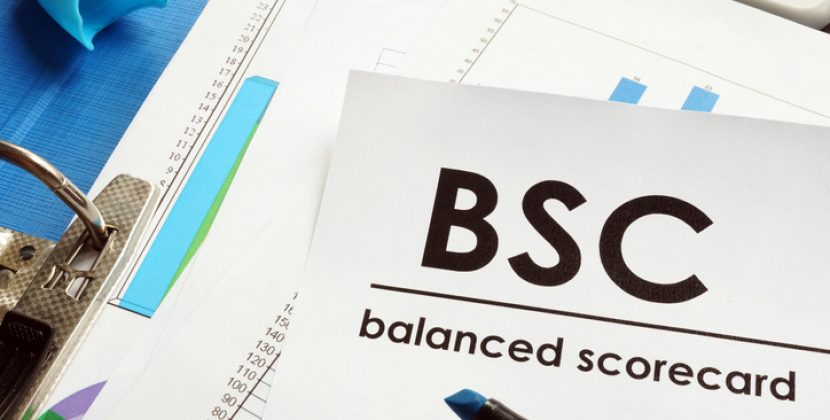
In summary, the Balanced Scorecard (BSC) is a strategic management methodology that translates a company's mission and vision into practical objectives. Created by Harvard professors Robert Kaplan and David Norton, the model emerged to overcome the limited view of the industrial era, which focused solely on financial indicators, proposing a much more balanced and complete management.
The great differentiator of the BSC, therefore, is its 360° approach. After all, it allows the organization to align its values and long-term goals with four perspectives: financial, customers, internal processes, and learning and growth. In this way, management stops looking only at past profits and begins to monitor the factors that truly drive future performance and business sustainability.
In practice, the BSC transforms abstract strategies into concrete indicators and initiatives. Thus, by balancing immediate financial results with investments in innovation and relationships, the company gains clarity to make difficult decisions in the present.
How does the Balanced Scorecard work?
The Balanced Scorecard (BSC) is a strategic approach based on four fundamental strategic components: objectives, targets, indicators, and initiatives. These components are primarily applied in conjunction with the four BSC perspectives: financial, customer, internal processes, and learning and growth.
Now, let's understand in more detail what each one represents!
What are the 4 strategic components and perspectives of the Balanced Scorecard?
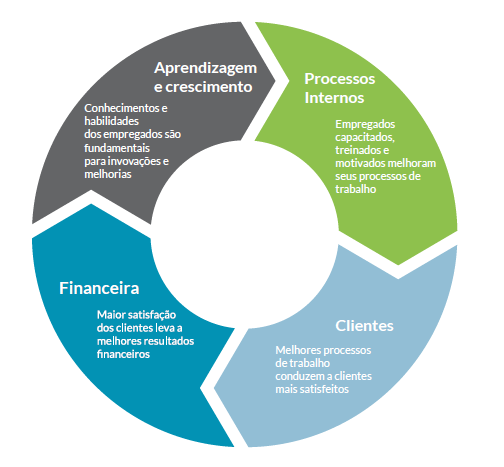
As we said, the secret to Balanced Scorecard It's not just about listing indicators, but about understanding how different areas connect to generate value. That's why you can imagine the BSC as a system of gears: for the financial results to appear at the top, the company's foundation needs to be solid.
And for this gear to turn, the BSC organizes the company into four fundamental perspectives. In each of them, you must unfold the strategy into four levels: objectives (what we want), indicators (how we measure), targets (the desired value), and initiatives (the practical actions).
See how this structure applies to each pillar:
1 - Learning and Growth Perspective
Everything starts with people and knowledge. And if your team isn't trained, the company doesn't evolve.
Example: your goal is to train the team on a new management methodology. The indicator, therefore, will be the number of training hours, with a target of 40 hours per person. The practical initiative, in this case, is to contract a course platform.
Without this knowledge base, you won't have the leverage to improve internal processes.
2 – Internal Processes Perspective
With a trained workforce, the focus shifts to operational efficiency. The goal here, therefore, is to ensure that internal operations are top-notch, reducing errors and production time.
In these cases, the metric could be the average time it takes to complete a task, with the goal of reducing that time by 20%. The initiative, on the other hand, would be to automate a step in the process.
Remember: when the internal process improves, the reflection reaches the customer directly.
3 - Customer Perspective
Here's how the market views your delivery. And if your internal operations (the previous step) are fast and flawless, your natural goal is to increase customer satisfaction.
The success indicator here is the satisfaction level (NPS), with the goal of achieving a high score. And the initiative could be the creation of a more agile support channel.
Remember: it's the satisfied customer who guarantees the health of the cash register.
4 – Financial Perspective
This is the final result. It's the top of the pyramid where the company owner looks. The objective here is to generate profit or increase revenue. Therefore, the indicator is the amount of cash in reais, the goal is to achieve a specific revenue amount for the month, and the initiative is the sales campaign that will attract this money. In the BSC, the financial perspective only does well if all three other perspectives below it function correctly.
In summary: In each of these four areas, you always need to answer the following questions: What do I want? (Objective), How do I measure it? (Metric), What is the number that defines success? (Target), and What will I actually do? (Action). That is why these four elements always go hand in hand at every level of the company.
Also read: Steps of strategic planning
How to apply the Balanced Scorecard using the strategy map?
First and foremost, it's important to highlight that a strategic map is the design that shows how your strategy will be put into practice. As such, it functions as a visual representation that connects the objectives of the four perspectives, clarifying the path the company needs to follow.
Furthermore, the map's great advantage is its clarity. After all, instead of long texts, it offers a single image where everyone can see how one area helps another.
Keep reading and check out the fundamental steps to create your map and make the process easier!
1 – Definition of the Strategic North
The first step is to look to the future and determine where the company wants to go in the medium and long term. And this direction must be fully connected to the organization's mission, vision, and values, serving as the compass that will guide all subsequent decisions.
Without this well-defined direction, the company runs the risk of creating indicators that lead nowhere. For this reason, it is at this stage that you establish the highest priorities that will give meaning to the objectives of each of the four BSC perspectives.
2 – Value Proposition Construction
Before setting internal goals, it's essential to understand what makes your company unique in the market. Your value proposition is the promise you make to your customer, identifying needs that only your business can meet in a differentiated and competitive way.
Therefore, by having clarity on what the client truly values, it becomes much easier to align the company's processes to deliver on that promise. This definition is what prevents the organization from wasting resources on improvements that the market does not consider important.
3 – Alignment of Financial Strategies
At this stage, you define what success means to stakeholders or business owners. The focus here is on establishing clear goals for revenue growth, reduction of operational costs, and maximization of returns on every investment made.
Furthermore, the financial strategies on the strategic map function as the final outcome of the operation. After all, they show whether the strategy as a whole is sustainable and whether efforts in other areas are truly translating into economic health for the company.
4 – Focus on customer strategies
Based on the value proposition defined in step 2, it's now time to outline how you will attract, satisfy, and retain your audience. This involves identifying target market segments and defining which relationship and quality indicators will be closely monitored.
The goal here is to translate the client's vision into numbers. By understanding exactly what satisfies their consumer, the company can build a solid bridge between internal operations and the desired revenue increase from a financial perspective.
5 - Structuring internal processes
Here, you identify the key processes that support customer delivery. The focus, therefore, should be on the continuous improvement of operations, whether in production agility, product innovation, or excellence in after-sales service.
Well-structured processes are what ensure that strategy doesn't depend on luck. And by optimizing internal activities, the company gains efficiency, reduces errors, and can deliver its promised value proposition much more consistently.
6 – Strengthening learning and growth
This step focuses on the company's foundation: people and infrastructure. The goal is to develop the team's competencies, strengthen the organizational culture, and ensure that available technology supports all organizational activities.
Remember: a company can only evolve its processes if its team is trained and motivated to do so. Therefore, at this stage, planning focuses on how digital knowledge and tools will be used to drive innovation and keep the company competitive in the long term.
7 – Connection and visualization of cause and effect
The final step, and perhaps the most important, is to connect all the previous points with arrows showing the cause-and-effect relationship. This way, by visualizing how learning drives processes, which satisfy customers and generate profit, the strategy gains logical and visual sense.
This integrated view helps identify bottlenecks and understand how progress in one goal directly impacts the others.
How can technology help you in applying the Balanced Scorecard in your company?
Many companies fail to implement the Balanced Scorecard because they try to manage complex goals through manual spreadsheets and decentralized information. This scenario leads to a lack of clarity and makes it difficult to visualize the connections between areas.
Therefore, for the BSC to be truly effective, it is essential to have technology that centralizes the entire strategy in one place, allowing leadership to track progress in real-time and stay focused on what generates results.
Actio’s Actio Strategy Management it is the ideal tool for this process, offering a complete platform that unifies the development of this map with the monitoring of indicators. With support for methodologies such as BSC, OKR, and PDCA, the software allows you to choose the best approach for your business, ensuring that all teams are aligned with the organization's vision. Thus, management ceases to be a bureaucratic task and becomes the engine of performance, driving excellence and quality in processes.
Don't forget to follow Actio on Instagram, LinkedIn and Facebook.
Frequently Asked Questions about the Balanced Scorecard (BSC)
Check out some of the most common questions on the topic below:
Although both focus on results, the BSC is geared towards long-term strategy and the overall health of the organization through fixed perspectives. OKRs (Objectives and Key Results), on the other hand, are typically used for shorter cycles and more agile, team-specific goals.
The senior leadership team defines the strategic direction, but managers from each area must participate in the creation of indicators. This ensures that the goals are realistic and that the entire company feels responsible for the results.
The ideal is to keep between 2 and 5 indicators per perspective. Remember that having too many indicators generates confusion and disperses focus; the objective of the BSC is to prioritize what is truly vital for success.