Skip to content
  • English
  • Português
  • Español
  • English
  • Português
  • Español
  • Products
    • Actio | Strategy Management
    • Actio | Project Management
    • Actio | Risk Management
    • Actio | Audit
    • Actio | Document Management
    • Actio | Process Management
    • Actio | Checklist Dayway
    • Actio | Individual Performance
    • Actio | Bonus Management
  • Solutions
    • Actio | Corporate Performance
    • Actio | Strategy Deployment
    • Actio | Strategy Execution
  • Services
    • Integrations
    • Analytics
  • Cases
  • Knowledge
    • Blog
    • Events and Webinars
  • Community
  • Contact us
  • Become a partner
  • Products
    • Actio | Strategy Management
    • Actio | Project Management
    • Actio | Risk Management
    • Actio | Audit
    • Actio | Document Management
    • Actio | Process Management
    • Actio | Checklist Dayway
    • Actio | Individual Performance
    • Actio | Bonus Management
  • Solutions
    • Actio | Corporate Performance
    • Actio | Strategy Deployment
    • Actio | Strategy Execution
  • Services
    • Integrations
    • Analytics
  • Cases
  • Knowledge
    • Blog
    • Events and Webinars
  • Community
  • Contact us
  • Become a partner
Contact us

Home " OKRs in 2025: Why They Still Matter — and Where They Fall Short 

OKRs in 2025: Why They Still Matter — and Where They Fall Short 

Discover why OKRs remain relevant in 2025, where they fall short in real-world use, and how to choose the best performance management method for your business.
  • Guilherme Barbassa
  • Strategy and Performance
  • 21:25
  • 13/06/2025

Table of contents

Foto de Guilherme Barbassa

Guilherme Barbassa

Guilherme Barbassa is CEO of Actio Software, with over 20 years of experience in strategic management and business transformation. He works in the integration between strategy, governance, and technology, supporting senior leadership in building results-oriented management systems.

Read also

Home » Blog » Strategy and Performance
" OKRs in 2025: Why They Still Matter — and Where They Fall Short 

OKRs in 2025: Why They Still Matter — and Where They Fall Short 

Indicators are essential, but they can hinder strategy execution when they fail to guide decision-making. Learn when metrics turn into noise.

  • By Guilherme Barbassa
  • Strategy and Performance
  • 16:00
  • 13/06/2025

Table of contents

OKRs (Objectives and Key Results) remain a vital tool for turning strategy into action ever since their inception in the 1970s by Andrew Grove, former CEO of Intel. Since then, John Doerr—one of Google's earliest investors—has spread the system across corporate environments, making it a standard management approach in leading tech companies and startups.  

However, the methodology has its limitations, especially if misapplied. Discover now whether adopting OKRs makes sense for your business. 

Enjoy the read! 

OKRs: A Brief Recap 

Before getting straight to the point, it’s useful to remember what this methodology actually is, so everyone’s on the same page. Developed in the 1970s by Andrew (Andy) Grove at Intel, and inspired by Peter Drucker’s earlier M.B.O. methodology, Objectives and Key Results is a system that brings clarity to qualitative goals. It does so by pairing them with tangible key results, which are often difficult to identify when objectives remain abstract. 

Example OKR: 

Objective (O): 

Reduce the company's carbon footprint by 25% by the end of 2025, using artificial intelligence to optimize operations and promote a culture of transparent environmental responsibility. 

Key Results (KRs): 

  1. Implement an AI-powered system by August 2025 to monitor real-time energy usage across at least 80% of the production chain. 
  1. Decrease average monthly energy consumption by 15% by November 2025 through AI-driven automation. 
  1. Publish quarterly ESG reports with data verified by external audits to ensure transparency and traceability. 
  1. Roll out mandatory sustainability and ethical AI training for 100% of staff by October 2025. 
  1. Convert 40% of logistical fleet to electric vehicles by December 2025. 

What OKRs Can Do for You 

Given this context, it’s clear why the system gained traction, right? Thanks in part to John Doerr’s promotion, OKRs became even more well-known and continue to be part of the management playbooks at Uber, Netflix, and Google. 
 
But the real reason for their popularity lies beyond historical momentum. Their benefits are tangible: strategic alignment across operational layers, faster goal execution, employee engagement, process transparency, and—above all—a data-driven culture with little room for guesswork. 

Nevertheless, no performance management system works miracles. Without the right strategy and discernment, OKRs can even lead to delays and long-term setbacks.  

What OKRs CAN'T Do for You 

Despite their strategic potential, OKRs are not magic bullets—and they can fail in many scenarios. Used as mere self-assigned tick-box exercises, they degenerate into number games, where results and milestones are manipulated to appear successful, diluting the methodology’s original intent. Moreover, the quarterly pacing demands intense dedication, which can upset work-life balance if not managed carefully.

Effective adoption also relies on a mature organizational culture and leaders capable of steering strategy into action—otherwise, OKRs remain a bureaucratic checklist. Excessive focus on individual goals can fragment teams and weaken collaboration. For smaller businesses, the additional hurdles of high implementation costs and the time needed to build cultural maturity pose real barriers to effective adoption.

Effective adoption also relies on a mature organizational culture and leaders capable of steering strategy into action—otherwise, OKRs remain a bureaucratic checklist. Excessive focus on individual goals can fragment teams and weaken collaboration. For smaller businesses, the additional hurdles of high implementation costs and the time needed to build cultural maturity pose real barriers to effective adoption. 

Contemporary Examples 

In 2025, organizations confront hybrid work models, economic volatility, and mounting pressure for digital productivity. A compelling example of how OKRs aren’t always the answer—and certainly not without integrated strategic and cultural alignment—is the recent case of the U.S. Office of Personnel Management. Under new leadership, there was an attempt to copy Silicon Valley discipline in a public agency by mandating weekly progress reports. However, the effort faltered when it overlooked critical cultural and operational differences. 

The proliferation of digital tools has enabled continuous monitoring—but also amplified surveillance biases and burnout risks. Giants like Microsoft and Netflix still utilize OKRs but have shifted toward qualitative dialogue over raw scoring. 

OKRs remain relevant in 2025—especially for organizations looking to accelerate strategic execution. But they work only when supported by: 

  1. A culture of meaningful conversations, not just metrics. 
  1. Leaders who guide without micromanaging. 
  1. Tracking tools paired with clear boundaries to prevent undue pressure. 

Delve deeper with our material below and understand how to outline and identify indicators that drive performance and underpin the definition of good OKRs: 

Indicators for improved performance

Regardless of the methodology, Actio Strategic Management is for you 

Even if OKRs aren’t an ideal fit for your business right now, there’s no shortage of alternative systems—BSC, KPI, ISO 31000, and more—that may align better with your reality.  

Whether it's OKR, BSC, KPI, ISO 3100, or any other methodology, the most important thing is to have a platform that enables the implementation of these systems with precision, practicality, and strategic visualizations for valuable executive decisions. This tool is Actio Strategic Management. 
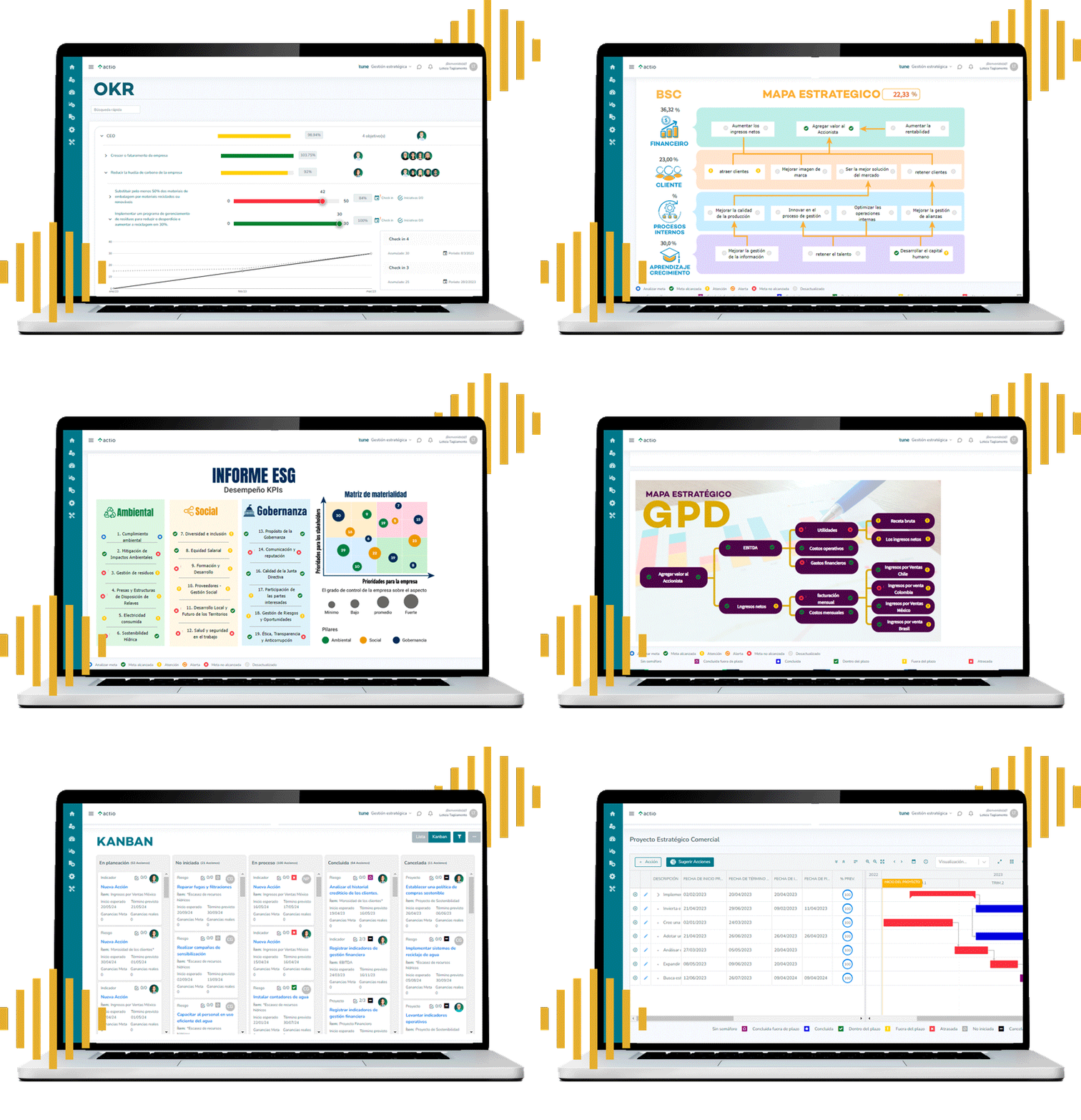
In addition to supporting all these methodologies, Tune offers action planning, real-time indicator tracking, and integration with tools like Power BI and ChatGPT, combining data and technology to drive results. 

Visit our page with details about the tool and the companies that are already revolutionizing performance management with Actio Strategic Management. 

Meet Actio Strategic Management

Follow us on our socials — LinkedIn, Instagram and Facebookfor practical, insightful tips for your corporate journey. 

Guilherme Barbassa
Guilherme Barbassa

Guilherme Barbassa is CEO of Actio Software, with over 20 years of experience in strategic management and business transformation. He works in the integration between strategy, governance, and technology, supporting senior leadership in building results-oriented management systems.

Foto de Guilherme Barbassa

Guilherme Barbassa

Guilherme Barbassa is CEO of Actio Software, with over 20 years of experience in strategic management and business transformation. He works in the integration between strategy, governance, and technology, supporting senior leadership in building results-oriented management systems.

Fill out the form and get to know the solution da Actio to manage strategy with governance, visibility, and alignment over time.

Read also

What is strategic management and how to implement it in an organization 

Strategy and Performance
Read more

Intelligent Automation: the new paradigm of strategic execution 

Strategy and Performance
Read more

AI Flowchart: From Process Modeling to Strategy Execution 

Strategy and Performance
Read more

Home " OKRs in 2025: Why They Still Matter — and Where They Fall Short 

OKRs in 2025: Why They Still Matter — and Where They Fall Short 

Discover why OKRs remain relevant in 2025, where they fall short in real-world use, and how to choose the best performance management method for your business.
  • 13/06/2025
  • 21:25
  • Strategy and Performance

Share this content:

Foto de Guilherme Barbassa

Guilherme Barbassa

Guilherme Barbassa is CEO of Actio Software, with over 20 years of experience in strategic management and business transformation. He works in the integration between strategy, governance, and technology, supporting senior leadership in building results-oriented management systems.

Share this content:

Latest posts:

Análise SWOT: como transformar análise estratégica em execução

06/03/2026

ESG e Compliance: Alinhando ética e sustentabilidade 

30/05/2025

Gestão Estratégica: Como alinhar metas e resultados

02/04/2025

Mapa estratégico no Balanced Scorecard: o que é, como fazer e exemplos práticos

02/04/2025

Gestão estratégica e planejamento: Dicas práticas

19/03/2025

Gestão de pessoas: exemplos, objetivos e como aplicar

13/02/2025

Gestão de pessoas nas empresas: Estratégias para engajar 

06/02/2025

Leave a reply

Automate, centralize, and track your company’s management processes. We combine technology with the latest in management practices.
Linkedin-in Facebook-f Instagram

CONTACT

  • +55 (31) 3972-1800
  • [email protected]
  • [email protected]

Opening

  • Monday to Friday, 9 AM to 5 PM

Knowledge

  • Blog
  • Events and Webinars

Actio

  • About us
  • Contact us
  • Privacy Policy
  • Terms of Service

© Actio Software. All rights reserved.

We are using cookies to give you the best experience on our website.

You can find out more about which cookies we are using or switch them off in .

Scroll to Top
Powered by  GDPR Cookie Compliance
Privacy Overview

This website uses cookies so that we can provide you with the best user experience possible. Cookie information is stored in your browser and performs functions such as recognising you when you return to our website and helping our team to understand which sections of the website you find most interesting and useful.

Strictly Necessary Cookies

Strictly Necessary Cookie should be enabled at all times so that we can save your preferences for cookie settings.