As crucial as drawing up a robust strategic plan is integrating it into the company culture and continuously monitoring the results. The big challenge, however, is ensuring that management's vision doesn't get “stuck” at the top, without reaching those who actually carry out the tasks.
And many organizations struggle to create indicators that align with their global strategy. The result of this is common and dangerous: unmotivated teams who lack clarity on how their daily activities actually move the organization's needle.
In this article, we will show how the OKR (Objectives and Key Results) methodology resolves this gap. For this, you will understand how this tool provides a comprehensive view of the business, prioritizes critical actions, and establishes a real connection between strategy and practical execution.
Enjoy the read!
But, after all, what are OKRs?

In a few words, the OKRs (Objectives and Key Results) are a performance management methodology. Its focus is to align the entire team's efforts toward common goals.
Created at Intel and popularized by Google, this approach is used today by companies of all sizes. And the method rests on two main pillars:
- Objectives They are qualitative and inspiring definitions. They clearly show where the company wants to go.;
- Key Results (KRs): They are quantitative and measurable goals. They function as the GPS that confirms if you are on the right track.
In other words, unlike rigid models, OKRs bring practicality to strategy. To this end, they guide daily tasks and show each employee how their work impacts the organization's ultimate success.
Benefits of OKRs in Strategic Planning
The great advantage of OKRs lies in their ability to move planning from paper to the core of the company culture. As such, by adopting this model, the organization gains clear competitive advantages, such as:
- Priority Focus: Focus on the most important goals;
- Transparency: Everyone understands the objectives and how to contribute;
- Agility: quick adaptation to market changes;
- Motivation: Acknowledging achievements boosts morale.
Also read: OKR: What it is and how to implement the methodology
Step-by-step for strategic planning with OKRs

Aligning strategic planning with OKR agility is the path to flawless execution. See how to implement this model step-by-step to connect your global goals to daily operations:
1 – Define clear and inspiring goals
The first step is to establish the organization's “north star.” To achieve this, goals should be qualitative, aspirational, and easy to remember in order to engage all levels of the company.
So, instead of focusing just on numbers now, focus on the purpose: the objective needs to answer where the company wants to go and why it's important. After all, when an objective is well-defined, it serves as a compass that facilitates the creation of Key Results by each department.
Examples to inspire you:
- Dominate the local market through an unforgettable shopping experience;
- Turn our customer retention into a global benchmark of excellence.
2 – Unfold objectives for the teams
With the global goals established, it's time to empower the teams. At this stage, each team must develop its own OKRs, ensuring that their individual goals contribute directly to the company's overarching objective.
The leaders“ role here is that of a mentor: they should encourage the creation of challenging and quantifiable goals. To facilitate this, the team should ask themselves: ”What delivery in the next 90 days will have the greatest impact on the company's success?".
3 – Create action plans and follow-up rituals
An OKR without an action plan is just a wish list. Therefore, it is crucial to list the initiatives, projects, and practical tasks that will be executed to move the key results' needles.
Furthermore, the methodology demands rhythm. Implement weekly check-ins: quick, objective meetings where the team reviews progress, identifies bottlenecks, and adjusts priorities. This constant monitoring prevents the project from getting lost in the daily grind.
4 – Implement a robust monitoring system
Managing OKRs in spreadsheets is usually the quickest path to abandoning the methodology in companies seeking scale. After all, monitoring needs to be visual and, preferably, automated.
Therefore, using specialized tools allows the progress of Key Results to be updated in real-time, generating transparency and saving time. Here, tools like Tune by Actio automate this process, ensuring the team's focus is on execution, not manual filling.
5 – Promote transparency and total alignment
One of the greatest strengths of OKR is its visibility. After all, when plans and progress are shared with the entire organization, information silos are broken down.
This allows one department to understand how the work of another impacts the bottom line, fostering a sense of collaboration and mutual accountability. A centralized platform strengthens this culture by enabling any employee to know how their role contributes to strategic growth.
6 – Institute a living feedback culture
Review moments should not just be for looking at numbers, but for fostering collective learning. For this reason, during accompaniment rituals, encourage open communication where feedback Flows naturally.
But, for this, remember: team members must feel comfortable exposing where they are failing and where they need help. This psychologically safe environment is what allows for quick adjustments to strategy before a mistake becomes a bigger loss.
7 – Implement cyclical performance reviews
Finally, establish monthly and quarterly reviews to assess the project's trajectory. In monthly meetings, the focus is on course correction, while at the end of the quarter, the analysis is deeper: what have we learned? What worked and what should be discarded?
These revisions ensure that the strategic planning Don't be a static piece, but a living organism that evolves as market challenges arise.
How to avoid mistakes when making a strategic plan with OKRs?
Avoiding certain misconceptions is crucial for preserving the effectiveness of strategic planning, as knowing and understanding these mistakes can prevent potential pitfalls. Check out some common misconceptions organizations make during strategic planning below:
- Communication impairment: It is fundamental that all members of the company understand the vision, objectives, and how their daily activities contribute to the goal.;
- Lack of flexibility: A strategic plan must be flexible enough to adjust to changes in market conditions or the organization's internal conditions.;
- 2- Goal setting Objectives and goals should be challenging, but still achievable. Unattainable goals can lead to frustration and demotivation.;
- Lack of team involvement: Failing to involve stakeholders in the planning process can result in resistance to strategy implementation.;
- Failure to monitor and evaluate: Without regular monitoring and progress evaluation, it becomes difficult to determine if the strategy is on the right track or if adjustments are needed.
Correcting these errors not only prevents setbacks but also strengthens the strategic planning process, contributing to long-term efficiency and success.
Introducing Tune by Actio, a strategic management software
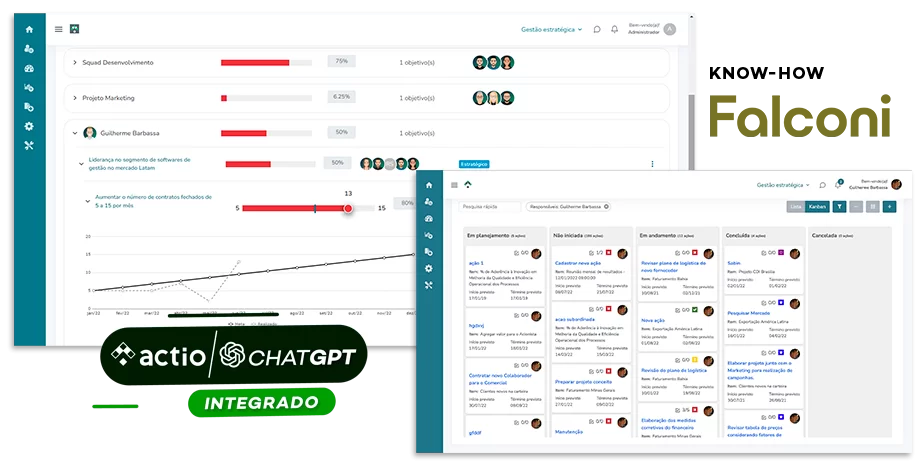
As we've seen, implementing OKRs in strategic planning offers a real competitive advantage, but success demands more than theory: it requires the engagement of the entire company and the support of the right technology. And to move goals from paper and ensure measurable results, it's essential to have tools that automate monitoring and bring transparency to execution.
O Tune by Actio, strategic management software Falconi Group, is the ideal solution for precisely managing your OKRs and projects. This is because, as part of the country's leading reference in business excellence, our platform guarantees full control over goals and action plans, replacing the complexity of spreadsheets with high-performance management focused on results.
Prepare your company for new levels of success by combining cutting-edge methodology and technology. Don't leave your strategy to chance: optimize your processes with those who understand management and keep up with Actio's news at LinkedIn and Facebook!
Frequently asked questions about strategic planning
Check out some of the most common questions on the topic below:
Strategic planning focuses on defining long-term goals and allocating resources to achieve organizational objectives. Tactical planning, on the other hand, is related to medium-term actions to implement the strategy, while operational planning involves daily activities to achieve specific goals.
KPI, or Key Performance Indicator, is a metric that measures an organization's success in achieving its goals. In other words, these metrics are essential for measuring performance and providing insights into critical areas, thus aiding in informed decision-making.
OKR, on the other hand, is a metric that defines objectives and key results to achieve them
The failure generally occurs for two reasons: lack of follow-up and disconnection from operations. This is because many companies create robust plans but do not establish review rituals or do not use adequate tools to monitor progress.
Thus, without clear indicators and checking rituals, the strategy ends up forgotten in the routine.