Many companies seek growth, but few manage to align the entire organization around the same priorities. It is in this scenario that the OKR (Objectives and Key Results) methodology stands out as the preferred tool of tech giants and high-performance companies.
However, although the concept seems simple, the practical application of OKRs usually raises questions: how to define ambitious goals without losing focus? What is the difference between OKRs and traditional goals?
To answer these questions, we've prepared this comprehensive guide. Here, you'll understand everything from the fundamental concept to the step-by-step process for implementing a results-driven culture in your company. Happy reading!
What is OKR?

Briefly, the acronym OKR means “Objectives and Key Results” in English, which in Portuguese can be translated as “Objetivos e Resultados-Chave”. But, for you to understand better, it's important to know that this agile methodology has two main elements:
Objective (O)
The Objective is the qualitative description of what the organization wishes to achieve. In other words, it functions as a statement of intent that must be, above all, meaningful, concrete, and inspiring. Thus, when well-structured, the Objective acts as an antidote against confused execution and lack of focus.
For efficient management, it is recommended to define 3 to 5 objectives per period, ensuring that the team's energy is focused on what truly matters.
- Practical example: instead of a vague wish, use something like: “become the most agile and preferred logistics solution in the Southeast region.”.
Key Results (KR)
If the Objective is the destination, then the Key Results are the milestones that confirm if you're on the right track. After all, they are quantitative metrics that objectively monitor progress.
This means that, to be effective, KRs must be specific, ambitious (but realistic), and, above all, measurable and verifiable. Additionally, each objective is generally supported by 2 to 5 Key Results: if all of them are achieved, the objective will necessarily be met.
Practical example for the objective of dominating the Southeast region:
- KR1: increase market share in the Southeast from 15.1% to 25.1%;
- KR2: achieve R$2 million in revenue from new contracts in the region;
- KR3: reduce the customer acquisition cost (CAC) by 10% in the São Paulo region.
Remember: Unlike traditional methodologies, OKRs are not just a to-do list. They are the performance compass that separates what is effort from what is, in fact, result.
Also read: 10 benefits of using OKR in your company
What is the origin of the OKR?

The OKR methodology originated in the 70s with Andrew Grove, CEO of Intel, who was seeking an agile model to keep up with the rapid changes in the technology sector. Grove detailed this vision in the book “High Output Management.”.
However, the method gained global traction in 1999 when investor John Doerr introduced it to Google's founders. The startup, which had only 40 people at the time, used OKRs as the engine for its exponential growth.
And Google's success has made OKRs a global standard, proving that the methodology is perfectly scalable. Proof of this is that today it is applied by companies of all sizes that wish to replicate this agility and maintain high performance.
Related: Can OKR Replace BSC? Insights by Actio Software
The main pillars of OKR
More than a goal structure, the success of OKRs lies in the philosophy that underpins the methodology. And without understanding the principles that govern this model, it runs the risk of becoming just a to-do list.
This means that for the implementation to truly transform your company culture, it is essential to master the four fundamental pillars that ensure operational agility and focus.
Check it out:
Ambition
As OKRs they should be ambitious in the purest sense of the word. After all, the OKR should not be impossible to achieve, but it should not be easy either.
He needs to inspire employees and provide a sense of purpose and meaningfulness to the work being done.
Measurable
Your OKR cannot be vague, such as “be a cooler company,” as this hinders the measurement of an objective. It needs to be specific and have clear criteria for evaluating its success.
Additionally, it's important to highlight that OKRs are data that help determine if established objectives have been achieved. Therefore, it's necessary to have ways to quantify the success of OKRs.
Remember: the objective establishes where the company wants to go, while the key results define the path and progress to get there.
Transparency
It is extremely important that all team members have access to the OKRs of other areas and employees of the company. This not only stimulates productivity through “healthy competition,” but also establishes ways for everyone to know what the priorities are for their colleagues and different departments.
Unification
Employee OKRs should align with team OKRs, which in turn should align with company OKRs.
Remember: unifying and integrating tasks and missions at all levels is one of the methodology's greatest challenges, but also one of its greatest benefits.
The biggest challenges when implementing OKRs
Although the concept is simple, implementation requires a change in mindset that doesn't always happen overnight. And anticipating obstacles is the first step to ensuring the methodology isn't abandoned in the first cycle.
Check out the biggest challenges companies face when implementing OKRs:
- Lack of clarity in objectives Creating vague or purely operational objectives prevents the team from feeling inspired or understanding the real business priority.;
- Confusing KRs with tasks: One of the most common mistakes is listing activities (e.g., “write a report”) instead of outcomes (e.g., “reduce response time by 20%”). OKRs should focus on impact, not effort;
- OKR Overload Trying to measure everything at once leads to a loss of focus. The methodology requires discipline to choose only what is essential, avoiding an overload of indicators.;
- Lack of leadership engagement: If executives don't use or track OKRs, the rest of the company quickly sees the methodology as just “another bureaucratic process.”;
- Punishment culture: OKR should be a tool for learning and growth. Therefore, if the company punishes the failure to achieve management ambitious, teams will start setting easy goals (sandbagging) to avoid risks;
- Neglecting follow-ups (Check-ins): Implementing OKRs and only looking at them at the end of the quarter is a fatal mistake. Remember that the method's agility depends on weekly or bi-weekly reviews for course corrections.;
- Difficulty with vertical and horizontal alignment: ensure that OKRs from different departments do not conflict and that everyone collaborates towards the organization's macro objectives.
Overcoming these challenges requires persistence and, above all, the understanding that OKRs are a muscle that needs to be trained every cycle. But with a few simple steps, you can get the most out of the methodology!
Keep reading and find out how to implement OKRs in seven steps!
Practical Guide: How to Implement OKRs in 7 Steps?
Now that you understand the power of OKRs, the challenge is to put the methodology into practice. After all, successful implementation requires method and discipline to ensure that initial enthusiasm translates into consistent results.
Follow this fundamental roadmap for structuring the model in your organization:
1 – Define inspiring and specific goals
Start by establishing the company's “north star” for the cycle. Objectives should be qualitative, easy to remember, and challenging enough to motivate the team.
Therefore, avoid generic phrases. Instead, create statements that make it clear where the organization aims to go and why it is important now.
2 – Balance Top-Down and Bottom-Up Approaches
The key to OKR engagement is collaborative development. Thus, while leadership sets the strategic direction (about 40% of the OKRs), teams should have the autonomy to propose how they will contribute to these outcomes (the remaining 60%).
This balance ensures that the CEO's strategy meets the operational reality of those implementing it.
3 – Work with quarterly cycles
Escape from static annual planning. OKRs work best on shorter horizons, typically quarters, which allows you to maintain a sense of urgency and the agility to correct course.
Three months is the ideal time to complete significant projects without losing the ability to adapt to market changes.
4 – Maintain a focus on full transparency
Unlike traditional, confidential goals, OKRs should be public to everyone in the company. After all, when an employee understands what a colleague in another department is trying to achieve, alignment happens naturally and organizational silos are broken.
Furthermore, transparency fosters accountability and helps identify synergies between areas.
5 - Realize weekly progress check-ins
Don't wait until the end of the quarter to measure success. Implement weekly quick meetings to review numbers, discuss roadblocks, and celebrate small wins.
This constant follow-up transforms OKRs into a living organism, allowing management to make decisions based on real data, not assumptions.
6 - Prioritize results over activities
A common mistake is confusing “doing things” with “generating value.” To avoid this, ensure your Key Results (KRs) measure the final impact and not just the effort. Therefore, instead of listing completed tasks, focus on tangible metrics that prove the company has truly progressed.
Remember: the focus should always be on the strategic outcome, never just on occupying the agenda.
7 – Conclude with a review and debrief
At the end of each cycle, take time to analyze what worked and what failed. After all, OKRs are a continuous learning process: use the data from the previous period to calibrate the goals for the next.
This closing step is vital for maturing the use of the methodology and strengthening the culture of high performance within the company.
Also read: How important is it to have results at work?
Improve the effectiveness of OKR with a multi-methodological platform
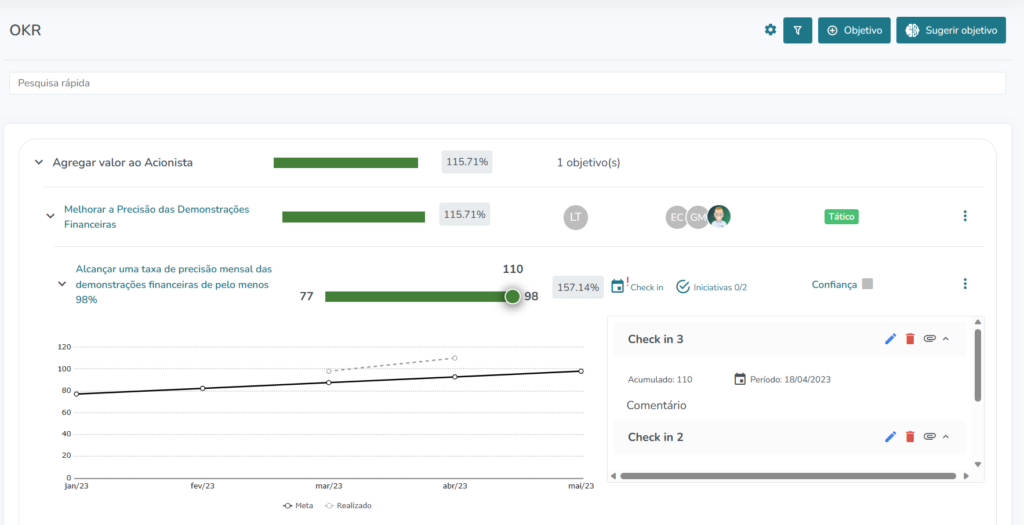
If, after following these steps, you still feel that management is scattered across spreadsheets or that each department speaks a different methodological “language,” it's time to elevate your operation. And the Actio Strategy Management is the ultimate solution for centralizing development and performance tracking in one place. After all, our platform is truly multi-methodological, allowing you to integrate OKRs, BSC, PDCA, ESG, and other models natively and cohesively.
The big differentiator? Actio's solutions now feature ChatGPT integration. This means you'll have a virtual Artificial Intelligence consultant available to guide your team in identifying causes, ensuring methodological consistency, and suggesting strategic adjustments in real-time.
Transform data into intelligent decisions and ensure your company not only sets goals but achieves operational excellence with agility and cutting-edge technology.
Don't forget to follow Actio on Instagram, LinkedIn and Facebook!
Frequently Asked Questions about OKRs
Check out some of the most common questions on the topic below:
The KPI (Key Performance Indicator) monitors the health of a continuous process (the “airplane dashboard”). The OKR, on the other hand, focuses on strategic changes and growth goals (the “airplane's route”).
It's an extremely ambitious, almost impossible goal, designed to push the team out of its comfort zone and generate disruptive innovations.
Yes. Remember when Google implemented it with only 40 employees? The methodology is scalable and helps small businesses stay focused on what really matters.