In today's business landscape, the line separating market-leading organizations from those merely surviving lies in execution capability. That is, more than designing a robust annual plan, the true leadership challenge is to translate strategy from paper into daily actions at the frontline.
And it is in this scenario that the OKR methodology (“Objectives and Key Results,”) consolidates itself as an indispensable governance tool. However, even so, many organizations don't know how to take the next step to implement this methodology in practice and without bureaucracy.
Want to know? Keep reading to understand how to integrate this methodology into your management and discover how OKRs can be the key to transforming your company's culture, alignment, and productivity!
What is the OKR Methodology?

Originally created at Intel by Andy Grove and later globally established by Google, the methodology of Objectives and Key Results revolutionized traditional Silicon Valley management models. And unlike old, rigid planning methods, the OKRs It stands out as an agile management tool. In other words, it is designed specifically to keep pace with the dynamic rhythm of today's market and ensure the company's cultural alignment.
The major turning point of the methodology lies in its simplicity and clarity, dividing into two fundamental parts that answer essential questions:
- Objectives Answer the question “Where do we need to go?”. These are qualitative, ambitious, and inspiring statements that provide clear direction for the teams' work.;
- Key Results Answer the question “How will we know when we get there?”. These are purely quantitative goals and impact metrics that validate whether the main objective has been achieved.
Thus, by connecting these two pillars, the methodology eliminates guesswork and ensures complete transparency in accountability.,This way, each collaborator can clearly see the direct impact of their daily deliverables on the global indicators and the organization's macro strategy.
Also read: Agile methodologies
Examples of OKRs
To better understand how the methodology works in practice, it's crucial to understand that a Key Result (KR) should never be a task, but rather the measurable impact what that action brought to the business.
See below for two corrected and structured examples based on market best practices:
Example 1: Technology Company (Growth Focus)
- Objective (O): accelerate market expansion and acquire new customers.
- Key Results (KRs):
- KR 1: increase monthly sales volume from 100,000 units to 120,000 units;
- KR 2: generate a 30% increase in the total active customer base by the end of the quarter;
- KR 3: increase customer retention rate (Customer Retention Rate) from 85% to 90%.
Example 2: E-commerce (focus on experience and conversion)
- Objective (O): optimize the purchase journey and turn the website into a sales machine.
- Key Results (KRs):
- KR 1: increase the website's average conversion rate from 21% to 2.51%;
- KR 2: Reduce average product page load time from 4 seconds to 2 seconds.;
- KR 3: achieve a minimum customer satisfaction score (CSAT) of 90% through the new support channel.
What is the difference between OKRs and more traditional methodologies?
The main difference between OKRs and traditional goal-setting methods lies in the emphasis on people. That is, on the OKRs, the goals are chosen based on what the people involved truly care about and find important.
Additionally, goals are created collaboratively, ensuring everyone is on the same page and motivated to work together towards a common objective.
The main benefits of OKRs
As we've seen, adopting the OKR methodology goes far beyond just changing the format in which teams record their goals. It's about a profound transformation in the company's execution culture.
Therefore, when implemented correctly and supported by leadership, the OKR framework generates clear competitive advantages for the operation, such as:
- Absolute focus on what generates value: OKR works with the philosophy that “less is more.” Therefore, by limiting each team to having between 2 and 3 key objectives per cycle, the methodology shields the company from having too many priorities.;
- 360° Organizational Alignment: Unlike the classic model where goals are born locked away in the boardroom, OKRs create a direct and public connection between the company's macro targets and the work of the departments. This rollout ensures that all areas move in absolute sync towards the same north.;
- Drastic increase in transparency and Accountability: One of the fundamental premises of OKRs is that all company goals are public to all employees. This eliminates barriers between company silos, encourages interdepartmental collaboration, and creates a real sense of self-responsibility.;
- Results-oriented culture The model compels leadership to stop measuring success by workload or hours dedicated. In the OKR universe, what matters is the impact generated;
- Agility and market responsiveness: In a volatile business environment, a rigid 12-month plan can lead a company to bankruptcy before the cycle is over. Quarterly OKR cycles give the organization the necessary flexibility to quickly recalibrate its course if competition changes or a new market opportunity arises.
How to implement OKRs in your company?
Now that you've mastered the concept and benefits of OKRs, the next challenge is to make the methodology work in practice. However, it's important to keep in mind that a successful implementation requires much more than simply rewriting current goals in a new format. It requires a structured process, transparent communication, and above all, genuine commitment from leadership to change the business's execution culture.
Want to understand how to implement? Below, we've prepared the definitive roadmap with the main steps for you to get OKRs off the ground and guide your team toward high performance:
1. Maturity and current culture diagnosis
Before distributing new goal forms, leadership and HR need to conduct a frank analysis of the company's execution culture. To do this, identify how goals are tracked today: are teams suffering from too many priorities? Are current results based on data or on “hunches”?
Understanding the bottlenecks of the old model is fundamental to designing a sensible transition process that doesn't create bureaucratic overload in operations.
2. Defining the balance between realistic and aspirational goals
In the world of OKRs, there are two main types of targets: the Roofshots (realistic and mandatory goals for the survival of the operation) and the moonshots (Aspirational and bold goals, designed to push the company out of its comfort zone).
At this stage, the board must balance these two worlds when establishing the company's macro OKRs, ensuring that the plan is challenging enough. But at the same time, without seeming impossible to the point of disengaging the team.
Related: Goal Management
3. Alignment Top-Downand Bottom-Up(Gap mapping)
With the company's macro objectives defined, it's time to look at the edges and identify what needs to change in the routine for the destination to be reached.
To do this, managers and their respective teams should meet to discuss which projects and processes need to be stopped, maintained, or started.
4. Change management and leadership engagement
The transition to an agile OKR culture doesn't happen overnight and often faces resistance from those accustomed to traditional models. To accelerate project adoption, HR must invest in intensive leadership training, turning managers into methodology ambassadors.
The most effective strategy is to start with a pilot project in only one or two areas of the company in the first quarter, gathering learnings before expanding the model to the entire organization.
5. Structuring Check-insand Key Results (KRs)
Finally, an OKR only survives if it is continuously measured. Therefore, to ensure the strategy's effectiveness, the company must establish a strict schedule of follow-up rituals, such as check-ins weekly or bi-weekly.
In these quick meetings, teams update the progress of each Key Result (KR) through concrete and auditable data. This frequent measurement allows for real-time identification of operational bottlenecks, ensuring the course is corrected well before the end of the quarterly cycle.
Introducing Tune by Actio, a strategic management software
As we've seen, OKRs are a powerful tool for driving organizational performance and alignment. By establishing clear, measurable objectives and tracking progress through key results, companies can reach new heights.
However, while the OKR methodology is a powerful approach, it's important to remember that its implementation requires commitment, planning, and involvement from the entire organization. And that's not all: implementing software can be the primary tool for effectiveness.
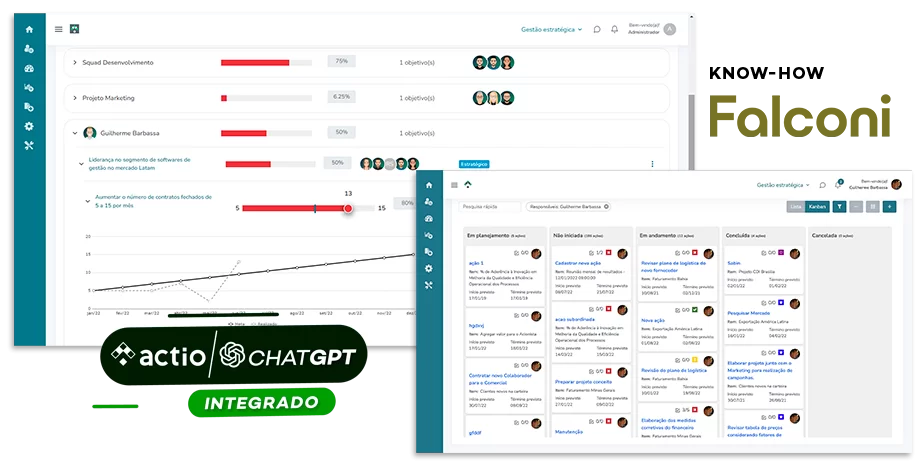
Want more effectiveness for this implementation? Find out about Tune by Actio, a software to manage projects in your company; with it, you ensure total control of all information, goals, and actions.
Don't forget to follow Actio on Instagram, LinkedIn and Facebook!
Frequently Asked Questions about OKRs
Check out some of the most common questions on the topic below:
The OKR methodology focuses on defining ambitious and measurable objectives. KPIs (Key Performance Indicators), on the other hand, are specific metrics used to measure an organization's performance in key areas.
Moreover, it is essential to note that KPIs can be part of the key results in an OKR system, but not all KPIs are vital results.
The ideal is to maintain focus: 2 to 3 Objectives per quarter, and each Objective should have between 3 and 5 Key Results (KRs). Going beyond this scatters the team's energy, causing the operation to chase after everything and deliver nothing with excellence.
In an OKR culture, achieving between 70% and 80% of an ambitious goal (Moonshot) is already considered a major success. However, if the team fell short of 50%, it’s time to hold a retrospective to determine whether the goal was poorly defined, whether resources were lacking, or whether there was a failure in execution—using the mistake as a learning opportunity.