
In a nutshell, hospital risk management is a strategic pillar that brings together processes and technologies to anticipate failures, mitigate threats, and prevent adversities. And in healthcare institutions, where the accuracy of decisions directly impacts human lives, this practice ceases to be merely technical compliance and becomes the foundation for care excellence and patient safety.
But, in practice, do you know how to effectively implement hospital risk management? Do you understand the essential steps and the competitive advantages this methodology provides to your organization? Continue reading and discover how to raise the standard of safety and quality of processes in your healthcare facility with Actio!
What is hospital risk management?

According to the Ministry of Health, hospital risk management aims to create and protect value, driving institutional performance and innovation. In other words, more than ensuring superior patient care outcomes, this approach builds a hospital environment based on trust and safety.
In practice, the methodology is consolidated through routines that standardize conduct and procedures. In other words, it acts as a strategic barrier in identifying adverse events, protecting not only the integrity of patients but also the reputation of the healthcare organization.
Furthermore, it is essential to highlight that this management is, above all, proactive. Thus, instead of merely reacting to failures, it anticipates future threats, ensuring the continued well-being of patients and frontline professionals.
Also read: Risk management in hospitals
What are the advantages of hospital risk management?
As we've seen, implementing effective hospital risk management goes far beyond regulatory compliance: it's a direct investment in the institution's sustainability. After all, by anticipating failures and structuring processes, the organization reaps benefits that impact everything from clinical outcomes to the business's financial health.
Check out the main advantages of adopting this strategy:
Improved hospital environment
By prioritizing the safety of patients, staff, and medical processes, the hospital creates a safer and more reliable environment.
This results in more confident and satisfied collaborators, dealing with less stress in their daily roles. As a result, this atmosphere promotes a more motivated team and positively impacts the patient experience.
Medical service quality
Institutions that prioritize hospital risk management establish a value cycle focused on patient safety. In this way, when protocols are rigorously followed, the incidence of errors is reduced, which directly improves the quality of care provided.
The result is an environment where the patient feels safe and supported, generating high satisfaction rates and strengthening the hospital's credibility in the market.
Incident and cost reduction
Promoting safety practices, appropriate training, and rigorous protocols reduce adverse events in the hospital environment. This, in turn, leads to lower expenses related to additional treatments, corrective procedures, and lawsuits.
As a result, the decrease in the readmission rate also contributes to a management more efficient use of internal resources.
How to implement effective risk management in healthcare

Effective implementation of hospital risk management requires a structured methodology with clear, repeatable steps. This is because, more than a defensive measure, this process provides the necessary mapping for managers to understand operational vulnerabilities and anticipate bottlenecks, shielding the institution from financial losses and adverse events.
To build a solid foundation for caregiving security, follow these five fundamental steps:
Risk Identification
The first step is to exhaustively map the potential risks that the healthcare institution faces. To achieve this, this task should be conducted by a multidisciplinary team, ensuring that the documentation is detailed to offer a panoramic view of the scenario.
For precise mapping, it is recommended:
- Conduct interviews with leadership and frontline teams;
- Analyze incident histories and documents from previous years;
- Promote brainstorming sessions to identify invisible vulnerabilities in the operational routine.
2. Risk analysis
After registration, it is necessary to measure the criticality of each threat. Here, the objective is to differentiate risks that could paralyze operations from those with minor consequences. This analysis can be done from two perspectives:
- Qualitative evaluate each risk based on the probability of occurrence and the expected impact, using scales ranging from “very low” to “very high”;
- Quantitative utilizes statistical data and numerical models to project losses and frequencies.
Tools such as Business Impact Analysis (BIA) and Cause-and-Effect Diagram (Ishikawa) are fundamental in this phase for deepening the understanding of the care context.
3. Risk Assessment
At this stage, the mapped risks are classified to define the order of priority in treatment. In other words, it is the moment to decide where resources and management attention will be applied first, focusing on what can compromise patient safety and the institution's financial health.
Tools like HACCP (Hazard Analysis and Critical Control Points) are excellent allies for validating this decision-making process.
4. Risk Treatment
With the priorities defined, the action plan begins. The focus here is on planning preventive measures to mitigate the probability of adverse events or minimize their damage.
The essential actions include:
- Definition of critical operational areas requiring immediate supervision;
- Review and alteration of management processes with structural flaws;
- Implementation of security barriers in care protocols.
5. Monitoring and control
Finally, remember: hospital risk management does not end with implementation. Therefore, it is essential to monitor the progress of the measures taken to ensure that healthcare risk management is continuous and effective.
Furthermore, this monitoring must ensure the strict execution of planned actions, evaluating the real gain in operational efficiency after improvements. Simultaneously, the process must maintain active vigilance to detect new emerging risks that require immediate interventions.
Example from Hospital Oswaldo Cruz
Paulo Ferreira, the internal audit manager at Oswaldo Cruz Hospital, and has closely dealt with a series of challenges since entering this complex world. And in an exclusive event, organized by Actiohe shared his insights about the challenges posed by hospital management and how innovation and intelligent technology use can help overcome them.
One of Ferreira's biggest challenges was having to start the hospital's internal audit from scratch. Paulo highlights that, in the past, all the institution's processes were done manually, with Excel spreadsheets being used to track deadlines and the progress of recommendations. But, with the The adoption of the Actio platform has made these steps more automatic, facilitating the tracking of actions and communication with managers.. “This platform has brought a new dynamic and made our work easier,” Ferreira comments.
In addition to the challenges of internal auditing, Paulo also became involved in another super important task: introducing risk management to the hospital. And the arrival of Actio technology, especially with the Actio Risk Management module, was a huge step forward.“Now, managers can directly access information on risks, actions, and solutions.” he explains.
In other words, Paulo Ferreira's successful trajectory at Oswaldo Cruz Hospital shows how innovation and the intelligent use of technology can help overcome complicated challenges.
Leveraging technology in risk management

Digital transformation is a great ally in building more secure processes. And the use of specialized software allows for the automation of critical steps, from data collection to real-time monitoring. After all, this eliminates manual errors and ensures that risk analysis is truly proactive.
With technology, communication between teams becomes fluid and indicators are centralized on strategic dashboards. Furthermore, this visibility facilitates the monitoring of preventive actions and accelerates decision-making in critical situations.
However, to ensure that this entire structure works in an integrated way, having the right tool is the differentiator that separates ordinary management from excellent management. And it was precisely to simplify this complexity that Actio developed solutions focused on performance and security. Check it out below!
Get to know Actio Risk Management, risk management software
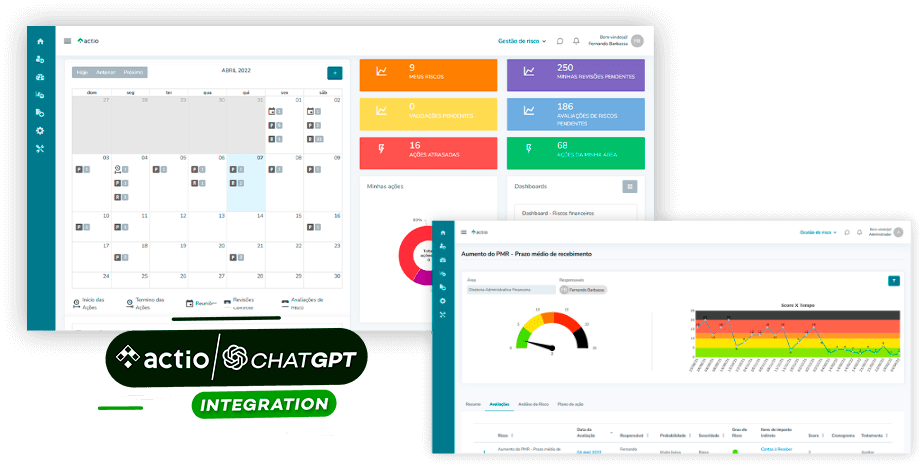
The best way to protect your institution and ensure patient safety is to anticipate problems with a solid strategy. To make this vision a reality, Actio has developed Actio Risk Management, a robust software designed to systematize and elevate the standard of your hospital operations. With it, your organization can intuitively apply the best market practices, shielding processes against negative scenarios and care failures.
All of this through an integrated and intuitive ecosystem, simplifying complex steps and ensuring that damage mitigation occurs in real time. In addition to ensuring strict compliance with global standards ISO 31,000, COSO, and PMI, optimizing the creation of strategic action plans and transforming critical data into assertive decisions.
Users recommend it!
Did you like this guide? To follow more insights on performance and strategic management, follow Actio on LinkedIn and Facebook.
Frequently Asked Questions about Hospital Risk Management:
Check out some of the most common questions on the topic below:
Reactive management focuses on analyzing the error after it has occurred to prevent it from happening again. Proactive management, on the other hand, uses methodologies to map vulnerabilities before the incident occurs.
The ideal scenario for any hospital is a balance between both, always prioritizing the anticipation of failures.
An adverse event is an incident that results in harm to the patient, not arising from their underlying illness, but from the care provided. Risk management acts precisely to create barriers that prevent systemic failure from reaching the patient, turning errors into learning opportunities for the process.
It consolidates itself by replacing punishment with learning. In other words, it is necessary to encourage clinicians and nursing staff to report incidents and “near misses” without fear of reprisal.
When failure is seen as an opportunity to protect the patient and improve processes, adherence to risk management becomes a natural part of the routine.