Have you heard of the Balanced Scorecard? If your company’s objectives are not being met due to a lack of engagement, if you need to generate commitment so that everyone strives to achieve defined goals, or if you want to measure the performance of an area and organize your planning, focusing on what truly matters, then the BSC may be the ideal tool for you. Read this article about the Balanced Scorecard and enjoy the benefits of using one of the most effective strategic management tools available today.
The Balanced Scorecard (BSC) is a strategic performance management tool.

The Balanced Scorecard (BSC) is a strategic management tool that emerged in the 1990s. In Portuguese, the term BSC means “Balanced Performance Indicators.” Developed by Harvard professors Robert Kaplan and David Norton in 1992, the Balanced Scorecard transformed the way strategic planning is managed and developed in organizations.
First and foremost, it is a management methodology that allows measuring the performance of a specific area of the company. Furthermore, by using the Balanced Scorecard, it is possible to analyze a business's progress in relation to its goals and objectives.
It is common for companies to apply the Balanced Scorecard to measure the organization's financial performance. However, with it, it is possible to conduct a complete analysis through various perspectives and have a much broader view of business performance.
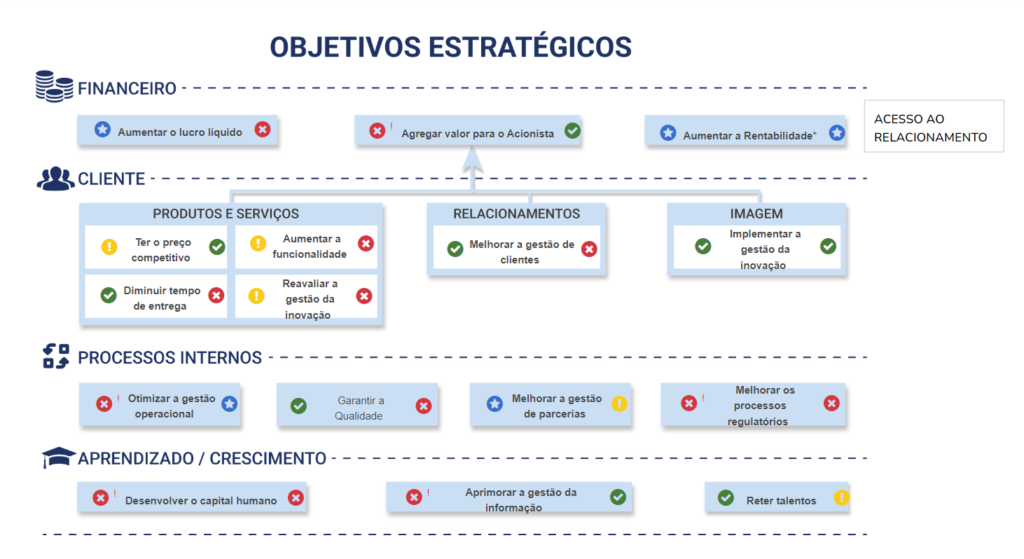
Furthermore, the Balanced Scorecard is based on four interconnected perspectives, each providing a view. These include:
1- Financial: The most used and seen in the market. It measures the financial performance of the organization. It includes metrics such as revenue, profit, return on investment, and cash flow.
2- Customer View Performance is assessed through information generated by customers. Additionally, satisfaction level, loyalty, and new customers are some of the indicators.
3- Internal ProcessesFrom this perspective, the organization analyzes its internal processes and seeks efficiencies. Metrics can include cycle time, product quality, production costs, and compliance with quality standards.
4- Learning and growth: This perspective focuses on developing skills and resources that will drive future performance. This involves employee training, organizational culture, innovation capacity, and the development of information systems.
Understand more clearly how the 4 perspectives of the BSC work in the image below:
Advantages of using the Balanced Scorecard
As mentioned at the beginning of this article, the Balanced Scorecard is one of the most effective strategic management tools today. With it, it is possible to visualize the performance of any area of an organization and correct existing flaws in the processes.
The first real advantage of using the Balanced Scorecard is the creation of more effective strategic planning. In other words, it allows for a clear visualization of the real needs of a specific area. As a consequence, the Balanced Scorecard also generates a more in-depth view of the goals and objectives to be worked on.
With this, the trend is that the company will naturally focus on what truly matters, building a clear direction for everyone.
After implementing the Balanced Scorecard into the company's routine, tracking information from various areas begins to be generated, making it possible to understand if everything agreed upon in the planning is proceeding as expected. The degree of analysis increases, and decision-making becomes effective.
Furthermore, another point as important as those mentioned above is the fact that the Balanced Scorecard provides a natural integration between a company's departments, facilitating communication. It is a tool that seeks to share planning with the entire organization. For example, it is necessary to bring together employees from various areas to build a strategic plan. This results in greater engagement and integration of those involved, as it is a process that goes beyond the construction phase and requires consistency in monitoring the indicators.
Are you looking for strategic management software? Meet Actio Strategic Management!
How the Balanced Scorecard Works in Practice

It's important to remember that the Balanced Scorecard is not limited to a financial performance analysis. There are perspectives – already mentioned in this article – on which the BSC is based and which provide a broad view of a business's performance.
The Balanced Scorecard is relatively easy to implement in an organization. Despite being a simple management tool, it is very valuable in terms of the level of information it provides.
Next, learn how to apply the Balanced Scorecard in 5 steps to your organization.
First step: The first task to be performed to implement the Balanced Scorecard in your organization is the development of strategic planning. Therefore, start by clearly defining the points and needs to be addressed.
Second step: Define objectives. Decide where your organization wants to go. What are the numbers to be achieved? Remember, objectives show where we want to go; do not confuse objectives with goals, which will be described next.
Third step: Set achievable goals. Goals are the means by which you will achieve your objectives.
Fourth step: Work on the indicators. These will always be predefined and show performance against an objective. Use software to manage your indicators, so you will have all the data integrated and a clear view of indicator performance.
Fifth step: Finally, create an action plan. This is the stage where responsibilities, deadlines, obligations, and tasks are delegated.
Check out some examples of metrics and objectives for each BSC perspective
Financial:
- Objective: Increase profit margin by 10% by year-end.
- Metric: Net profit margin.
Customer Perspective:
- Objective: Increase customer satisfaction by 15% by the end of the quarter.
- Metric: Customer satisfaction rating through surveys.
Internal processes:
- Objective: Reduce production cycle time by 20%% by the end of the semester.
- Metric: Percentage of employees who completed technical training.
What is the correct technology to implement the Balanced Scorecard?
The Balanced Scorecard is a valuable tool for organizations that want to measure and manage their performance comprehensively and in alignment with their strategy. Furthermore, by considering the four perspectives and establishing clear indicators, goals, and initiatives, companies can improve their performance, promote continuous learning, and achieve their strategic objectives effectively. Although the BSC is a powerful approach, it is important to remember that its implementation requires commitment, planning, and the involvement of the entire organization to achieve significant results.
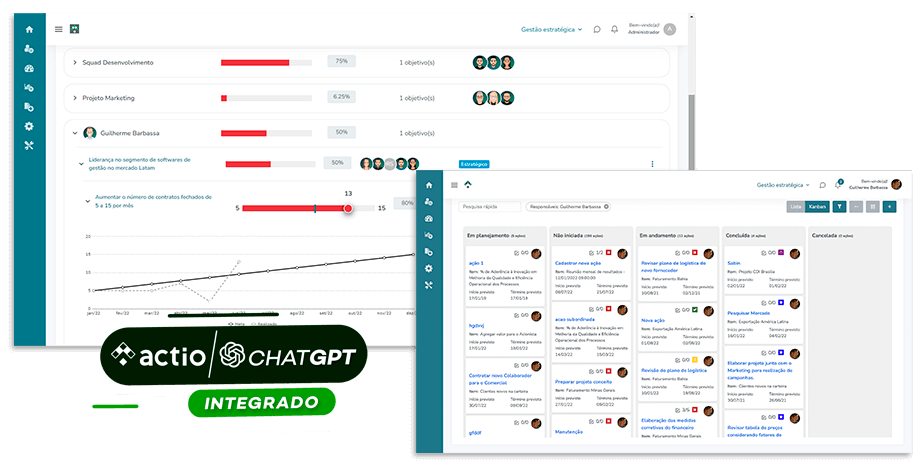
However, that's not all; using the right technology for your management processes is essential for effectiveness. Therefore, I recommend you get to know Actio Strategy Management, Actio's software for managing the BSC in your company, with it you ensure total control of all information, goals, and actions. A multi-methodology solution on a single platform that allows for full integration between the various areas of your organization.
Like the content? Don’t forget to follow Actio on Instagram, Linkedin and Facebook.