
In the universe of strategic planning and goal cascading, terms like OKR and KPI emerge as fundamental pillars. However, although they are frequently used in the same context, these methodologies have distinct natures and purposes. Therefore, the great challenge for managers is not to choose between one or the other, but to understand how they integrate to drive the business.
Ultimately, if there's no clarity on these distinctions, the implementation can lead to confusion: the team might end up focusing solely on maintaining the “status quo” or, worse, lose control of operational health in pursuit of aggressive goals. In other words, understanding the difference between monitoring performance and achieving disruptive objectives is what separates stable companies from organizations that truly scale.
With that in mind, in this blog, we will explore in depth the peculiarities and differences of OKR and KPI. Thus, you will discover how each approach works and how to use them strategically to transform your company's results culture.
Enjoy the read!
What is OKR?

The OKR (Objectives and Key Results) methodology focuses on transforming the company's purpose into achievable goals. Thus, Objectives define where the organization wants to go in an inspiring way, while Key Results are the metrics that prove, with data, if the path is correct.
This structure promotes total alignment: the board defines the macro challenges, and the teams break down their own goals to achieve them. Therefore, it's the model that has allowed giants like Google, Spotify, and LinkedIn to scale their operations with agility and a focus on innovation.
Also read: When clear goals fail to create focus in strategy execution
Key characteristics of OKR
For the methodology to work, it needs to break with the traditional, static management model. Thus, the characteristics of the OKRs are designed to create a high-performance culture where clarity and speed of execution are priorities.
Check out the pillars that make this approach so effective:
- Agility: Unlike rigid annual plans, OKRs work with shorter cycles. This allows for quick course corrections whenever the market or company priorities change.
- Transparency: OKRs eliminate information “silos.” This way, as all levels can view each other's objectives, collaboration increases, and the company's purpose becomes common.;
- Focus on results: Instead of monitoring only tasks or hours worked, the emphasis falls on the actual impact generated. This encourages the team to pursue ambitious goals that really drive innovation.
Examples of OKR methodology
To gain a deeper understanding of how to implement OKRs, it's helpful to look at different examples, don't you agree? And in this methodology, unlike traditional management approaches, the objectives and indicators must be aligned, establishing a clear relationship and maintaining focus.
With that in mind, I present some examples of OKRs:
1- Objective: Enhance customer satisfaction
- KR 1: achieve a score of 90 or higher on the customer satisfaction survey;
- KR 2: reduce the average response time to inquiries by 15%;
- KR 3: Implement a continuous feedback program to identify areas for improvement.
2- Objective: innovate internal processes
- KR 1: successfully implement a new teamwork methodology;
- KR 2: reduce operating costs by 10% through process automation;
- KR 3: conduct monthly training sessions to ensure effective adoption of new practices.
What is KPI?

Unlike OKRs, which aim at transformation and the future, the KPIs (Key Performance Indicators) They focus on continuous performance. After all, they are the key performance indicators that measure the health of operations in real time, making it possible to evaluate the success of specific areas and identify bottlenecks that require immediate improvement.
And in efficient management, these methodologies do not cancel each other out, but rather complement each other. Thus, while OKR defines where the company wants to go, KPI functions as the control panel that monitors whether the fundamental processes are running with the quality and efficiency necessary to sustain that growth.
Key characteristics of KPIs
So that management is based on data and not assumptions, KPIs need to act as the operation's vital monitoring system. This way, they transform large volumes of data into clear information, allowing the company to maintain control over its productivity and financial health.
See the pillars that support an efficient indicator strategy:
- Continuous measurement KPIs offer a real-time diagnosis of performance. This constant view allows management to quickly identify failures and implement continuous improvements before a small problem becomes a crisis.;
- Strategic alignment: no indicator should exist in isolation. Therefore, each KPI is chosen for its direct relationship with the organization's macro objectives, ensuring that the team's effort is always focused on the areas most critical to the business's success.;
- Ease of understanding A metric is only useful if it is understood. That's why KPIs are designed to be clear and accessible to all team levels, facilitating internal communication and ensuring everyone knows exactly what is being measured and why.
Examples of Key Performance Indicators (KPIs):
Key performance indicators (KPIs) play a crucial role in evaluating the success and effectiveness of business activities. Here are some relevant examples:
1- Strategic Management
- Goal Achievement Rate: Analyze the percentage of strategic goals achieved during a specific period.;
- Market Share: market share of the company compared to its competitors;
- Return on Investment (ROI) for projects: Calculate the financial return generated by the implemented projects.
2- Innovation
- Success Rate of New Products: Evaluate the percentage of launched products that achieve market success.;
- Average Time for Development of New Ideas: Analyze the time required to develop and launch new ideas or products.;
- Return on Investment in Innovation: Measure the financial return generated by implemented innovation initiatives.
So, what is the difference between OKR and KPI?

A primary distinction between OKRs and KPIs lies in the purpose of each methodology. This is because OKRs are widely employed to establish inspiring and ambitious goals within the company, frequently involving and motivating the entire team.
On the other hand, KPIs are specific to each area and are intended to measure the performance of a process or something that is already in progress. In other words, OKRs are more challenging and stimulating, leading the company to reach new heights and explore new horizons.
This way, if the goal is to achieve a big dream for the business, the OKR methodology is an excellent choice. Meanwhile, KPIs assess the success and performance of an action that is already in progress, providing a way to ensure effective control of activities.
Can Both Methodologies Be Used Together?
Yes, it's perfectly possible to integrate OKR and KPI strategies in a complementary way. After all, despite their distinctions, these approaches can be used together to enhance results.
For this, during the planning process, it is essential not only to define goals and tasks but also to analyze the execution of actions to ensure the fulfillment of established objectives, making adjustments when necessary.
Discover Actio Strategy Management, strategic management software from the Falconi group
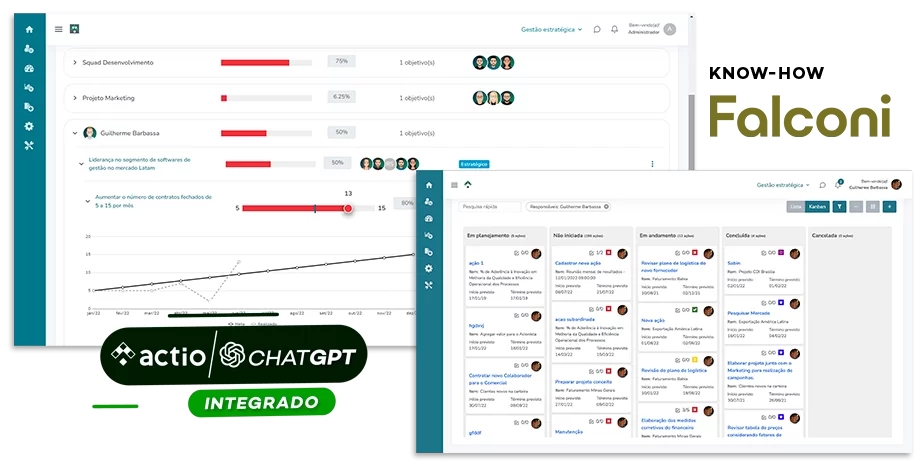
As we've seen, unifying OKR and KPI methodologies creates a balanced management strategy. Thus, while OKRs focus on growth and the future, KPIs support current operational efficiency. This integration ensures the company has a long-term vision without losing control of business health.
However, the success of this application requires commitment and, above all, technology. This is where the Actio Strategic Management stands out, allowing for complete automated control of goals and actions.
Ready to transform your results? Follow Actio on Instagram, LinkedIn and Facebook and follow market best practices!
Frequently Asked Questions about OKRs and KPIs
Check out some of the most common questions on the topic below:
The secret is focus. It is recommended to have 2 to 5 objectives (OKRs) per cycle and a lean set of KPIs (3 to 7) that truly represent the area's health, avoiding information overload.
The most common mistake is measuring everything and analyzing nothing. Choosing indicators that are not linked to the company's core strategy (the famous “vanity metrics”) consumes the team's time without generating business intelligence.
Yes. This happens when a key performance indicator (KPI) is significantly below expectations and requires a structural change to be brought back on track. If the “Churn” KPI is critical, it can become an OKR: “Reduce Churn by 20% through a new “Customer Success” program.”.

