
Have you ever wondered how successful companies measure and manage their performance comprehensively? In an increasingly results-driven world, organizational analysis has become fundamental to driving business growth and efficiency. That's where the concept of the 4 perspectives of the Balanced Scorecard (BSC) comes in.
This strategic planning methodology offers a balanced view of an organization's operations. With that in mind, in this blog, we will explore the 4 perspectives of the Balanced Scorecard and how they can be applied to drive business success. Happy reading!
What is the Balanced Scorecard (BSC)?
Before we focus on the 4 perspectives of the Balanced Scorecard (BSC), it's essential to understand what exactly the Balanced Scorecard (BSC) is. The Balanced Scorecard (BSC) is a strategic management methodology and performance indicator (KPI) dashboard that helps organizations translate their vision and strategy into tangible actions.
Furthermore, the methodology was developed by Harvard professors Robert Kaplan and David Norton and has been widely adopted as Organizational performance management model around the world.
The 4 Perspectives of the Balanced Scorecard
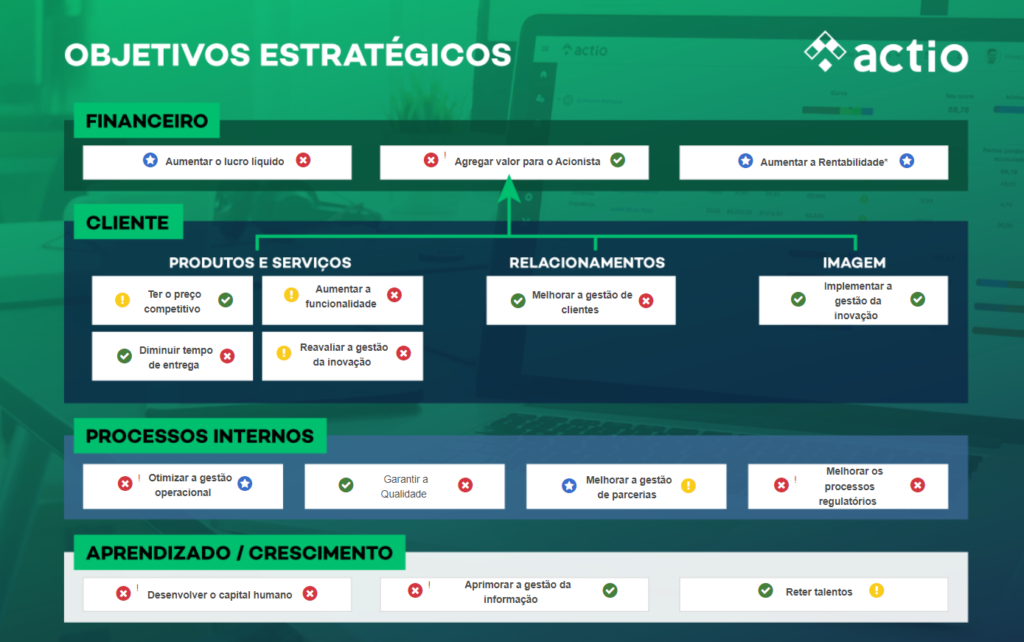
The methodology of Balanced Scorecard (BSC) is divided into four interconnected perspectives, each with its unique focus, but all contributing to a comprehensive view of organizational performance and data-driven strategic management.
Financial Perspective in the BSC
It is from the financial perspective that companies measure success in monetary terms. This perspective answers the question: “How are we doing financially?” Additionally, here, you should consider metrics such as revenue, net profit, return on investment, and operating costs.
Furthermore, the financial perspective is like the heart of the organization. If the heart isn't healthy, the whole body will suffer. Therefore, it's essential to pay close attention to these metrics to ensure the company's financial health.
Customer Perspective in the Balanced Scorecard
From the customer's perspective, the focus shifts to the needs and expectations of the customers. You should ask yourself: “How do our customers see us?”. Furthermore, it involves assessing customer satisfaction, brand loyalty, and retention.
Remember that satisfied customers tend to become brand advocates and bring in more business. Therefore, meeting customer expectations is crucial for long-term success.
Internal processes perspective:
The third perspective focuses on the organization's internal processes. Additionally, you examine how business processes are contributing to financial results and customer satisfaction. Ask yourself: “Which internal processes should we improve?”
Identifying and optimizing key processes can lead to operational efficiency, cost reduction, and improved quality, all of which contribute to superior performance.
Learning and growth perspective:
Finally, we arrive at the learning and growth perspective. It focuses on the continuous development of people and systems within the organization. Ask the question: “How can we innovate and learn to achieve our future goals?”. In other words, investing in training, employee development, and technology is essential to maintain relevance and agility in modern business.
Examples of the four Balanced Scorecard perspectives
Check out the practical examples of the 4 perspectives present in the Balanced Scorecard (BSC) below:
Financial Perspective
1- Total Revenue
Total revenue is a fundamental indicator of the financial perspective of the Balanced Scorecard. It represents the amount of money the company generates from its operations. Furthermore, tracking total revenue is essential to ensure the company is growing healthily.
2 – Profit Margin
The profit margin is the difference between total revenue and costs. It is a critical indicator for evaluating a company's operational efficiency. In other words, a healthy profit margin is a sign that the company is managing its costs effectively.
3 – Return on Investment (ROI)
Actio’s Return on Investment measures the return a company obtains from its investments. Additionally, it is an important metric for evaluating whether investments are generating value for the organization.
Customer Perspective
1 – Customer Satisfaction
Customer satisfaction is fundamental for customer loyalty and retention. Successful companies constantly seek ways to measure and improve customer satisfaction.
2 – Customer Retention Rate
Customer retention rate measures how many customers continue to do business with the company over time. Additionally, a high retention rate is an indicator that the company is meeting its customers' needs.
3 - Customer response time
Customer response time is crucial for customer satisfaction. Additionally, companies should strive to respond quickly to customer questions and concerns.
Internal Processes Perspective
The perspective of internal processes in the Balanced Scorecard (BSC) focuses on operational efficiency, productivity, and continuous improvement of organizational processes, ensuring that the company delivers value to the customer and achieves its strategic objectives.

1 – Production cycle
The production cycle measures the time it takes to transform raw materials into finished goods. In other words, reducing the production cycle can improve efficiency and reduce costs.
In the context of the Balanced Scorecard (BSC), this indicator is essential for optimizing processes and increasing operational performance.
Delivery Time
Delivery time measures how long it takes to deliver products or services to customers. In other words, faster deliveries can increase customer satisfaction and company competitiveness.
Within the Balanced Scorecard (BSC), this KPI is directly linked to customer experience and logistics efficiency.
3 – Use of resources
The effective use of resources, such as labor and materials, is a key performance indicator (KPI) in Balanced Scorecard (BSC). This way, it is crucial to improve operational efficiency and reduce costs.
Good resource management contributes to increased productivity and better strategic allocation.
Learning and Growth Perspective
The learning and growth perspective in the Balanced Scorecard (BSC) is related to the development of people, innovation, and organizational evolution, being fundamental for sustaining long-term results.
1 – Innovation
Innovation is fundamental for the company's long-term growth. In addition, companies must track the number of new ideas and innovative initiatives being implemented.
Without the Balanced Scorecard (BSC), innovation is one of the pillars for ensuring competitive advantage and adaptation to market changes.
2 – Employee Turnover
Employee turnover can affect company stability. In other words, reducing turnover and retaining talented employees is essential. This indicator in the Balanced Scorecard (BSC) is linked to talent management, engagement, and employee retention.
3 – Organizational culture
Organizational culture reflects the company's values and mission. Furthermore, a strong culture can motivate employees and align everyone in the pursuit of strategic objectives. In the context of the Balanced Scorecard (BSC), a solid organizational culture strengthens strategy execution and improves organizational performance.
Meet Actio Strategic Management, strategic management software
BRF, a Brazilian multinational company in the food sector resulting from the merger between Sadia and Perdigão, is revolutionizing the way it manages its results and drives its value with Actio Strategic Management. With 798 users and 360 indicators in the company, the software delivers a Performance Management, OKRs, and Project Management Solution in a single place, allowing BRF to achieve its goals simply and effectively.
Just like in the case of this success story, with the Actio Strategic Management, strategic management software, you ensure complete control of all information, goals, and actions. A multi-methodology solution on a single platform that allows for full integration between the various areas of your organization.
Learning and growth can be measured through indicators such as employee training rates, innovation rates, and the development of new skills. Additionally, the use of software is also recommended in this case.
Successful implementation of the BSC involves clearly defining strategic objectives, choosing relevant metrics, and creating an action plan to improve performance across all perspectives. Furthermore, it's important to choose the right software to assist your company in this process. In this regard, we recommend
The benefits of using the Balanced Scorecard (BSC) are diverse and include better strategic alignment between organizational goals. Furthermore, the BSC contributes to improving company performance, promoting greater customer satisfaction. In other words, the BSC also gives the organization a greater ability to adapt to market changes, making it more resilient and capable of facing challenges in a dynamic environment.
The customer's perspective is crucial because satisfied customers are more likely to buy again and recommend the company to others, thus contributing to financial success.
Companies often utilize the Balanced Scorecard (BSC) as a crucial tool for aligning their strategic objectives. Furthermore, the BSC aids in the constant monitoring of organizational performance, allowing for the proactive identification of areas for improvement.
This way, the organization can effectively communicate its strategy to all employees, promoting a shared understanding and engagement with the established goals.