In 2025, 88% of companies are already using artificial intelligence in at least one business function, a significant increase from the 78% recorded a year earlier, according to the latest global survey by McKinsey & Company.
The figure is impressive, but it hides an even more troubling number: only 6% of these organizations are able to attribute more than 5% of their EBIT to these initiatives.
Between technology adoption and real financial impact, there is a gap that separates leading companies from the rest, and it is rarely technological.
The cause of this mismatch is not a lack of tools, but the disconnection between data science and AI and the company's decision-making architecture. Without clarity on which areas of data science underpin each type of decision, executives invest in technology without redesigning processes, roles, and metrics.
In this article, you will understand how to structure data science and AI so that it truly supports the execution of strategy: from the technical areas that make up this discipline to the data governance that makes everything reliable enough to guide high-impact decisions.
Why data science and AI have become a priority
Data science and AI have become a priority because faster, evidence-based decisions have become a measurable competitive advantage.
According to McKinsey, 88% of companies already use AI on a regular basis, but only one-third have managed to scale these initiatives beyond isolated pilot projects; making execution—not adoption—the true competitive advantage.
The paradox of adoption with no impact on results
The research Build for the Future, from BCG, categorizes companies into four stages of AI maturity: stagnant, emerging, at scale, and “future-built.” Only 5% of the global total has reached the final stage.
The performance difference between this group and the rest of the market is not marginal, it is structural, as the following comparison shows:
- Revenue growth: 1.7x larger in “future-built” companies”
- EBIT margin: 1.6x larger
- Total shareholder return 3.6x larger
What separates this group is not the size of the technology budget, but the discipline of redesigning processes around data, rather than simply inserting AI into decision-making flows that existed before it.
The role of executive leadership in the turning point
The McKinsey describes a transformation model tested across more than 200 large-scale AI initiatives, structured in six dimensions: strategy, talent, operating model, technology, data, and scale.
None of these dimensions works in isolation from the others.
This repositions data science and AI as an executive committee agenda, rather than just an IT one. When leadership treats data as a strategic asset, the leap in analytical maturity happens considerably faster.
The main areas of data science that support corporate strategy
The areas of data science that best support strategic decisions are business intelligence, predictive data science, machine learning, and data engineering and governance.
Together, they cover the entire analytical cycle: understanding the past, predicting scenarios, prescribing actions, and ensuring that data is reliable enough for high-impact decisions.
BI and data science: from reporting to anticipation
BI and data science are not synonyms, even though they are frequently treated as such. BI organizes and describes what has already happened; data science models what will likely happen.
- Business Intelligence dashboards, reports and historical indicators that answer “what happened?”
- Predictive analysis: statistical and machine learning models that answer “what should happen?”
- Prescriptive analytics: simulations and optimization that answer “what action maximizes the result?”
A recurring mistake in medium and large companies is treating these layers as competing projects for budget, when they should be stages of the same analytical maturity journey.
The way this data is visualized also interferes with the speed of executive decision-making; not every indicator calls for the same type of chart, as we have already discussed in detail in which is the best chart for each performance indicator.
Machine learning and AI algorithms for predictive decisions
Machine learning is the technical engine behind most modern predictive AI applications. AI algorithms learn patterns in historical databases and project the probability of future events with superior accuracy compared to purely statistical methods.
The power of these AI algorithms lies in their ability to handle hundreds of variables simultaneously, something impractical in spreadsheets or traditional linear models. But an accurate model without a clear decision-making process around it generates no value, just another sophisticated report on the desk.
Data engineering and governance: the often forgotten foundation
None of the previous layers operate on inconsistent data. Even so, only 37% of companies report success in data quality improvement initiatives, according to an article published in the Harvard Business Review.
For its part, Gartner shows the other side of the equation: organizations with AI-ready data foundations report 20% more results attributable to artificial intelligence initiatives than others.
This explains why traditional, isolated dashboards are no longer enough as analytical maturity advances, a point we detail in and when dashboards are not enough.
- Data quality and standardization across systems;
- Data catalog and lineage, where they come from, who uses them, what they mean;
- Access governance, privacy, and regulatory compliance;
- Scalable infrastructure for volume and processing speed.
Applied artificial intelligence: from experimentation to strategic execution
Applied artificial intelligence means using predictive and generative models within real decision-making processes, not just in isolated pilots. This requires integrating data, metrics, and AI algorithms into existing management routines so that the technology influences decisions, rather than just reports.
An example of how this translates in practice
Consider the illustrative case of a mid-sized insurance company whose corporate goals and individual sales targets were reviewed in different cycles: quarterly for the company, and annually for the sales teams.
The calendar misalignment hid up to six months of deviation before any course correction.
By integrating predictive loss models into the same cadence as the strategy review, leadership began to anticipate target deviations up to two quarters in advance, instead of reacting to already consolidated results.
The gain didn't come from the algorithm alone, but from fitting it into the existing management ritual.
The gap between pilots and scale
BCG estimates that 60% of companies still report little or no measurable value from AI, even after significant investments.
The most cited cause is not the quality of the models, but the absence of process redesign around them.
This is the opposite of what leaders are doing: according to the same survey, about 70% of AI’s potential value is concentrated in core business functions rather than in support functions, where most companies still focus their pilot projects.
How to connect data science and AI to strategy execution
Connecting data science and AI to strategy execution requires transforming isolated indicators into a single strategic map, with an owner, a target, and a cause-and-effect relationship with the financial result for each metric.
Read more: How to implement Data AI in your company?
It is the model that Kaplan and Norton described over three decades ago, now accelerated by real-time data.
From isolated indicator to strategic map
Kaplan and Norton introduced the Balanced Scorecard in the Harvard Business Review in 1992 and expanded it years later into the concept of Strategy Maps: a way to connect financial, customer, internal process, and learning and growth objectives into a single cause-and-effect chain.
The authors' central contribution was not measuring more things, but measure the right things, in a connected way.
Data science and AI empower this model by enabling continuous monitoring: instead of quarterly reviews, deviations can be flagged almost in real time, with probable causes already pointed out by predictive models.
Data governance and decision-driven culture
According to the Gartner CDAO Agenda Survey (2025), 70% of chief data and analytics officers are already formally responsible for their companies’ AI strategy and operational model. Data leadership has evolved from being purely technical to becoming part of the core business decision-making process.
Even so, culture often fails to keep pace with structure: research from MIT Sloan Management Review It shows that 75% of executives consider ethical guidelines for AI to be important, but only 6% of organizations have actually developed them.
A decision-driven data analysis model helps reduce this gap between intention and practice, something that also it works for more operational routines.
- Clear roles for data owner and decision owner;
- Review rituals that bring together metrics, projects, and AI in a single dashboard;
- Documented ethical and compliance criteria, not just stated;
- Continuous leadership training in critical reading of predictive models.
What changes when data and AI are integrated into strategic management
Organizations that solved this equation share a structural characteristic: they connected the cycle of indicators, projects, and goals to the same database that powers the company's predictive models.
The strategic map ceases to be a static document and becomes updated by the same data that guide day-to-day operational decisions.
This changes what leadership can ask in a results meeting. Instead of “what happened in the quarter?”, the question becomes “which indicators are already signaling a deviation for the next quarter, and what action is correcting the course right now?”.
| What is usually communicated | What really matters to the executive |
| Integrated dashboards | Single view of goals, risks, and deviations without needing to consolidate spreadsheets |
| Embedded generative AI | Action recommendations already contextualized to the strategic objective of that indicator |
| Real-time indicators | Results meeting that discusses cause and correction, not just the monthly number |
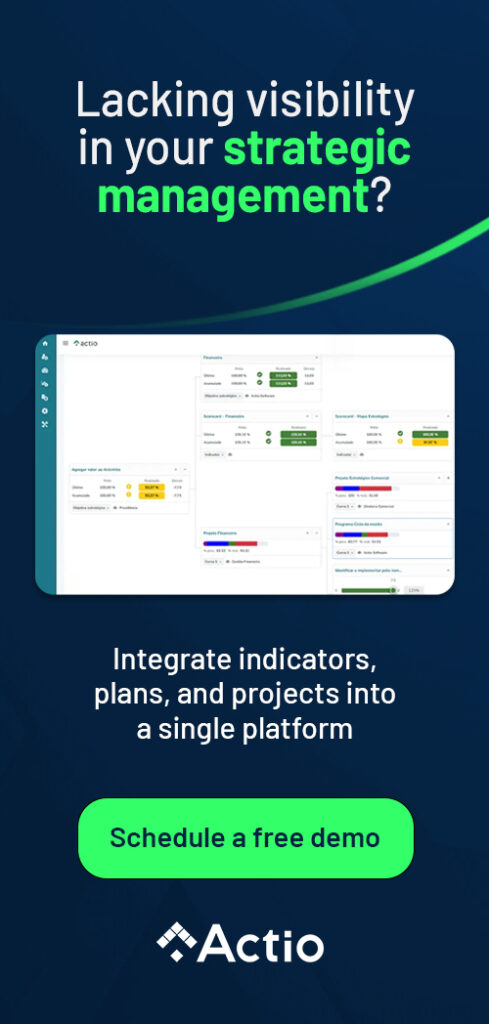
This is the kind of architecture that supports the module Actio's Strategic Managementa platform that integrates strategic maps, indicators, projects, action plans, and an AI consultant into a single environment.
From technology to decision
Data science and AI are no longer a choice between tools and have become a choice about how the company makes decisions. The areas of data science we explored here only generate a return when connected to the same ritual that already governs strategy execution.
The path does not begin by choosing the next algorithm, but by deciding which type of decision the company wants to improve first, and then asking what data, what indicators, and what degree of applied artificial intelligence that specific decision requires.
It is this discipline, more than any isolated model, that separates companies that use data science and AI from those that truly grow because of it.
If your company already has data and still doesn't have a decision-making architecture worthy of it, discover Actio's Strategic Management module and see how to transform indicators, projects, and AI into connected execution, from the strategic map to the result.