
Does your company set ambitious goals but get lost in execution or when correcting deviations? The secret to breaking free from this cycle and entering the path of sustainable growth is the PDCA Cycle. After all, more than just a simple management tool, this methodology is the pillar of continuous improvement and operational efficiency on a global scale.
Thus, when applied correctly, PDCA transforms how your team identifies problems and implements solutions, ensuring results are not just occasional, but consistent and scalable. Therefore, if you seek to transform your organization's culture with a focus on high performance, this guide is the starting point.
In this article, we will explore the strategic concept of the PDCA Cycle, how each step works, and the step-by-step process for successfully implementing it.
Enjoy the read!
What is the PDCA Cycle?
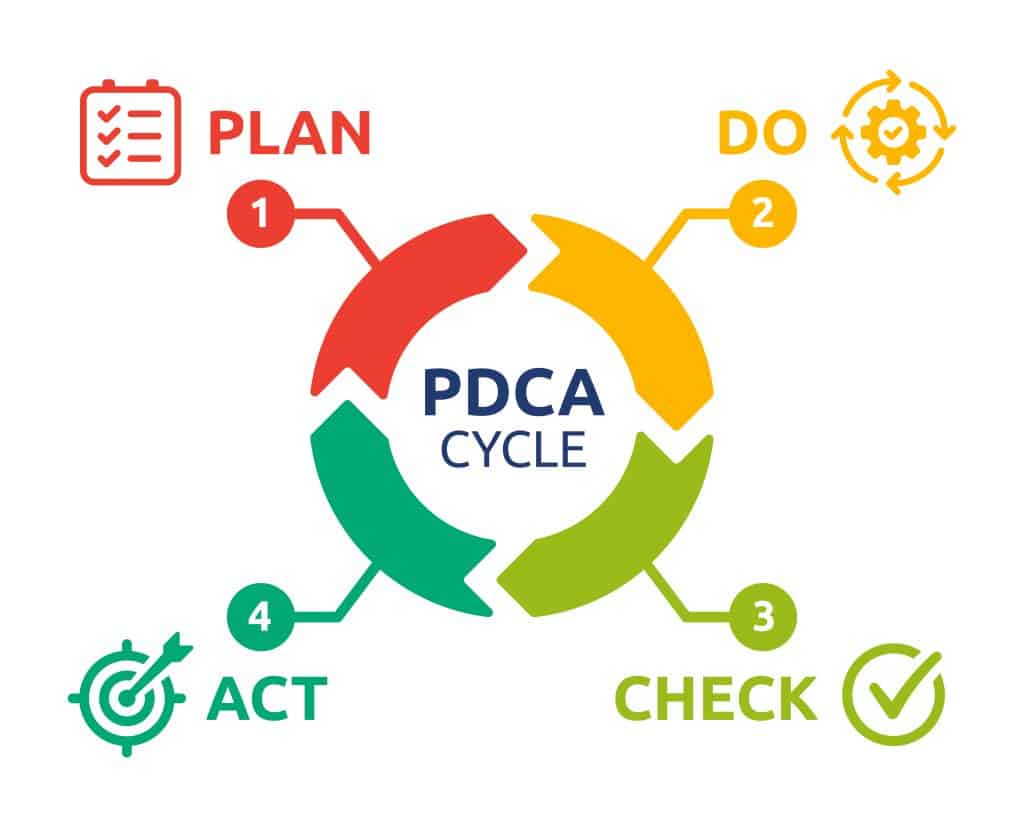
The PDCA Cycle, also known as the Deming Cycle, is one of the most established management methodologies in the world for promoting continuous improvement. After all, instead of just remedying failures, it offers a structured model for solving problems at their root, correcting deviations, and continuously improving organizational practices.
The name is an acronym for the four fundamental steps that govern the process:
- PlanProblem identification and definition of goals and methods;
- D (Do) – To do: Plan execution and performance data collection;
- C (Check) – To Check: Analysis of the results and comparison with what was planned;
- A (Act) – To Act: Bug fixing or standardization of what worked well.
Furthermore, unlike linear methods that have an end, PDCA is iterative. This means that at the end of the fourth stage, the cycle restarts to elevate the process to a new level of quality.
And due to its simplicity and effectiveness, it has become the foundation for various international management standards and is applied in all sectors, from industrial operations to strategic people management.
Also read: Strategic Management and Planning
How the PDCA Cycle Works
Briefly, PDCA's operation is based on the idea that no process is perfect, but all can be optimized. Thus, the methodology works like a gear system: each step feeds the next, creating a logical flow that replaces guesswork with informed decisions.
Furthermore, as we discussed above, unlike a linear execution, PDCA requires discipline to verify if what was planned actually delivered the expected return. Check out the details of each phase:
1 – P (Plan)
It all starts with diagnosis. In this phase, you must identify the problem or opportunity for improvement. Therefore, it is time to use tools such as the Ishikawa Diagram (to find the root cause) or the SWOT Analysis to define clear goals and action strategies.
Remember: good planning saves time and resources in subsequent steps.
2 – D (Do)
With the plan in hand, it's time to put it into practice. A golden tip is to implement changes on a reduced scale or in a pilot project before expanding to the entire company.
During execution, data collection is mandatory: you will need real evidence to know if the plan is working.
3 - C (Check)
This is the most overlooked but most important step. Here, you evaluate the results achieved and compare them with the goals set in the first step. The objective is to identify deviations: what went as expected? Where did the plan fail?
This critical analysis prevents errors from becoming routine in operations.
4 - Act A
The final phase decides the future of the process. Thus, if the results were positive, the solution is standardized and incorporated into the company's daily operations. If there were failures, the plan is reviewed and the cycle restarts to correct the identified problems.
This movement ensures that your company is constantly evolving and operating at peak efficiency.
Why Implement the PDCA Cycle in Your Company?
The PDCA is not just a methodology, it is a step towards operational excellence. Therefore, by adopting the PDCA Cycle, your company will be able to:
- Solve problems in a structured way, reducing errors and rework;
- Ensure process optimization and efficient resource utilization.;
- Promote a culture of innovation and continuous improvement in all areas.
Additionally, PDCA creates a solid foundation for the application of other methodologies, such as Lean, Six Sigma, and OKRs, enhancing the results.
How to Apply the PDCA Cycle in Practice?

To ensure that the application of PDCA doesn't remain just theoretical, it's necessary to transform the method into an organizational culture. And applying the cycle in practice requires discipline, method, and, above all, the involvement of the right people.
Ultimately, it's not just about following a task list, but about creating a workflow where data analysis guides every manager's decision. Check out the detailed step-by-step below to implement this methodology with a focus on real results:
1 - Diagnosis and identification of problems
The first step is to critically examine the operation. To do this, gather data on current processes and analyze KPIs and listen to the teams to identify critical points.
The goal here is to separate what is just a “symptom” (like a delay) from its actual cause (logistics failure, for example).
2 – Setting SMART Goals
It's not enough to want to “get better”; you need to know how much. Therefore, set specific, measurable, achievable, relevant, and time-bound goals (SMART goals).
For example, instead of “increasing productivity,” set the goal as: “reduce machine setup time by 15% over the next 90 days.”.
3 – Alignment and review meetings
PDCA doesn't work in silos. It's essential to hold alignment meetings to ensure everyone involved understands their responsibilities within the cycle.
These periodic breaks are for evaluating progress, sharing learnings, and ensuring the team doesn't deviate from the initial plan.
4 – Rigorous process documentation
A common mistake is to make adjustments and not record what was done. For this reason, make sure to document each step, from the hypotheses raised in the planning to the results gathered in the check.
This documentation builds a solid knowledge base, preventing the company from making the same mistakes in the future.
5 - Use of technology and support tools
For the cycle to spin at speed, visual management is indispensable. Use Pareto charts, control spreadsheets, or, preferably, strategic management software like Tune by Actio.
Remember: technology makes it easier to monitor KPIs in real-time, allowing the “Check” phase to be much more accurate and faster.
Count on Tune by Actio!
The implementation of the PDCA Cycle demands precision and constant monitoring, and Tune by Actio is the ideal tool for this mission. After all, our software centralizes the tracking of goals and results, allowing you to manage not only PDCA but also other strategic methodologies such as OKR, BSC, and ESG in one place.
By adopting this iterative and technological approach, your company transforms continuous improvement into a competitive differentiator. As a result, PDCA ceases to be just a theory and becomes the engine that solves problems, reduces waste, and consistently ensures the achievement of goals.
Regardless of your organization's size, this is the most versatile tool for promoting positive and sustainable changes in daily life. Therefore, now is the time to raise the bar for your management. If you don't yet use a structured methodology or struggle with a lack of visibility into indicators, start reaping the benefits of the union between the PDCA Cycle and Tune today. The success of your next plan depends on your ability to act and adjust now!
Don't forget to follow Actio on Instagram, LinkedIn and Facebook. Enjoy and share your knowledge, ask your questions, and be part of the Community Actio!
Frequently Asked Questions about the PDCA Cycle
Check out some of the most common questions on the topic below:
The main challenges include resistance to change, lack of team engagement, and poorly defined goals.
The time varies depending on the complexity of the process and the changes implemented, but improvements can be perceived in the short term, especially in smaller cycles.
PDCA widely applies to industries, services, technology, and project management.

