



The performance appraisal system is a tool responsible for employee development, since it points out the positive and negative points of each employee and shows how to improve. Whether in small or large companies, using this process can bring good results.
That's why, in this post, we've separated the main topics on the performance appraisal system so that you can understand how it works and learn, once and for all, how to implement it in your company. Have a good read!
What is the origin of performance evaluation?
First of all, to make it easier to understand, it's important to understand how performance appraisals have evolved.
The term appeared in the 1970s, but the first scientific approach is older, dating back to the early 1900s by the American Frederick Winslow Taylor. However, it wasn't until around 40 years ago that we saw an exponential rise in the number of multinationals adopting the practice.
After being influenced by the management by objectives movement, some organizations began to set specific targets for employees and give them grades according to their performance.
In the following decades, other similar scoring systems were implemented. However, they all had the same flaw: a lack of feedback. For the system to work, the employee also had to be involved in the analysis.
This is why, over the years, the system has evolved more and more and has become more complex, since its implementation has required dynamic management with constant investment, both in terms of technology and the training of evaluators and evaluands.
In addition, the focus has shifted to achieving results in conjunction with evaluating each employee's behavior. With all these changes, the tool began to be seen by companies as a way of valuing employees.
But what is a performance appraisal anyway?

The system consists of measuring the positive and negative points of an individual employee or the entire team. In other words, the role of each employee in the organization's results is taken into account in this model.
In addition, the analysis of behavioral and technical skills (hard and soft skills) can also be measured through performance evaluation. As a result, this system helps enhance the employee's professional developmentThis makes it easier for the manager to value the employee's skills.
Many people management teams use the tool because they understand that there is an improvement in the quality of deliveries as a whole, since, in addition to optimizing performance, performance evaluation allows talent to be identified and cultivated.
It is possible to carry out a performance appraisal with just one model, but experts advise using at least two in order to obtain more effective results and a broader view of the needs of employees and how to stimulate their professional development.
Looking for performance evaluation software? Get to know Actio Performance Management!
Why is evaluating employees important for the company?
It is possible to say that there are four main purposes when implementing performance evaluation in a company. These are:
- Keeping employees aligned with the company's goals and objectives
- Recognize any development and training needs
- Assisting the employee's work performance
- Provide organized data for making promotion and remuneration decisions
By improving employee performance and identifying the hard and soft skills gaps present in the organization, the firm can improve its processes and become more effective and competitive in the market.
However, despite its proven effectiveness, for the evaluation system to be beneficial to the company, it needs to have clear and transparent objectivesThe model is designed to allow employees to have enough information to achieve the quality standards expected by the company. That's why it's important to implement the model in the best possible way.
How should the evaluation be carried out?

For the performance appraisal system to be successful in your company, you need to follow three basic principles: observation, identification and feedback.
1- Observation
The observation method should be used on a daily basis in order to get a more comprehensive view of employee behavior. It's also important to focus daily on evaluating the employee's relationship with colleagues and their commitment to the company.
2- Identification
Once this is done, the manager can more clearly see the problems and attitudes that are not in line with the company's objectives. However, this should not be done unilaterally, so it is important that the employee also makes their own comments about the working environment.
3- Feedback
Finally, it's important to implement a culture of feedback within the company so that performance evaluations are more accurate. Bosses who build a relationship of dialog with the employee, by giving positive or constructive feedback, tend to make the team more motivated and engaged.
Discover Actio Performance Management, performance management software
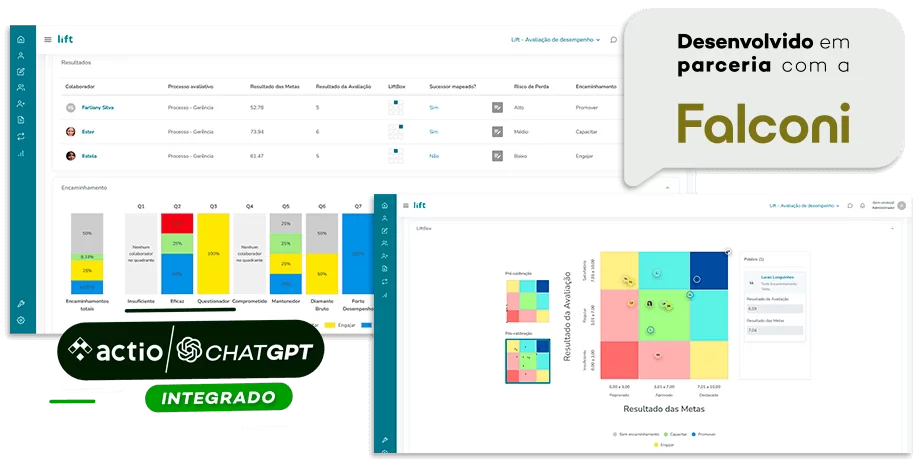
The Actio and Falconi joined forces to create the Actio Performance Management, software designed to revolutionize people management.
This tool offers a wide range of features, including feedback calculation; leader assessments; pairs; self-assessments and followers; development of individual plans (PDI); calibration; creation of succession maps and much more.
Moreover, Actio Performance Management is highly adaptable and can be customized to meet your organization's specific needs.
Did you like the content? Tell me in the comments.
Don’t forget to follow Actio on Instagram, Linkedin and Facebook.