Managing a company without a risk plan is like driving at high speed in the dark: you know the impact could be fatal, but you prefer to rely on luck. The problem is that in today's market, luck is not a management strategy. After all, a single misstep or a sudden change in the landscape can drain your cash flow and render years of effort useless.
The market doesn't forgive uninformed optimism, and living in reactive mode is the most expensive way to manage an operation. For this reason, we can say that risk management is, in fact, a tool for strategic freedom. This is because those who know the risks they are taking can take risks with much greater intelligence and competitive advantage.
In this article, we'll get straight to the point: understand what risk management is in practice and why it's the ultimate shield for your business's sustainability. Keep reading and get off the defensive with the help of Actio!
What is Risk Management?
Before we move forward, we need to align on the concept: managing risks isn't just about listing hypothetical problems. In practice, and following governance guidelines (like those in Law 14.133), it's a continuous process of identifying, assessing, and neutralizing threats before they become real losses. In other words, it's the mechanism that ensures your objectives are achieved with maximum efficiency and minimum surprises.
Thus, more than a bureaucratic obligation, this approach functions as a decision filter, where the focus is on:
- Anticipation prevent threats from even materializing;
- Mitigation If the problem occurs, ensure the impact is as minimal as possible.;
- Resilience expedite cash and operational recovery after an incident;
- Learning create safeguards so the same mistake never happens twice.
In summary, the risk management it doesn't serve to “lock down” the company, but to give it the necessary security to accelerate without fear of losing control.
What are the main business risks?
Ignoring risk management doesn't make threats disappear: it just leaves your company vulnerable to potentially fatal impacts. Therefore, when there's no contingency plan, the organization is exposed on various fronts, such as:
- Compliance Risks It covers the need to comply with government regulations and standards. In addition, of course, to the risk of losing important documents or changes in standards that affect the company's operations.
- Financial risk: involves factors such as high interest rates, difficulties in meeting financial obligations, and, consequently, customer default;
- Cyber risk covers cyberattacks and digital crimes, which can compromise company data security, information confidentiality, and, consequently, business continuity;
- Environmental risks: refers to accidents caused by natural disasters, such as fires, floods, or earthquakes, which can affect the company's facilities and operations;
- Workplace risks: encompasses adverse working conditions, such as extreme temperatures, excessive noise, exposure to health-hazardous substances, among others;
- Operational Risks: includes damage or theft of equipment essential for the company's operations, as well as any other factor that may cause operational disruptions;
- Strategic risk It's related to the entry of new competing brands into the market. In other words, it can affect the company's market share and business strategy.
Benefits of risk management

Now that you understand the damages your business is subject to by not adopting risk management, check out the main benefits of this methodology:
1 – Protection against uncertainties
Risk management identifies and mitigates problems, reducing the impact of unexpected events. In this case, as we've seen, it can include external risks, such as market changes or natural disasters, or internal risks, such as system failures or human errors.
2 – Informed decision-making
Risk analysis provides information on the risks associated with different strategies or projects. That is, it helps decision-makers choose the best option by avoiding unnecessary risks with the Risk control.
3 – Compliance with regulatory standards
Risk management helps ensure that the company complies with laws and regulations. Furthermore, this action prevents fines and reduces expenses and sanctions that can be costly and damage the company's reputation.
4 – Improvement of operational efficiency
It's not just about avoiding losses, but about gaining productivity. Therefore, identifying weaknesses and acting before a problem occurs ensures that the company operates with lean costs and without unnecessary interruptions.
5 - Strengthening of reputation
A proactive stance on risks is the greatest seal of maturity a company can exhibit. In the market, this translates into unwavering confidence from investors and partners, transforming brand integrity into a competitive differentiator that is difficult to overcome.
6 - Preparing for the Future
Anticipating future risks is the difference between panic and execution. Therefore, by creating response plans for unpredictable events, you ensure that while the competition tries to understand what happened, your operation is already executing the solution.
7 – Competitive advantage
Proactivity in risk analysis it's what separates leaders from followers. And, as we've discussed, companies that master their uncertainties project a solidity that attracts investors and retains partners, transforming security into a competitive advantage that the competition, stuck in reactive mode, simply cannot match.
How to manage risks well?

Understanding the concept is just the first step: the real difference lies in execution. After all, efficient risk management is not an isolated event, but a living cycle that must be embedded in the company's routine.
And if you want to move beyond improvisation and take full control of your strategic board, follow these five fundamental pillars for high-impact implementation:
1. Goal Alignment
Before looking at problems, you need to know what is non-negotiable for business success. To do this, set clear goals: is it the semester's revenue? The integrity of a new project? The continuity of operations? Without knowing what you want to achieve, any event will seem like a risk, and you will end up wasting energy trying to protect everything at once.
2. Exhaustive identification
Here, the secret is the detail. Gather the leaders and map every variable that could derail the train, from political instability to the failure of a critical supplier. The goal is to leave no “blind spots.”.
Remember: the risk you ignore is precisely the one with the greatest potential to paralyze your company.
3. Prioritization Matrix
Not every threat deserves your time. That's why you should use the risk matrix to cross probability (the chance of it happening) with impact (the extent of the damage).
This creates a visual map that separates “noise” from “fatal threats.” Additionally, focus your artillery on the critical quadrant: those events that have a high chance of occurring and can drain your cash.
4. Response plan
For each prioritized risk, design a line of defense. This goes beyond simply “avoiding” the problem: it involves creating containment plans (to lessen the damage) and rapid response plans (what to do the minute the problem occurs).
Remember: an effective action plan defines the “who,” the “when,” and the “how,” ensuring no one panics in the heat of the moment.
5. Monitoring and Adjustment Cycle
As we saw, risk management is not a static document; it is a living process. After all, yesterday's scenario is not the same as today's.
Therefore, establish review rituals to check if defenses remain solid and if new threats have emerged on the horizon. If the plan isn't providing the expected security, don't be afraid to adjust it: agility in correction is what guarantees survival.
Get to know Actio Risk Management, risk management software
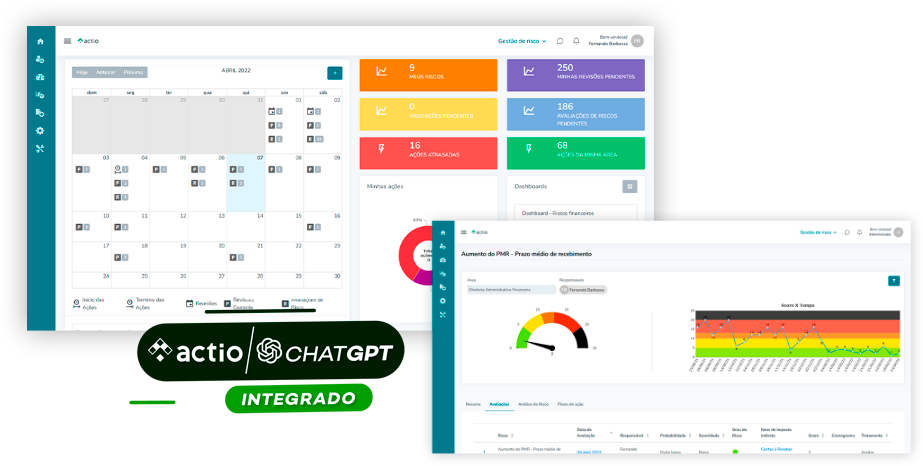
Risk management is too complex to be done in manual spreadsheets or stored in files that no one reads. And to ensure your company isn't a victim of the unexpected, we at Actio, a Falconi Group company, have developed the Actio Risk Management.
Our software is designed to transform risk management into an automated and strategic routine. With it, you can centralize communication, build intelligent risk matrices, and track mitigation plans in real-time, all within a single interface that eliminates blind spots. It's no wonder that major references, like Oswaldo Cruz Hospital, already use our solution to safeguard their operations and institutional performance.
By adopting Actio Risk Management, you aren't just preventing problems: you are implementing controls that truly work. You are also ensuring a competitive advantage that few in the market possess.
Your business's future can't depend on luck. Get to know Actio Risk Management and take control right now! Liked the content? Then don't stop here! Follow Actio on LinkedIn and Facebook!
Frequently Asked Questions about Risk Management
Check out some of the most common questions on the topic below:
This is where the response plan you designed comes in. After all, at the moment of crisis, the total focus should be on damage control and transparent communication with those involved. Risk management serves precisely so that, in these moments, no one wastes time deciding what to do: the team simply executes the already trained protocol to return to normal as soon as possible.
To measure success, you can look at metrics such as: number of risks identified vs. mitigated, average incident response time, total cost of losses from claims, and the level of regulatory compliance. The goal is to see these indicators improve over time, proving that the company is more resilient.
The first step is process mapping. This is because you cannot manage the risk of something you don't understand how it works.
Therefore, start with the most critical areas (usually Finance and Operations) and ask the question: “If this stops today, how much does it cost?” From that answer, you can begin to draw your first prioritization matrix and structure your defense plans.